Department of General Microbiology, FIN-00014 University of Helsinki, Finland.
Appl Environ Microbiol. 1994 Feb;60(2):641-53. doi: 10.1128/aem.60.2.641-653.1994.
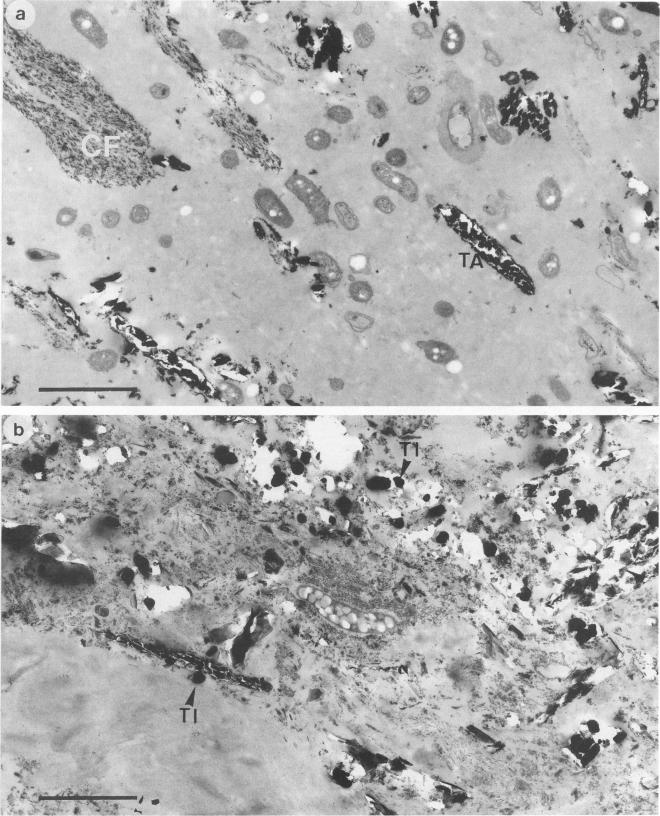
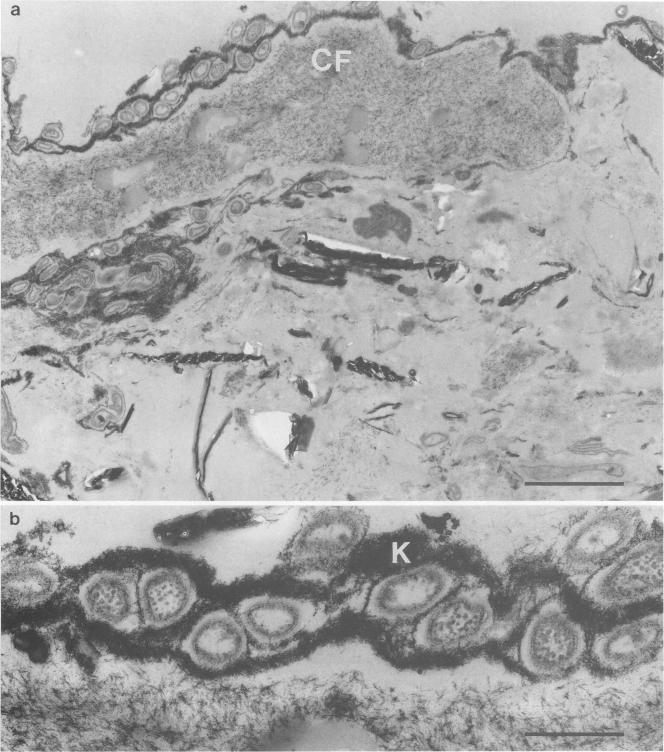
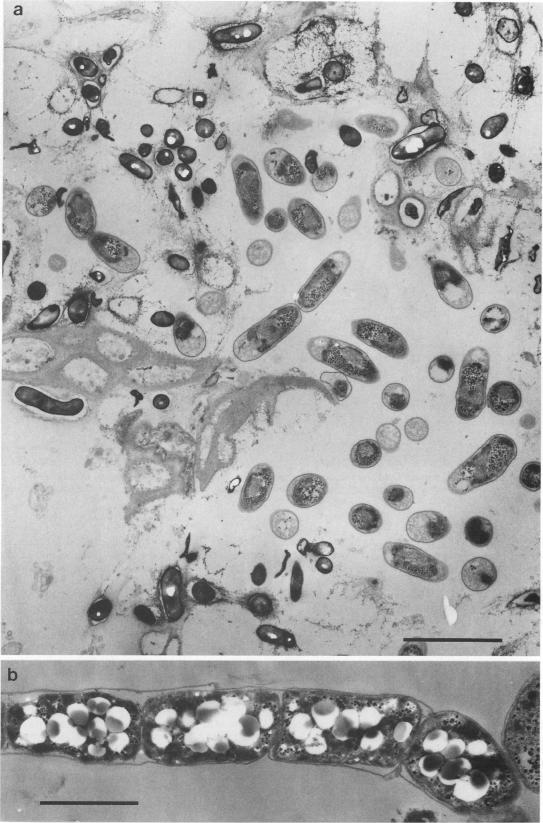
Biological slimes (biofilms) collected from the wet end of paper and board machines were examined by electron microscopy and analyzed for fatty acid composition, neutral sugar composition, and ATP. Electron microscopy revealed minuscule prokaryotic organisms (diameter, 0.2 to 0.4 mum). Larger cells morphologically resembling Sphaerotilus and Leptothrix spp. were found in slimes from machines using recycled fiber or unbleached pulp. The bacteria were embedded in a slimy matrix and often contained reserve materials microscopically resembling poly-beta-hydroxybutyrate and glycogen. Fatty acid analysis of the slimes revealed bacterial signature fatty acids in concentrations equivalent to the presence of 2 x 10 to 2.6 x 10 (average, 7 x 10) bacterial cells (live and dead) per g (dry weight) of slime. The slimes contained several known components of bacterial polysaccharides in addition to glucose, indicating that the slime body consisted of bacterial polysaccharides. The slimes contained uronic acids equivalent to a binding capacity of 12.5 to 50 mumol of divalent cations per g (dry weight) of slime. The uronic acid-containing polysaccharides may be responsible for the accumulation of heavy metals in the slime. Calculation of the ATP contents of the slimes resulted in an estimate of 5 x 10 cells per g (dry weight) of slime when calibrated with pure bacterial cultures isolated from the slimes. From electron micrographs, an estimate ranging from 1 x 10 to 1.5 x 10 (average, 4 x 10) cells per g (dry weight) of slime was obtained.
从造纸机和纸板机的湿部采集的生物粘液(生物膜)通过电子显微镜进行了检查,并分析了脂肪酸组成、中性糖组成和 ATP。电子显微镜显示了微小的原核生物(直径为 0.2 至 0.4 微米)。在使用回收纤维或未漂浆的机器的粘液中发现了形态上类似于 Sphaerotilus 和 Leptothrix spp. 的较大细胞。细菌嵌入在粘性基质中,并且经常包含微观上类似于聚-β-羟基丁酸和糖原的储备物质。粘液的脂肪酸分析表明,细菌特征脂肪酸的浓度相当于每克(干重)粘液中存在 2 x 10 至 2.6 x 10(平均值,7 x 10)个细菌细胞(活的和死的)。粘液除了葡萄糖外,还含有几种已知的细菌多糖成分,表明粘液体由细菌多糖组成。粘液中含有相当于 12.5 至 50 μmol 二价阳离子/克(干重)粘液的结合能力的糖醛酸。含糖醛酸的多糖可能是粘液中重金属积累的原因。根据从粘液中分离的纯细菌培养物进行校准,计算出粘液中 ATP 含量估计为每克(干重)粘液 5 x 10 个细胞。根据电子显微镜图像,估计每克(干重)粘液的细胞数在 1 x 10 至 1.5 x 10(平均值,4 x 10)个之间。