
生活方式作为无症状个体结肠肿瘤的预测指标
Lifestyle as a predictor for colonic neoplasia in asymptomatic individuals.
作者信息
Larsen Inger K, Grotmol Tom, Almendingen Kari, Hoff Geir
机构信息
The Cancer Registry of Norway, Institute of Population-based Cancer Research, Montebello, N-0310, Norway.
出版信息
BMC Gastroenterol. 2006 Jan 13;6:5. doi: 10.1186/1471-230X-6-5.
BACKGROUND
Lifestyle is a well-established risk factor for colorectal cancer (CRC) and is also found to be associated with occurrence of adenomas. In the present study we evaluated risk factors for both low-risk adenomas and advanced neoplasia in asymptomatic individuals using a single-paged questionnaire. Aiming to see if the questionnaire was a useful tool in picking up high-risk individuals.
METHODS
A cross-sectional study was carried out within a randomised controlled colorectal cancer screening trial (n = 6961). The population comprised men and women born between 1946 and 1950. Before screening in year 2001 they were asked to fill in a questionnaire about their present lifestyle. Cases were categorised according to the most severe findings at screening. Analyses were then conducted to find risk factors associated with the presence of either low-risk adenomas or advanced neoplasia.
RESULTS
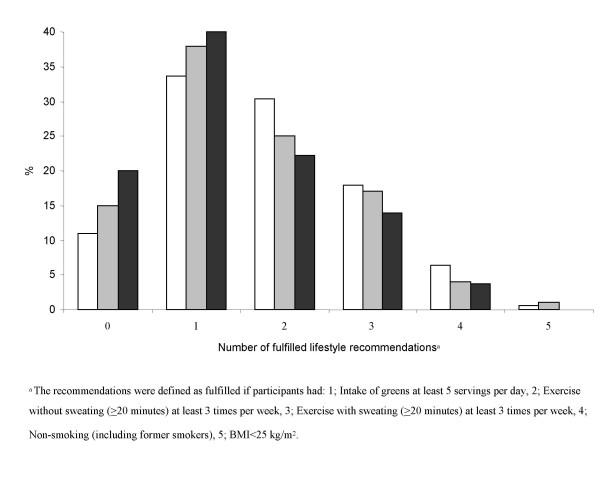
The response rate among attendees was 97% (3998/4111). Among these, 3447 (86%) had no neoplasia, 443 (11%) had low-risk adenomas, and 108 (3%) had advanced neoplasia. Low-risk adenomas were significantly associated with current smoking, and obesity. Participants with advanced neoplasia had a two-fold increased risk of not adhering to any of the selected lifestyle recommendations compared to controls. However, current smoking was the only variable that reached statistical significance in the multivariate analysis for these lesions. A dose-response relationship to the consumption of cigarettes per day was shown, where OR was 2.04 (CI 1.07-3.89) for the lowest consumption category.
CONCLUSION
The present findings indicate that a short questionnaire may be adequate in picking up the most consistent associations between lifestyle risk factors and colorectal neoplasia. Smoking and BMI were found to be the most significant risk factors for neoplasia, but adhering to recommendations on diet, and physical activity seems also to be of importance.
背景
生活方式是结直肠癌(CRC)公认的危险因素,也被发现与腺瘤的发生有关。在本研究中,我们使用单页问卷评估无症状个体中低风险腺瘤和高级别瘤变的危险因素。旨在观察该问卷是否是识别高危个体的有用工具。
方法
在一项随机对照结直肠癌筛查试验(n = 6961)中进行了一项横断面研究。研究人群包括1946年至1950年出生的男性和女性。在2001年筛查前,他们被要求填写一份关于其当前生活方式的问卷。病例根据筛查时最严重的发现进行分类。然后进行分析以找出与低风险腺瘤或高级别瘤变存在相关的危险因素。
结果
参与者的应答率为97%(3998/4111)。其中,3447人(86%)无瘤变,443人(11%)有低风险腺瘤,108人(3%)有高级别瘤变。低风险腺瘤与当前吸烟和肥胖显著相关。与对照组相比,患有高级别瘤变的参与者不遵守任何选定生活方式建议的风险增加了两倍。然而,在这些病变的多变量分析中,当前吸烟是唯一达到统计学显著性的变量。显示了与每日吸烟量的剂量反应关系,最低消费类别中的比值比为2.04(CI 1.07 - 3.89)。
结论
本研究结果表明,一份简短的问卷可能足以找出生活方式危险因素与结直肠瘤变之间最一致的关联。吸烟和体重指数被发现是瘤变最重要的危险因素,但遵守饮食和体育活动建议似乎也很重要。


 Zotero 插件