Wang Lin, Tharp Scott, Selzer Tzvia, Benkovic Stephen J, Kohen Amnon
Department of Chemistry, University of Iowa, Iowa City, Iowa 52242, USA.
Biochemistry. 2006 Feb 7;45(5):1383-92. doi: 10.1021/bi0518242.
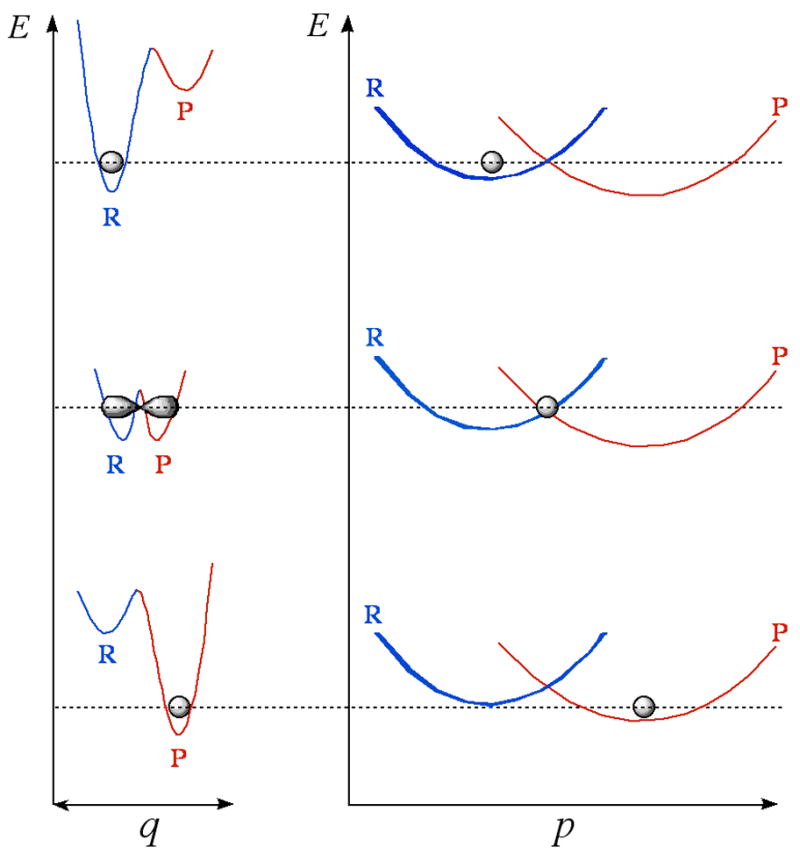
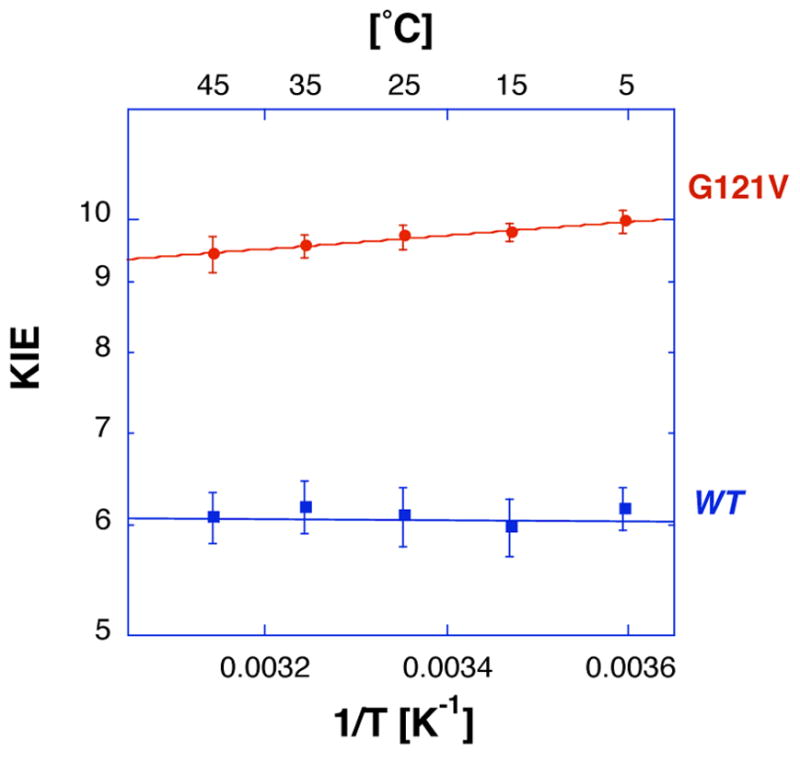
Previous studies of Escherichia coli dihydrofolate reductase (ecDHFR) have demonstrated that residue G121, which is 19 A from the catalytic center, is involved in catalysis, and long distance dynamical motions were implied. Specifically, the ecDHFR mutant G121V has been extensively studied by various experimental and theoretical tools, and the mutation's effect on kinetic, structural, and dynamical features of the enzyme has been explored. This work examined the effect of this mutation on the physical nature of the catalyzed hydride transfer step by means of intrinsic kinetic isotope effects (KIEs), their temperature dependence, and activation parameters as described previously for wild type ecDHFR [Sikorski, R. S., et al. (2004) J. Am. Chem. Soc. 126, 4778-4779]. The temperature dependence of initial velocities was used to estimate activation parameters. Isotope effects on the preexponential Arrhenius factors, and the activation energy, could be rationalized by an environmentally coupled hydrogen tunneling model, similar to the one used for the wild-type enzyme. Yet, in contrast to that in the wild type, fluctuations of the donor-acceptor distance were now required. Secondary (2 degrees ) KIEs were also measured for both H- and D-transfer, and as in the case of the wild-type enzyme, no coupled motion was detected. Despite these similarities, the reduced rates, the slightly inflated primary (1 degrees ) KIEs, and their temperature dependence, together with relatively deflated 2 degrees KIEs, indicate that the potential surface prearrangement was not as ideal as for the wild-type enzyme. These findings support theoretical studies suggesting that the G121V mutation led to a different conformational ensemble of reactive states and less effective rearrangement of the potential surface but has an only weak effect on H-tunneling.
先前对大肠杆菌二氢叶酸还原酶(ecDHFR)的研究表明,距离催化中心19埃的G121残基参与催化过程,这意味着存在长距离动态运动。具体而言,ecDHFR突变体G121V已通过各种实验和理论工具进行了广泛研究,并探讨了该突变对酶的动力学、结构和动态特征的影响。本研究通过固有动力学同位素效应(KIEs)、其温度依赖性以及活化参数,研究了该突变对催化氢化物转移步骤物理性质的影响,这些参数如先前对野生型ecDHFR所描述的那样 [西科尔斯基,R. S.等人(2004年)《美国化学会志》126,4778 - 4779]。初始速度的温度依赖性用于估计活化参数。同位素对指前阿仑尼乌斯因子和活化能的影响,可以通过与野生型酶所用模型类似的环境耦合氢隧穿模型来解释。然而,与野生型不同的是,现在需要供体 - 受体距离的波动。还测量了H转移和D转移的二级(2°)KIEs,与野生型酶的情况一样,未检测到耦合运动。尽管存在这些相似之处,但速率降低、一级(1°)KIEs略有增大及其温度依赖性,以及相对减小的2°KIEs,表明势能面预排列不如野生型酶那样理想。这些发现支持了理论研究,表明G121V突变导致了不同的反应态构象集合,势能面的重排效果较差,但对氢隧穿的影响较弱。