Edwards Richard, Hasselholdt Christian P, Hargreaves Kim, Probert Claire, Holford Richard, Hart Judy, Van Tongeren Martie, Watson Adrian F R
Department of Public Health, Wellington School of Medicine and Health Sciences, University of Otago, Wellington, New Zealand.
BMC Public Health. 2006 Feb 22;6:42. doi: 10.1186/1471-2458-6-42.
The UK government proposed introducing partial smokefree legislation for England with exemptions for pubs and bars that do not prepare and serve food. We set out to test the hypothesis that pubs from more deprived areas and non food-serving pubs have higher levels of particulate air pollution.
We conducted a cross sectional study in four mainly urban areas of the North West of England. We recruited a stratified random sample of 64 pubs divided into four groups based on whether their local population was affluent or deprived (using a UK area based deprivation measure), and whether or not they served food. The timing of air quality monitoring stratified to ensure similar distribution of monitoring by day of the week and time of evening between groups. We used a portable air quality monitor to collect fine particle (PM2.5) levels over a minimum of 30 minutes in areas where smoking was allowed,, and calculated mean time-time weighted average PM2.5 levels.
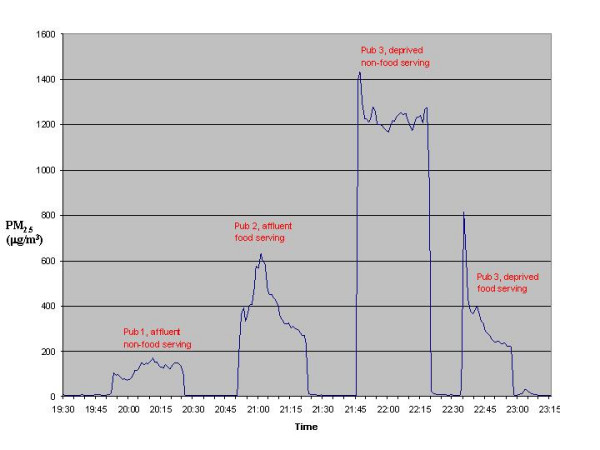
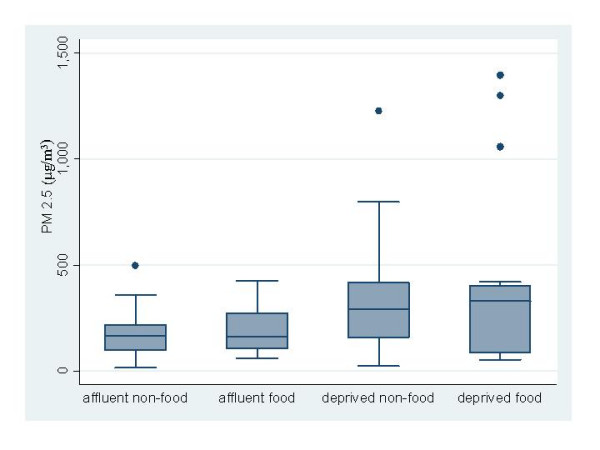
Mean PM2.5 was 285.5 microg/m3 (95% CI 212.7 to 358.3). Mean levels in the four groups were: affluent food-serving pubs (n = 16) 188.1 microg/m3 (95%CI 128.1 to 248.1); affluent non food-serving (n = 16) 186.8 microg/m3 (95%CI 118.9 to 254.3); deprived food-serving (n = 17) 399.4 microg/m3 (95%CI 177.7 to 621.2); and deprived non food-serving (n = 15) 365.7 microg/m3 (195.6 to 535.7). Levels were higher in pubs in deprived communities: mean 383.6 microg/m3 (95% CI 249.2 to 518.0) vs 187.4 microg/m3 (144.8 to 229.9); geometric mean 245.2 microg/m3 vs 151.2 microg/m3 (p = 0.03). There was little difference in particulate levels between food and non food-serving pubs.
This study adds to the evidence that the UK government's proposals for partial smokefree legislation in England would offer the least protection to the most heavily exposed group--bar workers and customers in non food-serving pubs in deprived areas. The results suggest these proposals would work against the UK government's stated aim to reduce health inequalities.
英国政府提议在英格兰引入部分无烟立法,不对不提供食物的酒吧和酒馆实行豁免。我们着手检验这样一个假设,即来自贫困地区的酒吧和不提供食物的酒吧空气污染颗粒水平更高。
我们在英格兰西北部四个主要城市地区进行了一项横断面研究。我们招募了64家酒吧的分层随机样本,根据当地人口是富裕还是贫困(使用基于英国地区的贫困衡量标准)以及是否提供食物,将其分为四组。空气质量监测时间进行分层,以确保各组之间按星期几和晚上时间的监测分布相似。我们使用便携式空气质量监测仪,在允许吸烟的区域至少30分钟内收集细颗粒物(PM2.5)水平,并计算时间加权平均PM2.5水平。
平均PM2.5为285.5微克/立方米(95%可信区间212.7至358.3)。四组中的平均水平分别为:富裕且提供食物的酒吧(n = 16)188.1微克/立方米(95%可信区间128.1至248.1);富裕且不提供食物的酒吧(n = 16)186.8微克/立方米(95%可信区间118.9至254.3);贫困且提供食物的酒吧(n = 17)399.4微克/立方米(95%可信区间177.7至621.2);贫困且不提供食物的酒吧(n = 15)365.7微克/立方米(195.6至535.7)。贫困社区酒吧的水平更高:平均383.6微克/立方米(95%可信区间249.2至518.0),而富裕社区酒吧为187.4微克/立方米(144.8至229.9);几何平均数分别为245.2微克/立方米和151.2微克/立方米(p = 0.03)。提供食物和不提供食物的酒吧之间颗粒水平差异不大。
这项研究进一步证明,英国政府在英格兰实施部分无烟立法的提议,对暴露最严重的群体——贫困地区不提供食物的酒吧的员工和顾客——提供的保护最少。结果表明,这些提议将与英国政府宣称的减少健康不平等的目标背道而驰。