Wilson Nick, Edwards Richard, Maher Anthony, Näthe Jenny, Jalali Rafed
Department of Public Health, University of Otago (Wellington), Wellington, New Zealand.
BMC Public Health. 2007 May 18;7:85. doi: 10.1186/1471-2458-7-85.
We aimed to: (i) assess compliance with a new smokefree law in a range of hospitality settings; and (ii) to assess the impact of the new law by measuring air quality and making comparisons with air quality in outdoor smoking areas and with international data from hospitality settings.
We included 34 pubs, restaurants and bars, 10 transportation settings, nine other indoor settings, six outdoor smoking areas of bars and restaurants, and six other outdoor settings. These were selected using a mix of random, convenience and purposeful sampling. The number of lit cigarettes among occupants at defined time points in each venue was observed and a portable real-time aerosol monitor was used to measure fine particulate levels (PM2.5).
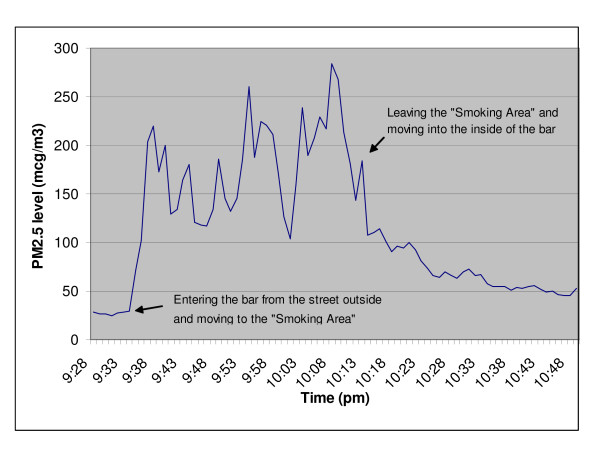
No smoking was observed during the data collection periods among over 3785 people present in the indoor venues, nor in any of the transportation settings. The levels of fine particulates were relatively low inside the bars, pubs and restaurants in the urban and rural settings (mean 30-minute level = 16 microg/m3 for 34 venues; range of mean levels for each category: 13 microg/m3 to 22 microg/m3). The results for other smokefree indoor settings (shops, offices etc) and for smokefree transportation settings (eg, buses, trains, etc) were even lower. However, some "outdoor" smoking areas attached to bars/restaurants had high levels of fine particulates, especially those that were partly enclosed (eg, up to a 30-minute mean value of 182 microg/m3 and a peak of maximum value of 284 microg/m3). The latter are far above WHO guideline levels for 24-hour exposure (ie, 25 microg/m3).
There was very high compliance with the new national smokefree law and this was also reflected by the relatively good indoor air quality in hospitality settings (compared to the "outdoor" smoking areas and the comparable settings in countries that permit indoor smoking). Nevertheless, adopting enhanced regulations (as used in various US and Canadian jurisdictions) may be needed to address hazardous air quality in relatively enclosed "outdoor" smoking areas.
我们旨在:(i)评估一系列餐饮场所对一项新的无烟法律的遵守情况;(ii)通过测量空气质量,并与室外吸烟区的空气质量以及来自餐饮场所的国际数据进行比较,来评估新法律的影响。
我们纳入了34家酒吧、餐馆和酒馆,10个交通场所,9个其他室内场所,6个酒吧和餐馆的室外吸烟区,以及6个其他室外场所。这些场所采用随机、便利和目的抽样相结合的方式选取。观察每个场所特定时间点内在场人员中点燃香烟的数量,并使用便携式实时气溶胶监测仪测量细颗粒物水平(PM2.5)。
在数据收集期间,室内场所的3785多名人员以及任何交通场所均未观察到吸烟现象。城市和农村地区的酒吧、酒馆和餐馆内细颗粒物水平相对较低(34个场所的30分钟平均水平 = 16微克/立方米;每个类别平均水平范围:13微克/立方米至22微克/立方米)。其他无烟室内场所(商店、办公室等)和无烟交通场所(如公共汽车、火车等)的结果甚至更低。然而,一些附属于酒吧/餐馆的“室外”吸烟区细颗粒物水平较高,尤其是那些部分封闭的区域(例如,30分钟平均价值高达182微克/立方米,最大值峰值为284微克/立方米)。后者远远高于世界卫生组织24小时暴露的指导水平(即25微克/立方米)。
新的国家无烟法律的遵守情况非常高,这也体现在餐饮场所相对良好的室内空气质量上(与“室外”吸烟区以及允许室内吸烟国家的类似场所相比)。尽管如此,可能需要采用强化法规(如美国和加拿大各司法管辖区所采用的法规)来解决相对封闭的“室外”吸烟区的有害空气质量问题。