• 文献检索
  • 文档翻译
  • 深度研究
  • 学术资讯
  • Suppr Zotero 插件Zotero 插件
  • 邀请有礼
  • 套餐&价格
  • 历史记录
应用&插件
Suppr Zotero 插件Zotero 插件浏览器插件Mac 客户端Windows 客户端微信小程序
定价
高级版会员购买积分包购买API积分包
服务
文献检索文档翻译深度研究API 文档MCP 服务
关于我们
关于 Suppr公司介绍联系我们用户协议隐私条款
关注我们

Suppr 超能文献

核心技术专利:CN118964589B侵权必究
粤ICP备2023148730 号-1Suppr @ 2026

文献检索

告别复杂PubMed语法,用中文像聊天一样搜索,搜遍4000万医学文献。AI智能推荐,让科研检索更轻松。

立即免费搜索

文件翻译

保留排版,准确专业,支持PDF/Word/PPT等文件格式,支持 12+语言互译。

免费翻译文档

深度研究

AI帮你快速写综述,25分钟生成高质量综述,智能提取关键信息,辅助科研写作。

立即免费体验

日本一家老年人公共临时就业机构(银色人力资源中心)成员中与“生活意义”相关的因素;性别差异

Factors associated with "Ikigai" among members of a public temporary employment agency for seniors (Silver Human Resources Centre) in Japan; gender differences.

作者信息

Shirai Kokoro, Iso Hiroyasu, Fukuda Hideki, Toyoda Yasuhiro, Takatorige Toshio, Tatara Kozo

机构信息

Graduate School of Social and Environmental Medicine, Osaka University, Japan.

出版信息

Health Qual Life Outcomes. 2006 Feb 27;4:12. doi: 10.1186/1477-7525-4-12.

DOI:10.1186/1477-7525-4-12
PMID:16504162
原文链接:https://pmc.ncbi.nlm.nih.gov/articles/PMC1450260/
Abstract

BACKGROUND

"Ikigai" is culturally defined in the society of Japan as a comprehensive concept describing subjective well-being. It is considered to be related to life-satisfaction, self-esteem, morale, happiness as well as evaluation towards meaning of one's life. Although previous studies examined factors associated with Ikigai with smaller samples, consistent results have not been obtained, especially from the viewpoint of gender differences. Identification of gender-specific factors related with Ikigai among the elderly, may be of value to enhance subjective well-being.

METHODS

Self-administered questionnaires were distributed among 4,737 randomly selected members of the Silver Human Resources Centre (SHRC), a public temporary employment agency for seniors, in Osaka, Japan. This represents about 10% of all registered members (n = 41,593) in the 38 SHRC centres in Osaka. A total of 4,376 subjects (male: 2,913; female: 1,463) provided a satisfactory response to the questionnaire (response rate: 92%). The status whether they have "Ikigai" or not was evaluated by self-anchoring scale ranging from 0 to 5 (0 = lowest rate and 5 = highest rate of having "Ikigai"). Also, self-rated life-change score through work (-3 to 3) was evaluated by three items, i.e.) changes in (1) the number of friends through work, (2) social interests and (3) the quantity of conversation with others (1 = increase, 0 = no change, and -1 = decrease).

RESULTS

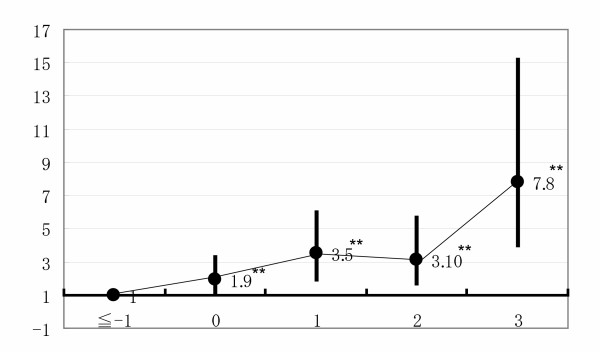
The factors associated with "Ikigai" for total subjects were the number of rooms in one's residence, annual income, healthy life style score (Breslow), the number of working days through SHRC, satisfaction with one's life history and life-change sore through work. The multivariable odds ratio (95% CI) of having "Ikigai" was 1.9 (1.1-3.3) for persons with no change in life thorough work compared with subjects with a score of < or = -1. Moreover, the multivariable odds ratios were 3.5 (1.9-6.6) for a life-change score = 1, 3.1 (1.7-5.7) for a score = 2 and 7.8 (4.0-15.2) for a score = 3 compared with persons with a score of < or = -1. For male subjects, other factors associated with having "Ikigai" were the number of rooms in their residence, annual income, the number of working days through SHRC, subjective assessment of health condition, and degree of satisfaction with their life history. For female, the corresponding factors were the presence of a spouse and degree of satisfaction with their life history.

CONCLUSION

Scores for life-changes through work were associated with a higher prevalence of having "Ikigai" for both male and female. For male, "Ikigai" tended to be associated with physical condition and socioeconomic factors such as the size of their residence or annual income, while for female, family relations such as having spouse and psychological factors such as satisfaction with one's life history were significant factors. In spite of the design limitations of this study, it is possible to conclude that the recognition of life change through obtaining work may enhance "Ikigai" among people who wish to engage in productive activities in their later stages of life for both male and female. SHRC has a potential to provide resources for fulfilling one's "Ikigai" through supporting working opportunities to realize life changes for both elder male and female.
https://cdn.ncbi.nlm.nih.gov/pmc/blobs/3a73/1450260/2ba5a14084ed/1477-7525-4-12-1.jpg
摘要

背景

在日本社会,“生活意义”在文化层面被定义为一个描述主观幸福感的综合概念。它被认为与生活满意度、自尊、士气、幸福以及对个人生活意义的评价相关。尽管先前的研究以较小样本探讨了与“生活意义”相关的因素,但尚未获得一致结果,尤其是从性别差异的角度。识别老年人中与“生活意义”相关的性别特异性因素,可能对提高主观幸福感具有价值。

方法

在日本大阪,对银色人力资源中心(SHRC)4737名随机抽取的成员进行了自填式问卷调查,该中心是一家面向老年人的公共临时就业机构。这约占大阪38个SHRC中心所有注册成员(n = 41593)的10%。共有4376名受试者(男性:2913名;女性:1463名)对问卷给出了满意答复(答复率:92%)。他们是否拥有“生活意义”的状况通过0至5的自我锚定量表进行评估(0 = “生活意义”拥有率最低,5 = “生活意义”拥有率最高)。此外,通过工作的自评生活变化得分(-3至3)通过三个项目进行评估,即:(1)通过工作结交的朋友数量、(2)社会兴趣以及(3)与他人交谈的数量(1 = 增加,0 = 无变化,-1 = 减少)。

结果

全体受试者中与“生活意义”相关的因素包括居住房间数、年收入、健康生活方式得分(布雷斯洛)、通过SHRC的工作日数、对个人生活经历的满意度以及工作带来的生活变化得分。与生活变化得分≤ -1的受试者相比,工作中生活无变化的人拥有“生活意义”的多变量优势比(95%置信区间)为1.9(1.1 - 3.3)。此外,与得分≤ -1的人相比,生活变化得分为1时多变量优势比为3.5(1.9 - 6.6),得分为2时为3.1(1.7 - 5.7),得分为3时为7.8(4.0 - 15.2)。对于男性受试者,与拥有“生活意义”相关的其他因素包括居住房间数、年收入、通过SHRC的工作日数、对健康状况的主观评估以及对个人生活经历的满意度。对于女性,相应因素为配偶的存在以及对个人生活经历的满意度。

结论

工作带来的生活变化得分与男性和女性拥有“生活意义”的较高患病率相关。对于男性,“生活意义”往往与身体状况和社会经济因素相关,如居住面积或年收入大小;而对于女性,家庭关系如拥有配偶以及心理因素如对个人生活经历的满意度是重要因素尽管本研究存在设计局限性,但可以得出结论,认识到通过工作实现生活变化可能会提高男性和女性在晚年希望从事生产性活动人群中的“生活意义”。SHRC有潜力通过为老年男性和女性提供支持工作机会以实现生活变化,来为实现个人的“生活意义”提供资源。

相似文献

1
Factors associated with "Ikigai" among members of a public temporary employment agency for seniors (Silver Human Resources Centre) in Japan; gender differences.日本一家老年人公共临时就业机构(银色人力资源中心)成员中与“生活意义”相关的因素;性别差异
Health Qual Life Outcomes. 2006 Feb 27;4:12. doi: 10.1186/1477-7525-4-12.
2
Japan's silver human resource centers and participant well-being.日本的银色人力资源中心与参与者福祉。
J Cross Cult Gerontol. 2005 Mar;20(1):47-66. doi: 10.1007/s10823-005-3797-4.
3
Understanding the Connection Among Ikigai, Well-Being, and Home Robot Acceptance in Japanese Older Adults: Mixed Methods Study.了解日本老年人的生活意义、幸福感与家用机器人接受度之间的联系:混合方法研究
JMIR Aging. 2023 Oct 4;6:e45442. doi: 10.2196/45442.
4
[Regional differences in ikigai (reason(s) for living) in elderly people--relationship between ikigai and family structure, physiological situation and functional capacity].老年人生活意义(生存理由)的地区差异——生活意义与家庭结构、生理状况及功能能力之间的关系
Nihon Ronen Igakkai Zasshi. 2003 Jul;40(4):390-6. doi: 10.3143/geriatrics.40.390.
5
Work and Family Conflicts, Depression, and "Ikigai": A Mediation Analysis in a Cross-cultural Study Between Japanese and Egyptian Civil Workers.工作与家庭冲突、抑郁与“生活动力”:日本与埃及文职人员跨文化研究中的中介分析。
J Epidemiol. 2023 Jul 5;33(7):360-366. doi: 10.2188/jea.JE20210338. Epub 2022 Jun 9.
6
Pursuit of psychological well-being (ikigai) and the evolution of self-understanding in the context of caregiving in Japan.在日本的照护背景下对心理幸福感(生活意义)的追求与自我认知的演变
Cult Med Psychiatry. 2002 Dec;26(4):399-417. doi: 10.1023/a:1021747419204.
7
Do age, gender, and subjective health-related factors influence health-related life satisfaction in people with disabilities who are physically active?: a secondary analysis.年龄、性别和与主观健康相关的因素是否会影响身体活跃的残疾人群的健康相关生活满意度?一项二次分析。
Womens Health Nurs. 2024 Mar;30(1):56-66. doi: 10.4069/whn.2024.03.18. Epub 2024 Mar 29.
8
QOL models constructed for the community-dwelling elderly with ikigai (purpose in life) as a composition factor, and the effect of habitual exercise.以生活意义(ikigai)为构成因素,为社区居住老年人构建的生活质量模型以及习惯性运动的影响。
J Physiol Anthropol Appl Human Sci. 2005 Sep;24(5):525-33. doi: 10.2114/jpa.24.525.
9
Making Meaning Together: Co-designing a Social Robot for Older Adults with Ikigai Experts.共同创造意义:与拥有“生き甲斐”理念的专家共同设计一款面向老年人的社交机器人。
Int J Soc Robot. 2023 May 21:1-16. doi: 10.1007/s12369-023-01006-z.
10
Associations between psychological distress and the most concerning present personal problems among working-age men in Japan.日本劳动年龄男性人群中心理困扰与当前最关注的个人问题之间的关联。
BMC Public Health. 2015 Mar 31;15:305. doi: 10.1186/s12889-015-1676-7.

引用本文的文献

1
Assessment of behavioral emotion regulation and relationship with mental health in adults: BERQ Japanese version.成人行为情绪调节评估及其与心理健康的关系:BERQ日语版
Discov Ment Health. 2025 Aug 20;5(1):128. doi: 10.1007/s44192-025-00272-9.
2
Factors Related to Ikigai among Home-visit Rehabilitation Users Aged 75 Years and Older Receiving Home Medical and Nursing Care in Japan.日本75岁及以上接受家庭医疗护理的上门康复使用者中与生活意义相关的因素
Phys Ther Res. 2024;27(3):144-150. doi: 10.1298/ptr.E10289. Epub 2024 Nov 14.
3
Relationship between Ikigai and longitudinal changes in serum HDL cholesterol levels: the Circulatory Risk in Communities Study (CIRCS).

本文引用的文献

1
Effects of social relationships on mortality among the elderly in a Japanese rural area: an 88-month follow-up study.日本农村地区老年人社交关系对死亡率的影响:一项为期88个月的随访研究。
J Epidemiol. 2005 May;15(3):78-84. doi: 10.2188/jea.15.78.
2
Subjective usefulness and 6-year mortality risks among elderly persons in Japan.日本老年人的主观效用与6年死亡风险。
J Gerontol B Psychol Sci Soc Sci. 2004 Sep;59(5):P246-9. doi: 10.1093/geronb/59.5.p246.
3
[Regional differences in ikigai (reason(s) for living) in elderly people--relationship between ikigai and family structure, physiological situation and functional capacity].
伊基加和血清高密度脂蛋白胆固醇水平纵向变化的关系:社区循环风险研究(CIRCS)。
Lipids Health Dis. 2024 Aug 28;23(1):270. doi: 10.1186/s12944-024-02256-0.
4
Biopsychosocial Consideration of in Older Adults in Japan through a Cross-Sectional Study.通过横断面研究对日本老年人进行生物心理社会考量
Geriatrics (Basel). 2024 Jun 8;9(3):78. doi: 10.3390/geriatrics9030078.
5
An Integrated Cognitive-Motivational Model of Ikigai (Purpose in Life) in the Workplace.工作场所中“生活意义”(ikigai)的综合认知-动机模型。
Eur J Psychol. 2023 Nov 30;19(4):387-400. doi: 10.5964/ejop.9943. eCollection 2023 Nov.
6
Understanding the Connection Among Ikigai, Well-Being, and Home Robot Acceptance in Japanese Older Adults: Mixed Methods Study.了解日本老年人的生活意义、幸福感与家用机器人接受度之间的联系:混合方法研究
JMIR Aging. 2023 Oct 4;6:e45442. doi: 10.2196/45442.
7
Finding : How robots can support meaning in later life.研究发现:机器人如何在晚年生活中提供意义支持。
Front Robot AI. 2022 Oct 24;9:1011327. doi: 10.3389/frobt.2022.1011327. eCollection 2022.
8
Purpose in life () and employment status in relation to cardiovascular mortality: the Japan Collaborative Cohort Study.生活目的与心血管疾病死亡率的关系:日本综合队列研究。
BMJ Open. 2022 Oct 10;12(10):e059725. doi: 10.1136/bmjopen-2021-059725.
9
Complex Multimorbidity and Working beyond Retirement Age in Japan: A Prospective Propensity-Matched Analysis.复杂的多重疾病与在日本延长工作年限:一项前瞻性倾向评分匹配分析。
Int J Environ Res Public Health. 2022 May 27;19(11):6553. doi: 10.3390/ijerph19116553.
10
Relationships Between IKIGAI Well-Being and Motivation for Autonomous Regulation of Eating and Exercise for Health - Included the Relevance Between Sense of Coherence and Social Support.生之意义幸福感与为健康自主调节饮食和运动的动机之间的关系——包括连贯感与社会支持之间的相关性。
Int J Behav Med. 2023 Jun;30(3):376-387. doi: 10.1007/s12529-022-10098-2. Epub 2022 May 13.
老年人生活意义(生存理由)的地区差异——生活意义与家庭结构、生理状况及功能能力之间的关系
Nihon Ronen Igakkai Zasshi. 2003 Jul;40(4):390-6. doi: 10.3143/geriatrics.40.390.
4
Changes in psychosocial conditions and eventual mortality in community-residing elderly people.社区老年人心理社会状况的变化及最终死亡率
J Epidemiol. 2003 Mar;13(2):72-9. doi: 10.2188/jea.13.72.
5
[Factors associated with self-rated health for non-institutionalized aged persons].[非机构化老年人自评健康的相关因素]
Nihon Koshu Eisei Zasshi. 2002 May;49(5):409-16.
6
Stability and change in structural social relations as predictor of mortality among elderly women and men.老年女性和男性中,结构性社会关系的稳定性与变化作为死亡率的预测因素
Eur J Epidemiol. 2000;16(12):1087-97. doi: 10.1023/a:1010897810514.
7
The relationship of psychosocial factors to total mortality among older Japanese-American men: the Honolulu Heart Program.日裔美国老年男性心理社会因素与总死亡率的关系:檀香山心脏研究项目
J Am Geriatr Soc. 2001 Jun;49(6):725-31. doi: 10.1046/j.1532-5415.2001.49148.x.
8
Gender differences in self-concept and psychological well-being in old age: a meta-analysis.老年期自我概念与心理健康的性别差异:一项元分析。
J Gerontol B Psychol Sci Soc Sci. 2001 Jul;56(4):P195-213. doi: 10.1093/geronb/56.4.p195.
9
Self-reported life satisfaction and 20-year mortality in healthy Finnish adults.芬兰健康成年人的自我报告生活满意度与20年死亡率
Am J Epidemiol. 2000 Nov 15;152(10):983-91. doi: 10.1093/aje/152.10.983.
10
Influences of socioeconomic status, social network, and competence on subjective well-being in later life: a meta-analysis.社会经济地位、社会网络和能力对晚年主观幸福感的影响:一项荟萃分析。
Psychol Aging. 2000 Jun;15(2):187-224. doi: 10.1037//0882-7974.15.2.187.