Kaptein A, Roodenburg L, Princen H M
Gaubius Institute TNO, Leiden, The Netherlands.
Biochem J. 1991 Sep 1;278 ( Pt 2)(Pt 2):557-64. doi: 10.1042/bj2780557.
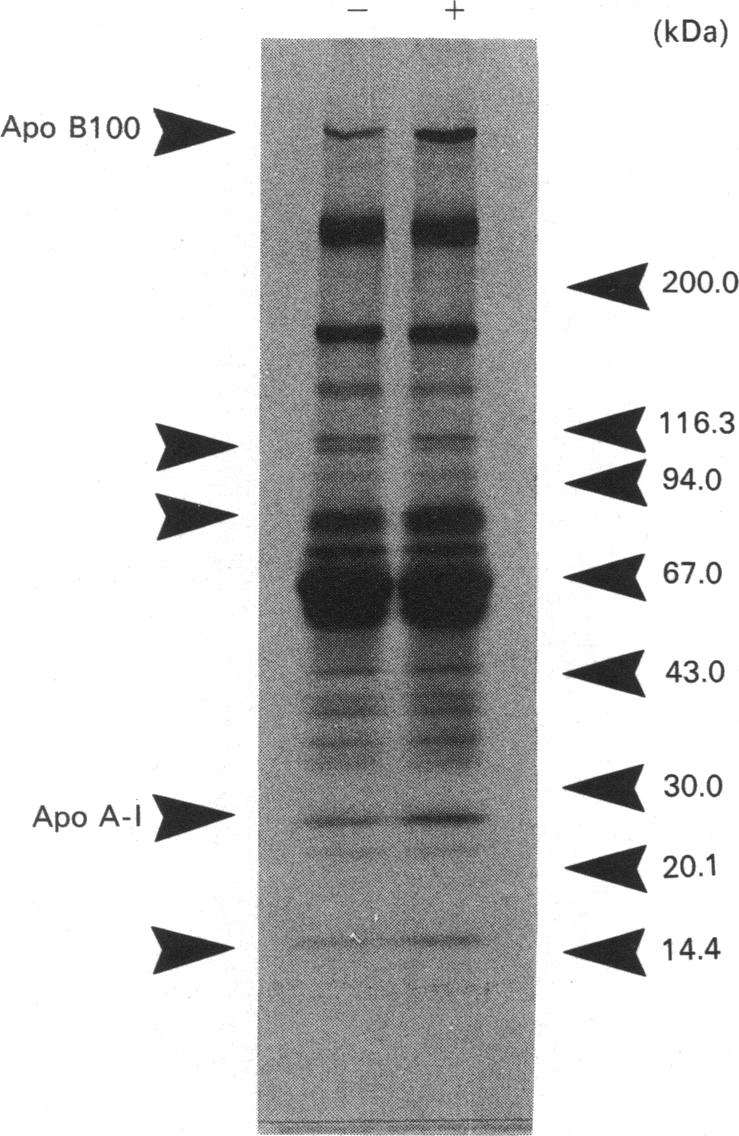
Addition of sodium butyrate to the culture medium of the human hepatoma cell line Hep G2 resulted in a time- and dose-dependent increase in the secretion of apolipoprotein A-I (apo A-I) and apolipoprotein B100 (apo B100). After a 24 h preincubation period, a 2.4- and 2.2-fold increase in the secretion of apo A-I and apo B100 respectively was obtained during the next 24 h in the presence of 2 mM-sodium butyrate. Secretion of albumin, fibrinogen or [35S]methionine-labelled newly synthesized proteins was unaffected or only marginally affected, indicating that the effect of butyrate on apo A-I and apo B100 is not part of a general effect on protein synthesis and secretion. In structure-function studies, butyrate was found to be the most potent inducer among various straight-chain carboxylic acids. Hydroxylated, aminated and otherwise modified butyrate derivatives were inactive. The enhanced accumulation of apo A-I and apo B100 in the culture medium could not be explained by changes in the uptake and degradation of the synthesized apolipoproteins or by alterations in the secretion of possible intracellular pools. In addition, [35S]methionine incorporation studies indicated that synthesis and/or secretion of newly synthesized apo A-I and apo B100 is enhanced in the presence of butyrate. The apo A-I mRNA level was increased 2.3-fold upon treatment with 2 mM-butyrate for 48 h, suggesting regulation at (post-)transcriptional level. In contrast, no change in the level of apo B100 mRNA in butyrate-treated cells was observed, indicating regulation at translational or co- or post-translational level. We propose that the effect of butyrate on the secretion of apo A-I and apo B100 by Hep G2 results from two different regulatory mechanisms.
在人肝癌细胞系Hep G2的培养基中添加丁酸钠,会导致载脂蛋白A-I(apo A-I)和载脂蛋白B100(apo B100)的分泌呈时间和剂量依赖性增加。经过24小时的预孵育期后,在存在2 mM丁酸钠的情况下,接下来的24小时内apo A-I和apo B100的分泌分别增加了2.4倍和2.2倍。白蛋白、纤维蛋白原或[35S]甲硫氨酸标记的新合成蛋白质的分泌未受影响或仅受到轻微影响,这表明丁酸盐对apo A-I和apo B100的作用并非对蛋白质合成和分泌的普遍影响的一部分。在结构-功能研究中发现,丁酸盐是各种直链羧酸中最有效的诱导剂。羟基化、胺化及其他修饰的丁酸盐衍生物无活性。培养基中apo A-I和apo B100积累的增加无法通过合成载脂蛋白的摄取和降解变化或细胞内可能的池的分泌改变来解释。此外,[35S]甲硫氨酸掺入研究表明,在丁酸盐存在下新合成的apo A-I和apo B100的合成和/或分泌增强。用2 mM丁酸盐处理48小时后,apo A-I mRNA水平增加了2.3倍,表明在转录(后)水平受到调控。相比之下,在丁酸盐处理的细胞中未观察到apo B100 mRNA水平的变化,表明在翻译或共翻译或翻译后水平受到调控。我们认为,丁酸盐对Hep G2分泌apo A-I和apo B100的作用源于两种不同的调节机制。