Grabowska Katarzyna, Högberg Liselotte, Penttinen Pasi, Svensson Ake, Ekdahl Karl
Department of Epidemiology, Swedish Institute for Infectious Disease Control (EPI/SMI), SE-171 82 Solna, Sweden.
BMC Infect Dis. 2006 Mar 20;6:58. doi: 10.1186/1471-2334-6-58.
Influenza is characterized by seasonal outbreaks, often with a high rate of morbidity and mortality. It is also known to be a cause of significant amount secondary bacterial infections. Streptococcus pneumoniae is the main pathogen causing secondary bacterial pneumonia after influenza and subsequently, influenza could participate in acquiring Invasive Pneumococcal Disease (IPD).
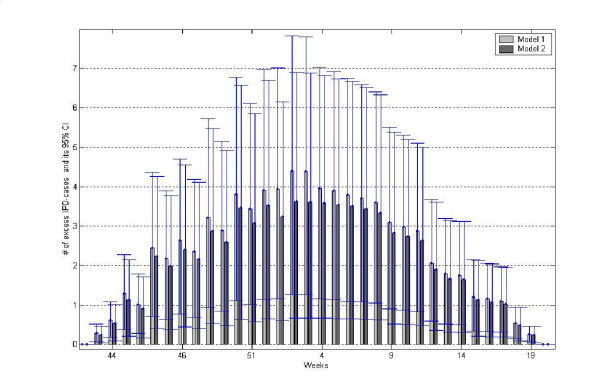
In this study, we aim to investigate the relation between influenza and IPD by estimating the yearly excess of IPD cases due to influenza. For this purpose, we use influenza periods as an indicator for influenza activity as a risk factor in subsequent analysis. The statistical modeling has been made in two modes. First, we constructed two negative binomial regression models. For each model, we estimated the contribution of influenza in the models, and calculated number of excess number of IPD cases. Also, for each model, we investigated several lag time periods between influenza and IPD. Secondly, we constructed an "influenza free" baseline, and calculated differences in IPD data (observed cases) and baseline (expected cases), in order to estimate a yearly additional number of IPD cases due to influenza. Both modes were calculated using zero to four weeks lag time.
The analysis shows a yearly increase of 72-118 IPD cases due to influenza, which corresponds to 6-10% per year or 12-20% per influenza season. Also, a lag time of one to three weeks appears to be of significant importance in the relation between IPD and influenza.
This epidemiological study confirms the association between influenza and IPD. Furthermore, negative binomial regression models can be used to calculate number of excess cases of IPD, related to influenza.
流感具有季节性爆发的特点,发病率和死亡率通常较高。它也是大量继发性细菌感染的一个病因。肺炎链球菌是流感后引起继发性细菌性肺炎的主要病原体,随后,流感可能参与侵袭性肺炎球菌病(IPD)的发生。
在本研究中,我们旨在通过估计因流感导致的IPD病例每年的超额数来研究流感与IPD之间的关系。为此,我们在后续分析中使用流感流行期作为流感活动的指标作为风险因素。统计建模采用两种模式。首先,我们构建了两个负二项回归模型。对于每个模型,我们估计流感在模型中的贡献,并计算IPD病例的超额数。此外,对于每个模型,我们研究了流感与IPD之间的几个滞后时间段。其次,我们构建了一个“无流感”基线,并计算IPD数据(观察到的病例)与基线(预期病例)之间的差异,以估计每年因流感导致的IPD病例额外增加数。两种模式均使用零至四周的滞后时间进行计算。
分析显示,每年因流感导致的IPD病例增加72 - 118例,相当于每年增加6 - 10%或每个流感季节增加12 - 20%。此外,一至三周的滞后时间在IPD与流感的关系中似乎具有重要意义。
这项流行病学研究证实了流感与IPD之间的关联。此外,负二项回归模型可用于计算与流感相关的IPD超额病例数。