Forsyth Dental Center, Boston, Massachusetts 02115.
Infect Immun. 1971 Apr;3(4):567-73. doi: 10.1128/iai.3.4.567-573.1971.
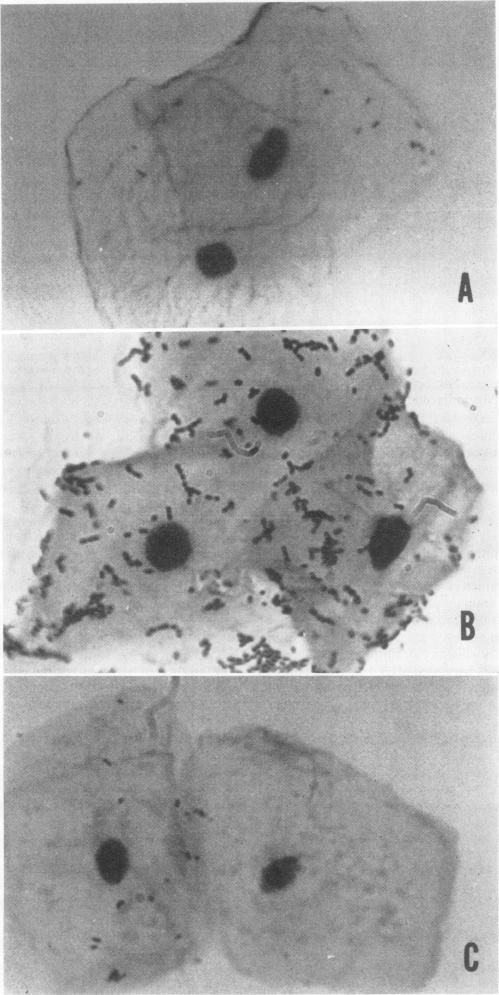
The possible relationship between the ability of Streptococcus species to adhere to oral epithelial cells and their natural distribution on epithelial surfaces within the mouth was studied. Strains of S. salivarius and S. sanguis, which are present in significant proportions on oral epithelial surfaces, were found to possess a definite capacity to adhere to epithelial cells obtained from cheek scrapings of humans, hamsters, and germ-free rats. In contrast, strains of S. mutans, which are found in only minor proportions, if at all, on oral epithelial surfaces exhibited feeble or no adherence to oral epithelial cells. S. salivarius cells attached well to human cheek cells over the range of pH 5 to 8. Its adherence was not found to be markedly influenced by saliva or by growth in sucrose broth. Several other types of bacteria were examined which also exhibited widely different abilities to attach to human cheek cells. Mixtures of streptomycin-labeled strains were introduced into the mouths of volunteers for study of the adherence of Streptococcus species to oral epithelial surfaces in vivo. Labeled S. salivarius and S. sanguis were recovered in high proportions from cheek and tongue surfaces, whereas the proportions of labeled S. mutans recovered from these surfaces were low in comparison to the original mixture. These data indicate that a correlation exists between the relative adherence of various Streptococcus species and their proportional distribution found naturally on oral epithelial surfaces. The ability of bacteria to adhere to surfaces is proposed as a critical ecological determinant affecting their colonization in environments with open surfaces exposed to bathing fluids.
研究了链球菌属(Streptococcus species)黏附于口腔上皮细胞的能力与其在口腔上皮表面天然分布之间的可能关系。在口腔上皮表面存在显著比例的唾液链球菌(S. salivarius)和血链球菌(S. sanguis)菌株被发现具有明确的黏附于人类、仓鼠和无菌大鼠颊拭子上皮细胞的能力。相比之下,在口腔上皮表面仅以较小比例存在的变形链球菌(S. mutans)菌株则表现出较弱或几乎没有对口腔上皮细胞的黏附。唾液链球菌细胞在 pH 值为 5 到 8 的范围内很好地附着于人类颊细胞。其黏附未发现明显受到唾液或蔗糖肉汤中生长的影响。还检查了其他几种具有广泛不同黏附于人类颊细胞能力的细菌。将链霉素标记的菌株混合物引入志愿者口中,以研究链球菌属在体内对口腔上皮表面的黏附。标记的唾液链球菌和血链球菌从颊部和舌部表面以高比例回收,而从这些表面回收的标记变形链球菌的比例与原始混合物相比较低。这些数据表明,各种链球菌属的相对黏附能力与其在口腔上皮表面自然存在的比例分布之间存在相关性。细菌黏附于表面的能力被提出作为影响其在暴露于沐浴液的开放表面环境中定植的关键生态决定因素。