Su Ting-Yi, Lee Ming-Hsun, Huang Ching-Tai, Liu Tsui-Ping, Lu Jang-Jih
Division of Infectious Diseases, Department of Internal Medicine, Chang Gung Memorial Hospital at Linkou, Chang Gung University College of Medicine.
Department of Laboratory Medicine, Chang Gung Memorial Hospital at Linkou.
Medicine (Baltimore). 2018 Dec;97(50):e13607. doi: 10.1097/MD.0000000000013607.
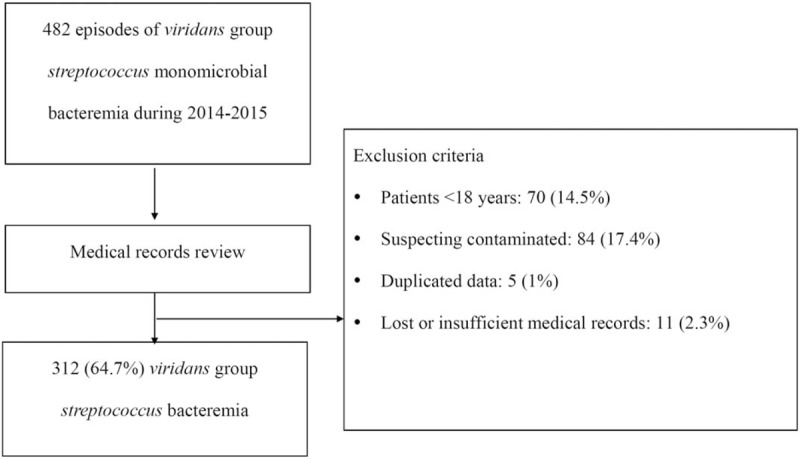
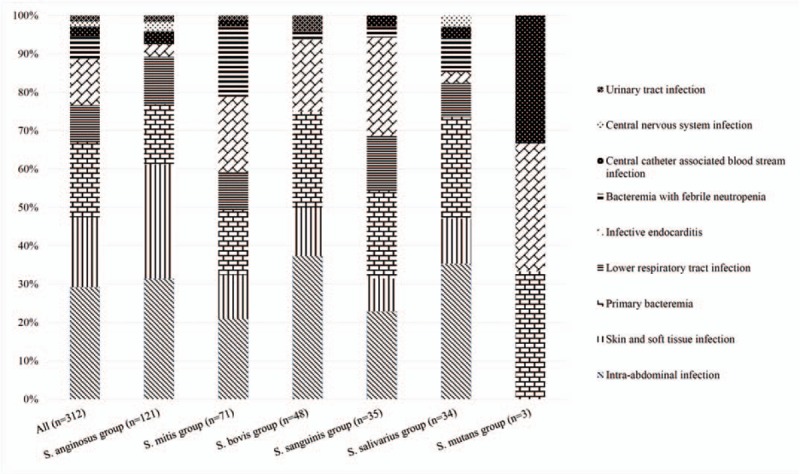
The accuracy of matrix-assisted laser desorption ionization-time of flight mass spectrometry (MALDI-TOF MS) for identifying viridans group streptococcus (VGS) was improving. However, the clinical impact of identifying VGS had not been well recognized. Our study had comprehensively studied the clinical manifestations and outcome of VGS blood stream infection by using MALDI-TOF MS for identification.This retrospective study enrolled 312 adult patients with a monomicrobial blood culture positive for VGS. Blood culture was examined through MALDI-TOF MS.The most common VGS species were the Streptococcus anginosus group (38.8%) and Streptococcus mitis group (22.8%). Most species showed resistance to erythromycin (35.6%), followed by clindamycin (25.3%) and penicillin (12.5%). Skin and soft tissue infection and biliary tract infection were significantly related to S. anginosus group bacteremia (P = .001 and P = .005, respectively). S. mitis group bacteremia was related to infective endocarditis and bacteremia with febrile neutropenia (P = .005 and P < .001, respectively). Infective endocarditis was also more likely associated with S. sanguinis group bacteremia (P = .009). S. anginosus group had less resistance rate to ampicillin, erythromycin, clindamycin, and ceftriaxone (P = .019, <.001, .001, and .046, respectively). A more staying in intensive care unit, underlying solid organ malignancy, and a shorter treatment duration were independent risk factors for 30-day mortality. This study comprehensively evaluated different VGS group and their clinical manifestations, infection sources, concomitant diseases, treatments, and outcomes. Categorizing VGS into different groups by MALDI-TOF MS could help clinical physicians well understand their clinical presentations.
基质辅助激光解吸电离飞行时间质谱(MALDI-TOF MS)鉴定草绿色链球菌(VGS)的准确性正在提高。然而,VGS鉴定的临床影响尚未得到充分认识。我们的研究通过使用MALDI-TOF MS进行鉴定,全面研究了VGS血流感染的临床表现和结局。这项回顾性研究纳入了312例成年患者,其血培养为单一微生物阳性的VGS。通过MALDI-TOF MS对血培养进行检测。最常见的VGS菌种是咽峡炎链球菌群(38.8%)和缓症链球菌群(22.8%)。大多数菌种对红霉素耐药(35.6%),其次是克林霉素(25.3%)和青霉素(12.5%)。皮肤和软组织感染以及胆道感染与咽峡炎链球菌群菌血症显著相关(分别为P = 0.001和P = 0.005)。缓症链球菌群菌血症与感染性心内膜炎和发热性中性粒细胞减少菌血症相关(分别为P = 0.005和P < 0.001)。感染性心内膜炎也更可能与血链球菌群菌血症相关(P = 0.009)。咽峡炎链球菌群对氨苄西林、红霉素、克林霉素和头孢曲松的耐药率较低(分别为P = 0.019、<0.001、0.001和0.046)。在重症监护病房停留时间更长、存在潜在实体器官恶性肿瘤以及治疗持续时间较短是30天死亡率的独立危险因素。本研究全面评估了不同的VGS组及其临床表现、感染源、伴随疾病、治疗和结局。通过MALDI-TOF MS将VGS分为不同组有助于临床医生更好地了解其临床表现。