Blaney Davidson Esmeralda N, Vitters Elly L, van den Berg Wim B, van der Kraan Peter M
Experimental Rheumatology and Advanced Therapeutics, St, Radboud University Medical Centre Nijmegen, Geert Grooteplein 26-28, 6525 GA Nijmegen, The Netherlands.
Arthritis Res Ther. 2006;8(3):R65. doi: 10.1186/ar1931. Epub 2006 Mar 29.
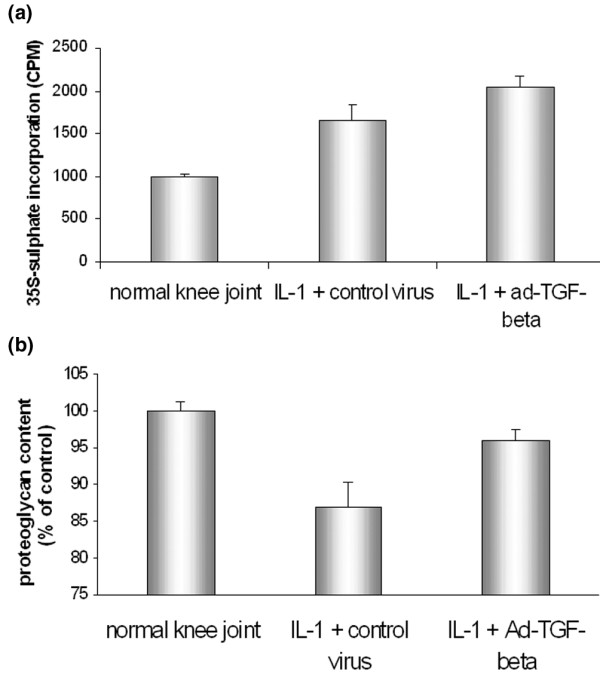
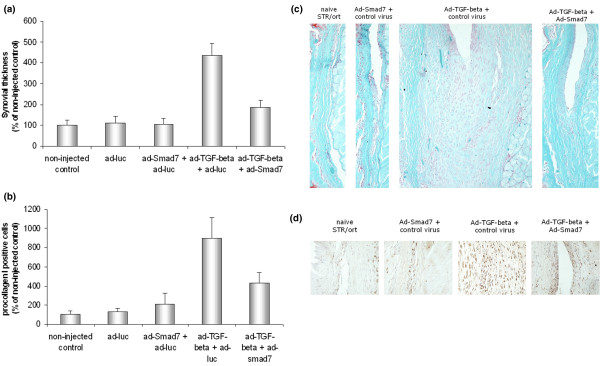
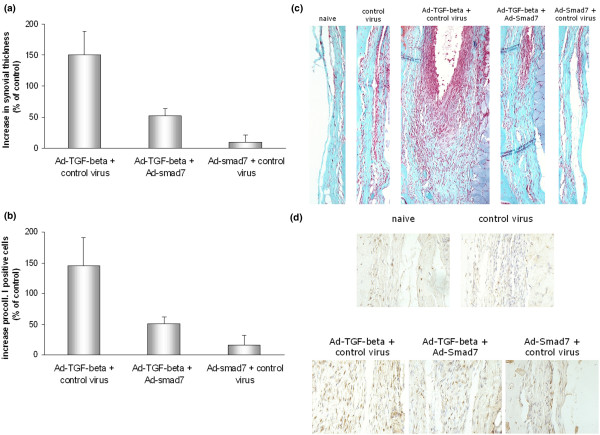
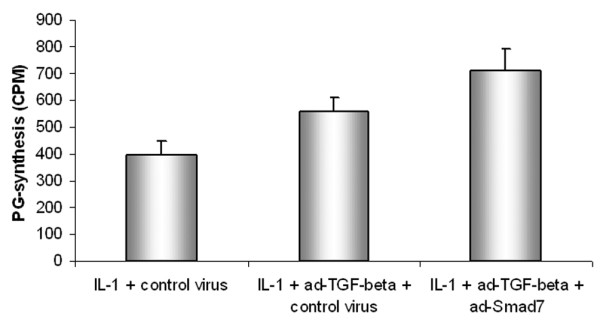
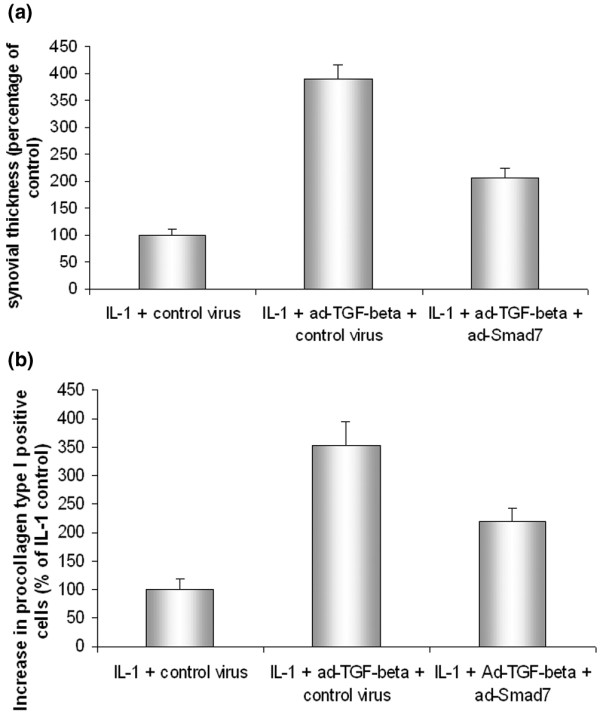
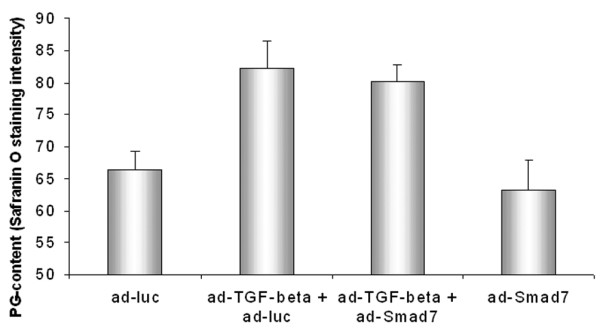
Cartilage damage in osteoarthritis (OA) is considered an imbalance between catabolic and anabolic factors, favoring the catabolic side. We assessed whether adenoviral overexpression of transforming growth factor-beta (TGFbeta) enhanced cartilage repair and whether TGFbeta-induced fibrosis was blocked by local expression of the intracellular TGFbeta inhibitor Smad7. We inflicted cartilage damage by injection of interleukin-1 (IL-1) into murine knee joints. After 2 days, we injected an adenovirus encoding TGFbeta. On day 4, we measured proteoglycan (PG) synthesis and content. To examine whether we could block TGFbeta-induced fibrosis and stimulate cartilage repair simultaneously, we injected Ad-TGFbeta and Ad-Smad7. This was performed both after IL-1-induced damage and in a model of primary OA. In addition to PG in cartilage, synovial fibrosis was measured by determining the synovial width and the number of procollagen I-expressing cells. Adenoviral overexpression of TGFbeta restored the IL-1-induced reduction in PG content and increased PG synthesis. TGFbeta-induced an elevation in PG content in cartilage of the OA model. TGFbeta-induced synovial fibrosis was strongly diminished by simultaneous synovial overexpression of Smad7 in the synovial lining. Of great interest, overexpression of Smad7 did not reduce the repair-stimulating effect of TGFbeta on cartilage. Adenoviral overexpression of TGFbeta stimulated repair of IL-1- and OA-damaged cartilage. TGFbeta-induced synovial fibrosis was blocked by locally inhibiting TGFbeta signaling in the synovial lining by simultaneously transfecting it with an adenovirus overexpressing Smad7.
骨关节炎(OA)中的软骨损伤被认为是分解代谢和合成代谢因子之间的失衡,偏向于分解代谢一方。我们评估了转化生长因子-β(TGFβ)的腺病毒过表达是否能增强软骨修复,以及细胞内TGFβ抑制剂Smad7的局部表达是否能阻断TGFβ诱导的纤维化。我们通过向小鼠膝关节注射白细胞介素-1(IL-1)造成软骨损伤。2天后,我们注射编码TGFβ的腺病毒。在第4天,我们测量蛋白聚糖(PG)的合成和含量。为了研究我们是否能同时阻断TGFβ诱导的纤维化并刺激软骨修复,我们注射了Ad-TGFβ和Ad-Smad7。这在IL-1诱导损伤后以及原发性OA模型中均进行。除了软骨中的PG,通过测定滑膜宽度和表达I型前胶原的细胞数量来测量滑膜纤维化。TGFβ的腺病毒过表达恢复了IL-1诱导的PG含量降低并增加了PG合成。TGFβ诱导OA模型软骨中PG含量升高。通过在滑膜衬里同时过表达Smad7,TGFβ诱导的滑膜纤维化被显著减轻。非常有趣的是,Smad7的过表达并未降低TGFβ对软骨的修复刺激作用。TGFβ的腺病毒过表达刺激了IL-1和OA损伤软骨的修复。通过同时用过量表达Smad7的腺病毒转染滑膜衬里来局部抑制TGFβ信号传导,阻断了TGFβ诱导的滑膜纤维化。