Qian Ziliang, Yin Yanbin, Zhang Yong, Lu Lingyi, Li Yixue, Jiang Ying
Molecular and Investigative Toxicology, Merck Research Laboratories, WP45-330, West Point, PA 19486, USA.
BMC Genomics. 2006 Apr 5;7:74. doi: 10.1186/1471-2164-7-74.
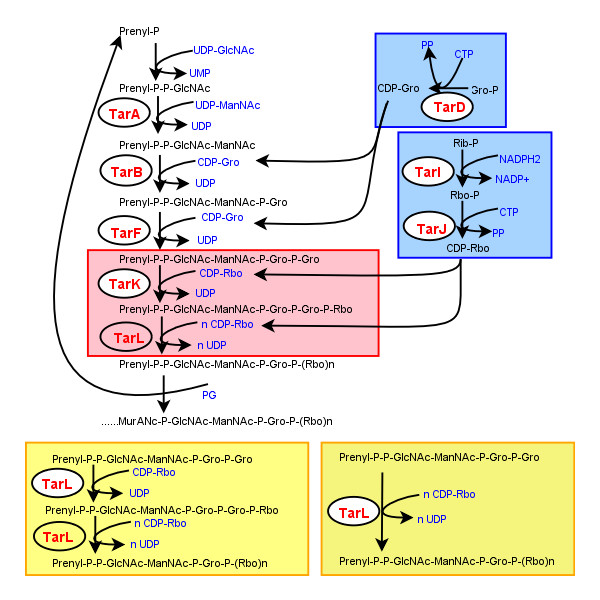
Staphylococcus aureus or MRSA (Methicillin Resistant S. aureus), is an acquired pathogen and the primary cause of nosocomial infections worldwide. In S. aureus, teichoic acid is an essential component of the cell wall, and its biosynthesis is not yet well characterized. Studies in Bacillus subtilis have discovered two different pathways of teichoic acid biosynthesis, in two strains W23 and 168 respectively, namely teichoic acid ribitol (tar) and teichoic acid glycerol (tag). The genes involved in these two pathways are also characterized, tarA, tarB, tarD, tarI, tarJ, tarK, tarL for the tar pathway, and tagA, tagB, tagD, tagE, tagF for the tag pathway. With the genome sequences of several MRSA strains: Mu50, MW2, N315, MRSA252, COL as well as methicillin susceptible strain MSSA476 available, a comparative genomic analysis was performed to characterize teichoic acid biosynthesis in these S. aureus strains.
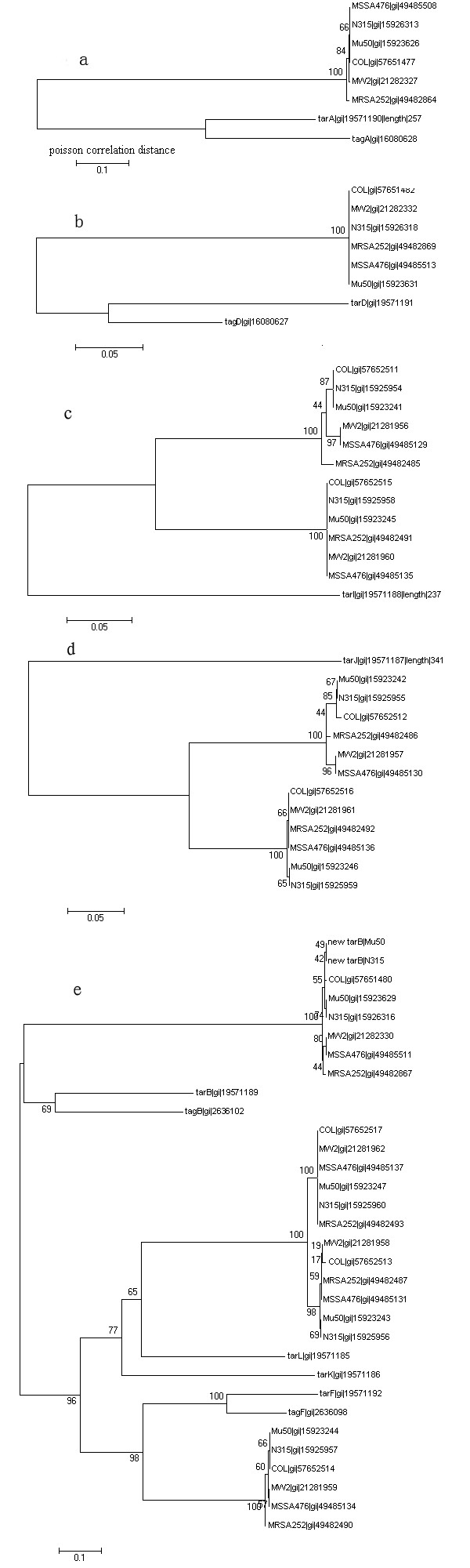
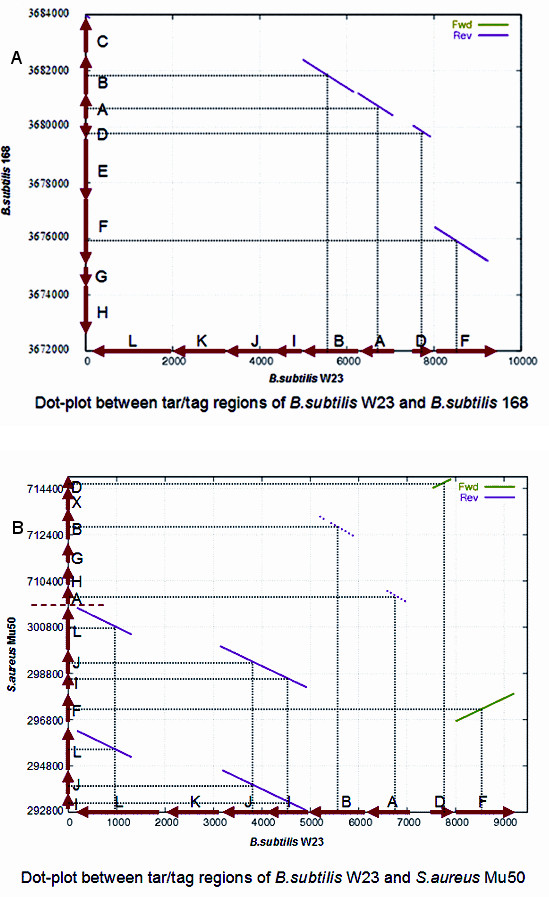
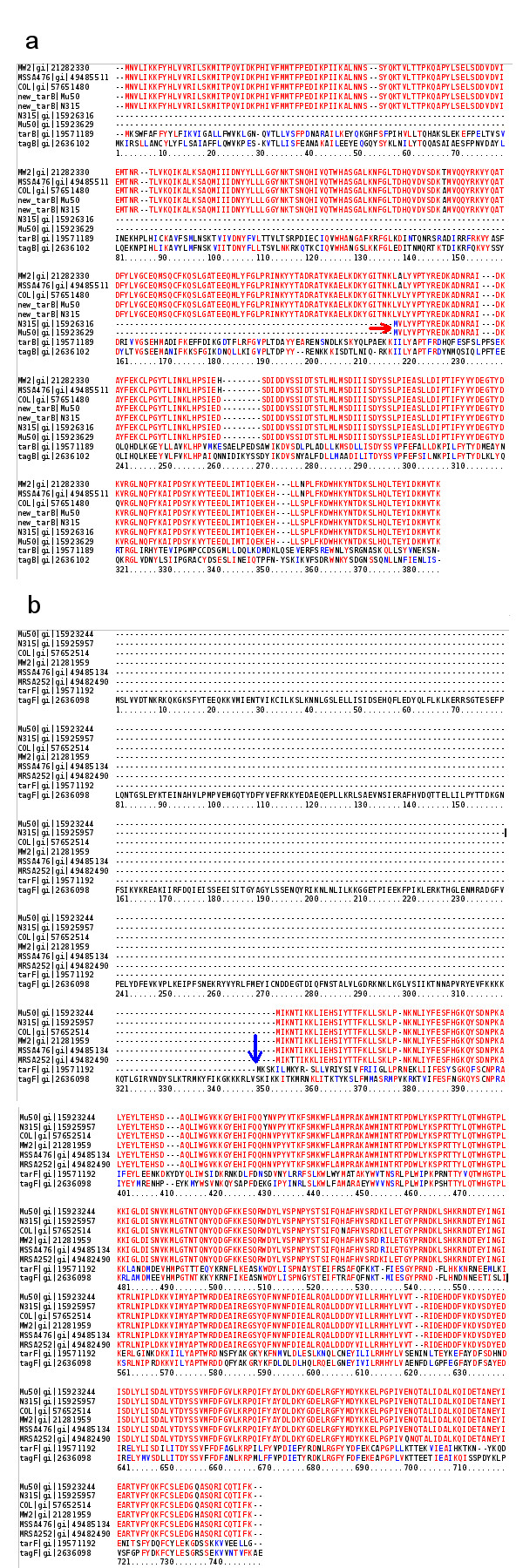
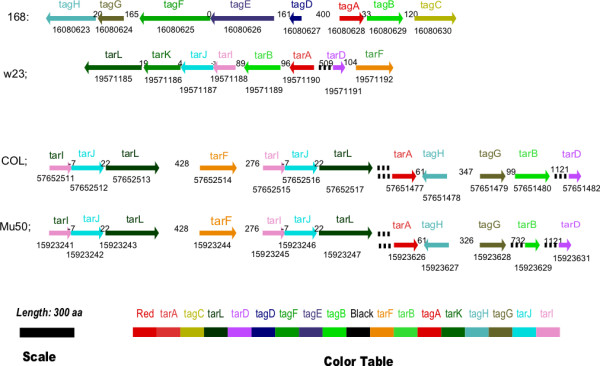
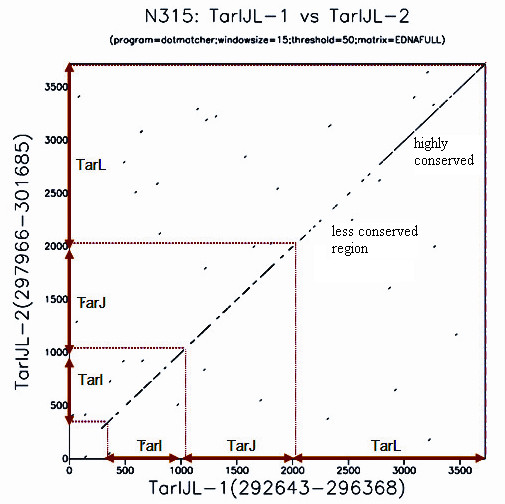
We identified all S. aureus tar and tag gene orthologs in the selected S. aureus strains which would contribute to teichoic acids sythesis. Based on our identification of genes orthologous to tarI, tarJ, tarL, which are specific to tar pathway in B. subtilis W23, we also concluded that tar is the major teichoic acid biogenesis pathway in S. aureus. Further analyses indicated that the S. aureus tar genes, different from the divergon organization in B. subtilis, are organized into several clusters in cis. Most interesting, compared with genes in B. subtilis tar pathway, the S. aureus tar specific genes (tarI,J,L) are duplicated in all six S. aureus genomes.
In the S. aureus strains we analyzed, tar (teichoic acid ribitol) is the main teichoic acid biogenesis pathway. The tar genes are organized into several genomic groups in cis and the genes specific to tar (relative to tag): tarI, tarJ, tarL are duplicated. The genomic organization of the S. aureus tar pathway suggests their regulations are different when compared to B. subtilis tar or tag pathway, which are grouped in two operons in a divergon structure.
金黄色葡萄球菌或耐甲氧西林金黄色葡萄球菌(MRSA)是一种后天获得的病原体,是全球医院感染的主要原因。在金黄色葡萄球菌中,磷壁酸是细胞壁的重要组成部分,其生物合成尚未得到充分表征。对枯草芽孢杆菌的研究分别在两株菌W23和168中发现了两种不同的磷壁酸生物合成途径,即核糖醇磷壁酸(tar)途径和甘油磷壁酸(tag)途径。参与这两条途径的基因也已得到表征,tar途径的基因有tarA、tarB、tarD、tarI、tarJ、tarK、tarL,tag途径的基因有tagA、tagB、tagD、tagE、tagF。随着几株MRSA菌株(Mu50、MW2、N315、MRSA252、COL)以及甲氧西林敏感菌株MSSA476的基因组序列可用,进行了比较基因组分析以表征这些金黄色葡萄球菌菌株中的磷壁酸生物合成。
我们在所选的金黄色葡萄球菌菌株中鉴定出了所有有助于磷壁酸合成的金黄色葡萄球菌tar和tag基因直系同源物。基于我们对枯草芽孢杆菌W23中tar途径特有的tarI、tarJ、tarL基因直系同源物的鉴定,我们还得出结论,tar是金黄色葡萄球菌中主要的磷壁酸生物合成途径。进一步分析表明,与枯草芽孢杆菌中的发散型组织不同,金黄色葡萄球菌的tar基因顺式排列成几个簇。最有趣的是,与枯草芽孢杆菌tar途径中的基因相比,金黄色葡萄球菌tar特有的基因(tarI、J、L)在所有六个金黄色葡萄球菌基因组中都有重复。
在我们分析的金黄色葡萄球菌菌株中,tar(核糖醇磷壁酸)是主要的磷壁酸生物合成途径。tar基因顺式排列成几个基因组群,tar特有的基因(相对于tag):tarI、tarJ、tarL有重复。金黄色葡萄球菌tar途径的基因组组织表明,与枯草芽孢杆菌的tar或tag途径相比,它们的调控方式不同,枯草芽孢杆菌的tar或tag途径在发散型结构中被组织成两个操纵子。