Alving K, Janson C, Nordvall L
Department of Physiology and Pharmacology, Karolinska Institutet, SE-17177 Stockholm, Sweden.
Respir Res. 2006 Apr 20;7(1):67. doi: 10.1186/1465-9921-7-67.
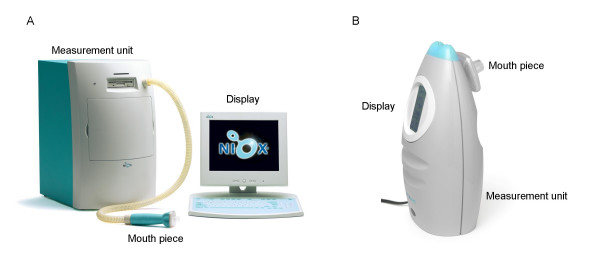
Exhaled nitric oxide (NO) measurement has been shown to be a valuable tool in the management of patients with asthma. Up to now, most measurements have been done with stationary, chemiluminescence-based NO analysers, which are not suitable for the primary health care setting. A hand-held NO analyser which simplifies the measurement would be of value both in specialized and primary health care. In this study, the performance of a new electrochemical hand-held device for exhaled NO measurements (NIOX MINO) was compared with a standard stationary chemiluminescence unit (NIOX).
A total of 71 subjects (6-60 years; 36 males), both healthy controls and atopic patients with and without asthma were included. The mean of three approved exhalations (50 ml/s) in each device, and the first approved measurement in the hand-held device, were compared with regard to NO readings (Bland-Altman plots), measurement feasibility (success rate with 6 attempts) and repeatability (intrasubject SD).
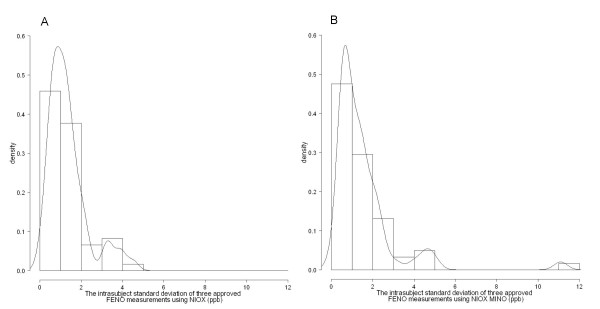
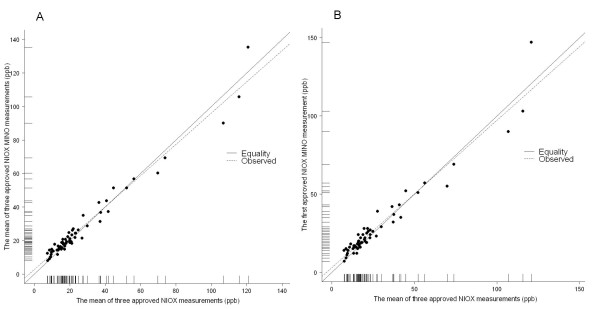
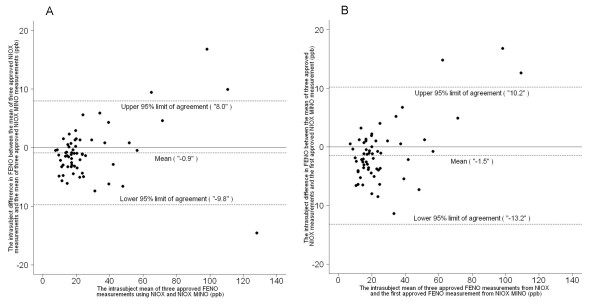
Success rate was high (> or = 84%) in both devices for both adults and children. The subjects represented a FENO range of 8-147 parts per billion (ppb). When comparing the mean of three measurements (n = 61), the median of the intrasubject difference in exhaled NO for the two devices was -1.2 ppb; thus generally the hand-held device gave slightly higher readings. The Bland-Altman plot shows that the 95% limits of agreement were -9.8 and 8.0 ppb. The intrasubject median difference between the NIOX and the first approved measurement in the NIOX MINO was -2.0 ppb, and limits of agreement were -13.2 and 10.2 ppb. The median repeatability for NIOX and NIOX MINO were 1.1 and 1.2 ppb, respectively.
The hand-held device (NIOX MINO) and the stationary system (NIOX) are in clinically acceptable agreement both when the mean of three measurements and the first approved measurement (NIOX MINO) is used. The hand-held device shows good repeatability, and it can be used successfully on adults and most children. The new hand-held device will enable the introduction of exhaled NO measurements into the primary health care.
呼出一氧化氮(NO)测量已被证明是管理哮喘患者的一项有价值的工具。到目前为止,大多数测量是使用基于化学发光的固定式NO分析仪进行的,这些分析仪不适合初级卫生保健环境。一种简化测量的手持式NO分析仪在专科和初级卫生保健中都将具有价值。在本研究中,将一种用于呼出NO测量的新型电化学手持式设备(NIOX MINO)的性能与标准固定式化学发光设备(NIOX)进行了比较。
共纳入71名受试者(6至60岁;36名男性),包括健康对照者以及有或无哮喘的特应性患者。比较了每个设备中三次认可呼气(50毫升/秒)的平均值以及手持式设备中的首次认可测量值,涉及NO读数(Bland-Altman图)、测量可行性(6次尝试的成功率)和重复性(受试者内标准差)。
对于成人和儿童,两种设备的成功率都很高(≥84%)。受试者的呼出一氧化氮分数(FENO)范围为8至147十亿分之一(ppb)。比较三次测量的平均值(n = 61)时,两种设备呼出NO的受试者内差异中位数为-1.2 ppb;因此,一般来说手持式设备的读数略高。Bland-Altman图显示一致性界限的95%为-9.8和8.0 ppb。NIOX与NIOX MINO中首次认可测量值之间的受试者内中位数差异为-2.0 ppb,一致性界限为-13.2和10.2 ppb。NIOX和NIOX MINO的重复性中位数分别为1.1和1.2 ppb。
当使用三次测量的平均值和首次认可测量值(NIOX MINO)时,手持式设备(NIOX MINO)和固定式系统(NIOX)在临床上具有可接受的一致性。手持式设备显示出良好重复性,并且可以成功用于成人和大多数儿童。这种新型手持式设备将使呼出NO测量能够引入初级卫生保健。