Wallman Thorne, Wedel Hans, Johansson Saga, Rosengren Annika, Eriksson Henry, Welin Lennart, Svärdsudd Kurt
Department of Public Health and Caring Sciences, University Hospital, Uppsala, Sweden.
BMC Public Health. 2006 Apr 22;6:103. doi: 10.1186/1471-2458-6-103.
Several studies have shown a markedly higher mortality rate among disability pensioners than among non-retired. Since most disability pensions are granted because of non-fatal diseases the reason for the increased mortality therefore remains largely unknown. The aim of this study was to evaluate potential explanatory factors.
Data from five longitudinal cohort studies in Sweden, including 6,887 men and women less than 65 years old at baseline were linked to disability pension data, hospital admission data, and mortality data from 1971 until 2001. Mortality odds ratios were analyzed with Poisson regression and Cox's proportional hazards regression models.
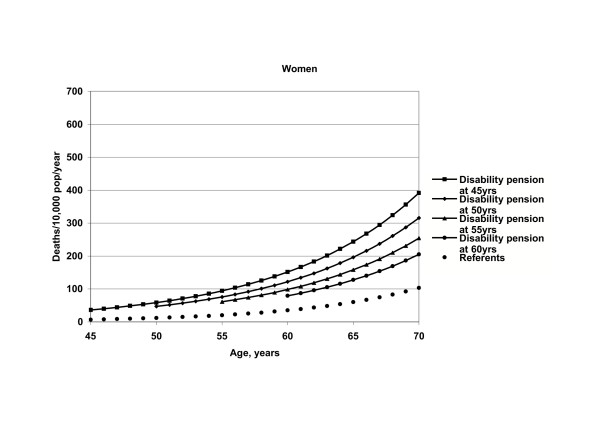
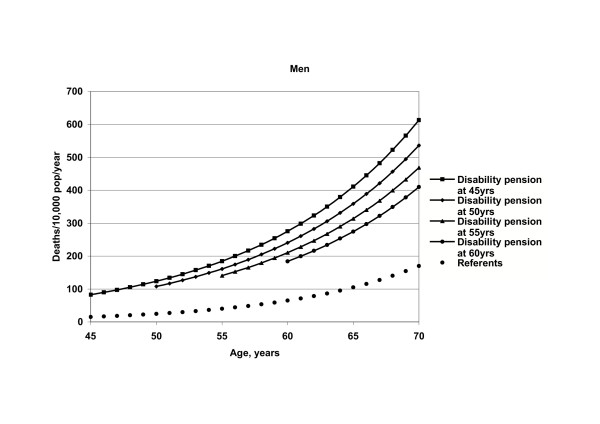
1,683 (24.4%) subjects had a disability pension at baseline or received one during follow up. 525 (7.6%) subjects died during follow up. The subjects on disability pension had a higher mortality rate than the non-retired, the hazards ratio (HR) being 2.78 (95%CI 2.08-3.71) among women and 3.43 (95%CI 2.61-4.51) among men. HR was highest among individuals granted a disability pension at young ages (HR >7), and declined parallel to age at which the disability pension was granted. The higher mortality rate among the retired subjects was not explained by disability pension cause or underlying disease or differences in age, marital status, educational level, smoking habits or drug abuse. There was no significant association between reason for disability pension and cause of death.
Subjects with a disability pension had increased mortality rates as compared with non-retired subjects, only modestly affected by adjustments for psycho-socio-economic factors, underlying disease, etcetera. It is unlikely that these factors were the causes of the unfavorable outcome. Other factors must be at work.
多项研究表明,残疾养老金领取者的死亡率明显高于未退休者。由于大多数残疾养老金是因非致命疾病而发放的,因此死亡率上升的原因在很大程度上仍不明确。本研究的目的是评估潜在的解释因素。
来自瑞典五项纵向队列研究的数据,包括基线时年龄小于65岁的6887名男性和女性,与1971年至2001年的残疾养老金数据、住院数据和死亡率数据相关联。使用泊松回归和考克斯比例风险回归模型分析死亡率比值比。
1683名(24.4%)受试者在基线时领取残疾养老金或在随访期间领取。525名(7.6%)受试者在随访期间死亡。领取残疾养老金的受试者死亡率高于未退休者,女性的风险比(HR)为2.78(95%可信区间2.08 - 3.71),男性为3.43(95%可信区间2.61 - 4.51)。HR在年轻时领取残疾养老金的个体中最高(HR>7),并随着领取残疾养老金的年龄增加而下降。退休受试者中较高的死亡率不能用残疾养老金原因、潜在疾病或年龄、婚姻状况、教育水平、吸烟习惯或药物滥用的差异来解释。残疾养老金原因与死亡原因之间没有显著关联。
与未退休受试者相比,领取残疾养老金的受试者死亡率增加,心理社会经济因素、潜在疾病等调整对其影响不大。这些因素不太可能是不良结果的原因。一定有其他因素在起作用。