Lanki Timo, de Hartog Jeroen J, Heinrich Joachim, Hoek Gerard, Janssen Nicole A H, Peters Annette, Stölzel Matthias, Timonen Kirsi L, Vallius Marko, Vanninen Esko, Pekkanen Juha
Environmental Epidemiology Unit, National Public Health Institute, Kuopio, Finland, and Environmental and Occupational Health Division, Institute for Risk Assessment Sciences, Utrecht University, the Netherlands.
Environ Health Perspect. 2006 May;114(5):655-60. doi: 10.1289/ehp.8578.
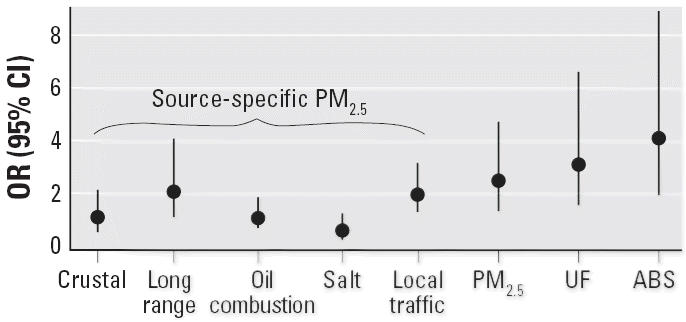
Epidemiologic studies have shown that ambient particulate matter (PM) has adverse effects on cardiovascular health. Effective mitigation of the health effects requires identification of the most harmful PM sources. The objective of our study was to evaluate relative effects of fine PM [aerodynamic diameter<or=2.5 microm (PM2.5)] from different sources on exercise-induced ischemia. We collected daily outdoor PM2.5 samples between autumn 1998 and spring 1999 in Helsinki, Finland. The mass of PM2.5 was apportioned between five sources. Forty-five elderly nonsmoking persons with stable coronary heart disease visited a clinic biweekly for submaximal exercise testing, during which the occurrence of ST segment depressions was recorded. Levels of PM2.5 originating from local traffic and long-range transport were associated with ST segment depressions>0.1 mV, with odds ratios at 2-day lag of 1.53 [95% confidence interval (CI), 1.19-1.97] and 1.11 (95% CI, 1.02-1.20) per 1 microg/m3, respectively. In multipollutant models, where we used indicator elements for sources instead of source-specific PM2.5, only absorbance (elemental carbon), an indicator of local traffic and other combustion, was associated with ST segment depressions. Our results suggest that the PM fraction originating from combustion processes, notably traffic, exacerbates ischemic heart diseases associated with PM mass.
流行病学研究表明,环境颗粒物(PM)对心血管健康有不良影响。要有效减轻其对健康的影响,需要确定最有害的PM来源。我们研究的目的是评估不同来源的细颗粒物[空气动力学直径≤2.5微米(PM2.5)]对运动诱发缺血的相对影响。1998年秋季至1999年春季,我们在芬兰赫尔辛基每日采集室外PM2.5样本。PM2.5的质量被分配到五个来源。45名患有稳定型冠心病的老年不吸烟患者每两周到诊所进行一次次极量运动测试,期间记录ST段压低的发生情况。来自本地交通和远距离传输的PM2.5水平与ST段压低>0.1 mV相关,每增加1微克/立方米,2天滞后的优势比分别为1.53[95%置信区间(CI),1.19 - 1.97]和1.11(95%CI,1.02 - 1.20)。在多污染物模型中,我们使用来源指示元素而非特定来源的PM2.5,结果显示只有吸光度(元素碳),即本地交通和其他燃烧的一个指标,与ST段压低相关。我们的结果表明,源自燃烧过程(尤其是交通)的PM部分会加剧与PM质量相关的缺血性心脏病。