Zhang Li, Ajiferuke Isola, Sampson Margaret
Natural Sciences Library, University of Saskatchewan, Saskatoon, Canada.
BMC Med Res Methodol. 2006 May 9;6:23. doi: 10.1186/1471-2288-6-23.
The Cochrane Highly Sensitive Search Strategy (HSSS), which contains three phases, is widely used to identify Randomized Controlled Trials (RCTs) in MEDLINE. Lefebvre and Clarke suggest that reviewers might consider using four revisions of the HSSS. The objective of this study is to validate these four revisions: combining the free text terms volunteer, crossover, versus, and the Medical Subject Heading CROSS-OVER STUDIES with the top two phases of the HSSS, respectively.
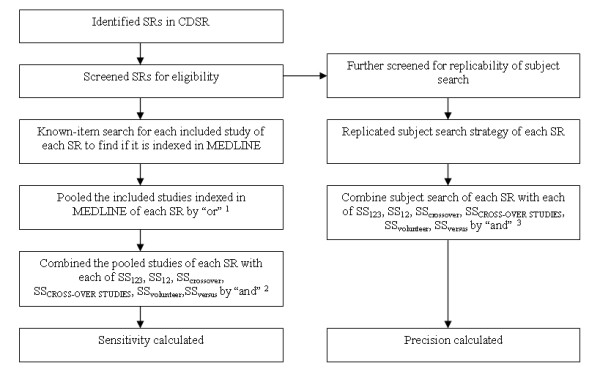
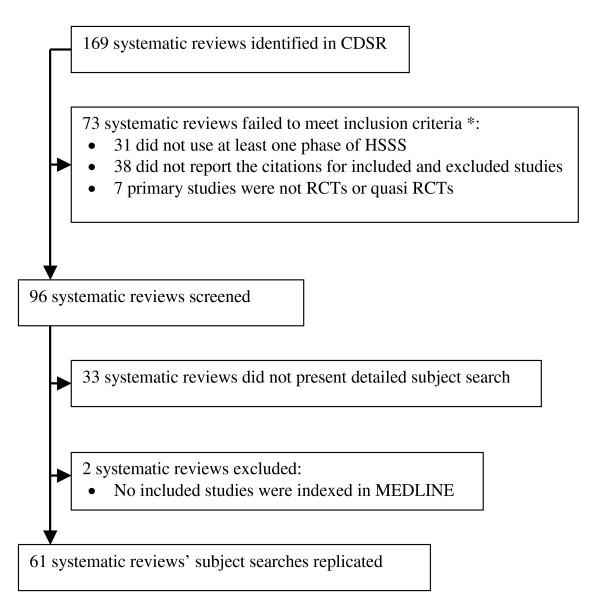
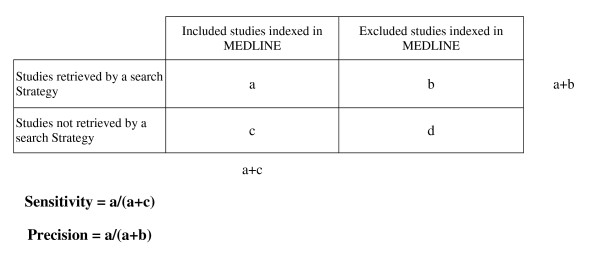
We replicated the subject search for 61 Cochrane reviews. The included studies of each review that were indexed in MEDLINE were pooled together by review and then combined with the subject search and each of the four proposed search strategies, the top two phases of the HSSS, and all three phases of the HSSS. These retrievals were used to calculate the sensitivity and precision of each of the six search strategies for each review.
Across the 61 reviews, the search term versus combined with the top two phases of the HSSS was able to find 3 more included studies than the top two phases of the HSSS alone, or in combination with any of the other proposed search terms, but at the expense of missing 56 relevant articles that would be found if all three phases of the HSSS were used. The estimated time needed to finish a review is 1086 hours for all three phases of the HSSS, 823 hours for the strategy versus, 818 hours for the first two phases of the HSSS or any of the other three proposed strategies.
This study shows that compared to the first two phases of the HSSS, adding the term versus to the top two phases of the HSSS balances the sensitivity and precision in the reviews studied here to some extent but the differences are very small. It is well known that missing relevant studies may result in bias in systematic reviews. Reviewers need to weigh the trade-offs when selecting the search strategies for identifying RCTs in MEDLINE.
Cochrane高灵敏度检索策略(HSSS)包含三个阶段,广泛用于在MEDLINE中识别随机对照试验(RCT)。勒费布尔和克拉克建议综述作者可考虑使用HSSS的四个修订版。本研究的目的是验证这四个修订版:分别将自由文本词“志愿者”“交叉”“对比”以及医学主题词“交叉研究”与HSSS的前两个阶段相结合。
我们重复了对61篇Cochrane系统评价的主题检索。将每篇综述中收录的、在MEDLINE中被索引的研究按综述汇总在一起,然后与主题检索以及四种拟议检索策略中的每一种、HSSS的前两个阶段和HSSS的所有三个阶段相结合。这些检索结果用于计算每种综述的六种检索策略各自的灵敏度和精确率。
在61篇综述中,检索词“对比”与HSSS的前两个阶段相结合,比单独使用HSSS的前两个阶段或与任何其他拟议检索词相结合,能多找到3篇纳入研究,但代价是遗漏了如果使用HSSS的所有三个阶段将会找到的56篇相关文章。完成一篇综述估计所需时间,HSSS的所有三个阶段为1086小时,“对比”策略为823小时,HSSS的前两个阶段或其他三种拟议策略中的任何一种为818小时。
本研究表明,与HSSS的前两个阶段相比,在HSSS的前两个阶段添加“对比”一词在一定程度上平衡了本研究中综述的灵敏度和精确率,但差异非常小。众所周知,遗漏相关研究可能导致系统评价出现偏倚。综述作者在选择用于在MEDLINE中识别RCT的检索策略时需要权衡利弊。