Department of Internal Medicine, Yale University School of Medicine, New Haven, Connecticut.
J Clin Invest. 1968 Jan;47(1):107-17. doi: 10.1172/JCI105701.
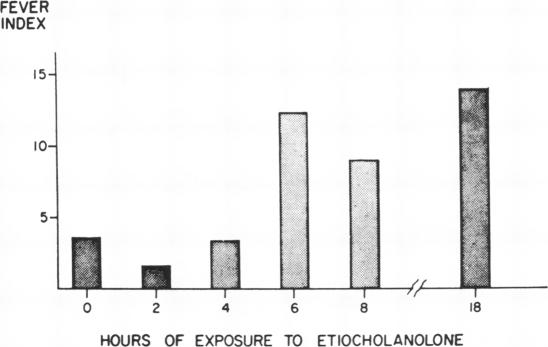
When a serum-buffer solution of etiocholanolone is incubated with human blood leukocytes in vitro, a pyrogen is released. Like endogenous pyrogen of leukocyte origin, this pyrogen produces prompt monophasic fevers in rabbits, does not induce fever tolerance when given daily, and is inactivated by trypsin. In many respects, the characteristics of the in vitro reaction resemble experimental steroid-induced fever. For example, release of pyrogen varies directly with the concentration of steroid. 4-8 hr of contact between steroid and leukocyte is required for activation of the cell. Rabbit leukocytes are not activated by etiocholanolone. Finally, androsterone, the 5alpha-isomer of etiocholanolone, does not induce pyrogen release in vitro. These studies suggest that experimental steroid fever in man may be mediated by an endogenous pyrogen released from leukocytes.
当血清缓冲液中的表雄酮与体外的人血白细胞孵育时,会释放出热原。与白细胞来源的内源性热原一样,这种热原在兔子体内产生迅速的单相发热,每日给予时不会诱导发热耐受,并且被胰蛋白酶失活。在许多方面,体外反应的特征类似于实验性类固醇诱导的发热。例如,热原的释放与类固醇的浓度直接相关。类固醇与白细胞接触 4-8 小时即可激活细胞。兔白细胞不会被表雄酮激活。最后,表雄酮的 5α-异构体雄酮,不会在体外诱导热原释放。这些研究表明,人类的实验性类固醇发热可能是由白细胞释放的内源性热原介导的。