Roesch Matthew R, Stalnaker Thomas A, Schoenbaum Geoffrey
Department of Anatomy and Neurobiology, University of Maryland School of Medicine, Baltimore, MD 21201, USA.
Cereb Cortex. 2007 Mar;17(3):643-52. doi: 10.1093/cercor/bhk009. Epub 2006 May 12.
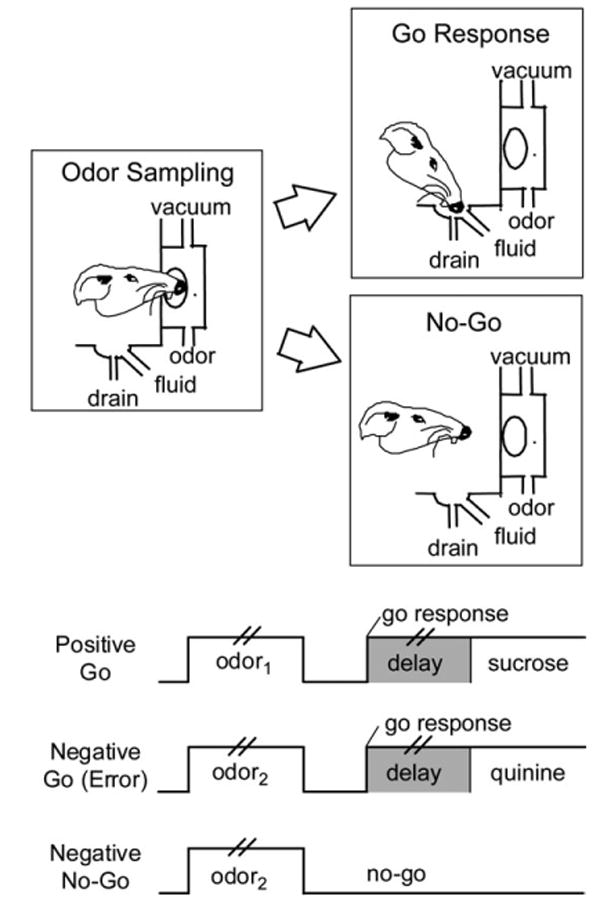
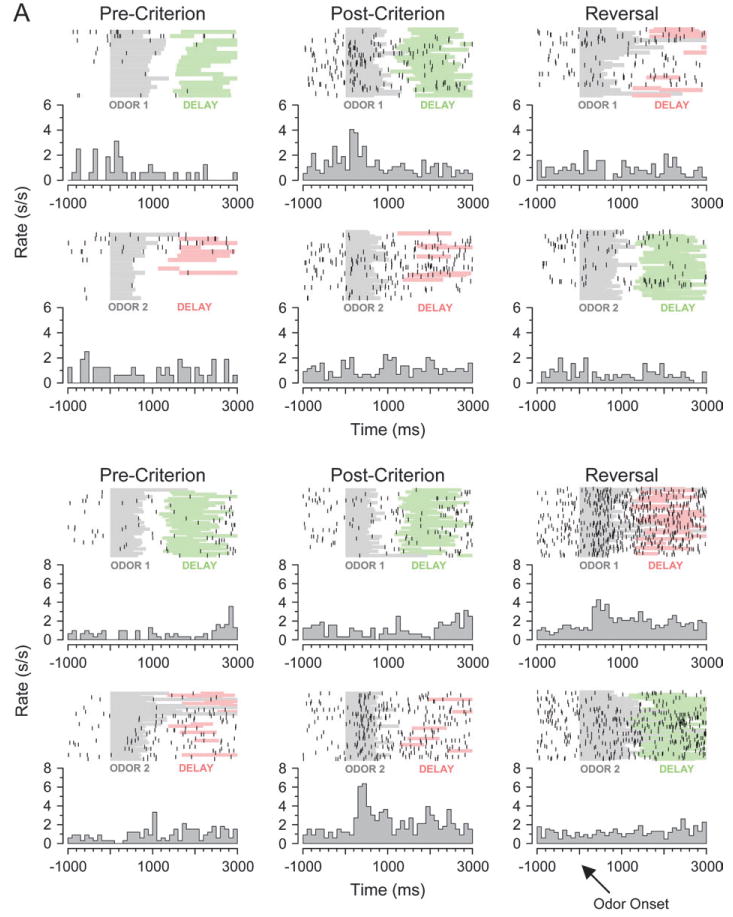
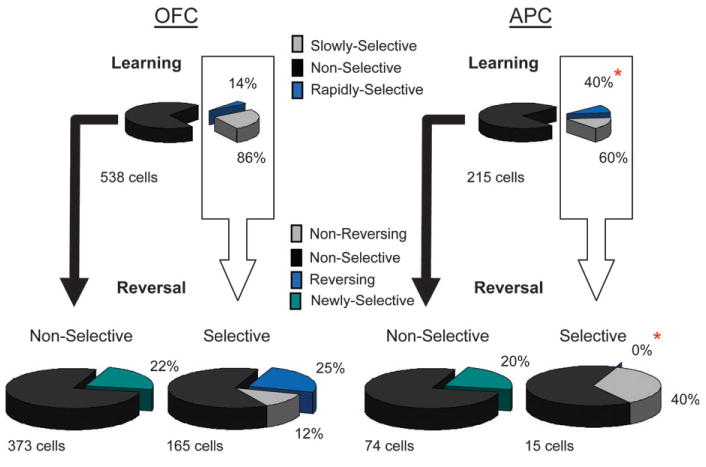
Recent proposals have conceptualized piriform cortex as an association cortex, capable of integrating incoming olfactory information with descending input from higher order associative regions such as orbitofrontal cortex (OFC). If true, encoding in piriform cortex should reflect associative features prominent in these areas during associative learning involving olfactory cues. To test this hypothesis, we recorded from neurons in OFC and anatomically related parts of the anterior piriform cortex (APC) in rats, learning and reversing novel odor discriminations. Findings in OFC were similar to what we have reported previously, with nearly all the cue-selective neurons exhibiting substantial plasticity during learning and reversal. Also, many of the cue-selective neurons were originally responsive in anticipation of the outcomes early in learning, thereby providing a single-unit representation of the cue-outcome associations. Some of these features were also evident in firing activity in APC, including some plasticity across learning and reversal. However, APC neurons failed to reverse cue selectivity when the associated outcome was changed, and the cue-selective population did not include neurons that were active prior to outcome delivery. Thus, although representations in APC are substantially more associative than expected in a purely sensory region, they do appear to be somewhat more constrained by the sensory features of the odor cues than representations in downstream areas of OFC.
最近的研究提出,将梨状皮层概念化为联合皮层,它能够将传入的嗅觉信息与来自眶额皮层(OFC)等高级联合区域的下行输入进行整合。如果这一观点正确,那么在涉及嗅觉线索的联合学习过程中,梨状皮层中的编码应该反映出这些区域中突出的联合特征。为了验证这一假设,我们在大鼠的眶额皮层和前梨状皮层(APC)的解剖学相关部位记录神经元活动,让大鼠学习并反转新的气味辨别任务。眶额皮层的研究结果与我们之前报道的相似,几乎所有线索选择性神经元在学习和反转过程中都表现出显著的可塑性。此外,许多线索选择性神经元在学习早期就对预期结果产生反应,从而提供了线索 - 结果关联的单神经元表征。其中一些特征在梨状前皮层的放电活动中也很明显,包括学习和反转过程中的一些可塑性。然而,当相关结果改变时,梨状前皮层神经元未能反转线索选择性,并且线索选择性群体中不包括在结果呈现之前活跃的神经元。因此,尽管梨状前皮层中的表征比纯感觉区域预期的更具关联性,但它们似乎比眶额皮层下游区域的表征在某种程度上更受气味线索的感觉特征的限制。