• 文献检索
  • 文档翻译
  • 深度研究
  • 学术资讯
  • Suppr Zotero 插件Zotero 插件
  • 邀请有礼
  • 套餐&价格
  • 历史记录
应用&插件
Suppr Zotero 插件Zotero 插件浏览器插件Mac 客户端Windows 客户端微信小程序
定价
高级版会员购买积分包购买API积分包
服务
文献检索文档翻译深度研究API 文档MCP 服务
关于我们
关于 Suppr公司介绍联系我们用户协议隐私条款
关注我们

Suppr 超能文献

核心技术专利:CN118964589B侵权必究
粤ICP备2023148730 号-1Suppr @ 2026

文献检索

告别复杂PubMed语法,用中文像聊天一样搜索,搜遍4000万医学文献。AI智能推荐,让科研检索更轻松。

立即免费搜索

文件翻译

保留排版,准确专业,支持PDF/Word/PPT等文件格式,支持 12+语言互译。

免费翻译文档

深度研究

AI帮你快速写综述,25分钟生成高质量综述,智能提取关键信息,辅助科研写作。

立即免费体验

手臂、肩部和手部功能障碍简化问卷(QuickDASH):基于完整版DASH问卷回答的效度和信度

The shortened disabilities of the arm, shoulder and hand questionnaire (QuickDASH): validity and reliability based on responses within the full-length DASH.

作者信息

Gummesson Christina, Ward Michael M, Atroshi Isam

机构信息

National Institute of Arthritis and Musculoskeletal and Skin Diseases, NIH, Bethesda, Maryland 20892, USA.

出版信息

BMC Musculoskelet Disord. 2006 May 18;7:44. doi: 10.1186/1471-2474-7-44.

DOI:10.1186/1471-2474-7-44
PMID:16709254
原文链接:https://pmc.ncbi.nlm.nih.gov/articles/PMC1513569/
Abstract

BACKGROUND

The 30-item disabilities of the arm, shoulder and hand (DASH) questionnaire is increasingly used in clinical research involving upper extremity musculoskeletal disorders. From the original DASH a shorter version, the 11-item QuickDASH, has been developed. Little is known about the discriminant ability of score changes for the QuickDASH compared to the DASH. The aim of this study was to assess the performance of the QuickDASH and its cross-sectional and longitudinal validity and reliability.

METHODS

The study was based on extracting QuickDASH item responses from the responses to the full-length DASH questionnaire completed by 105 patients with a variety of upper extremity disorders before surgery and at follow-up 6 to 21 months after surgery. The DASH and QuickDASH scores were compared for the whole population and for different diagnostic groups. For longitudinal construct validity the effect size and standardized response mean were calculated. Analyses with ROC curves were performed to compare the ability of the DASH and QuickDASH to discriminate among patients classified according to the magnitude of self-rated improvement. Cross-sectional and test-retest reliability was assessed.

RESULTS

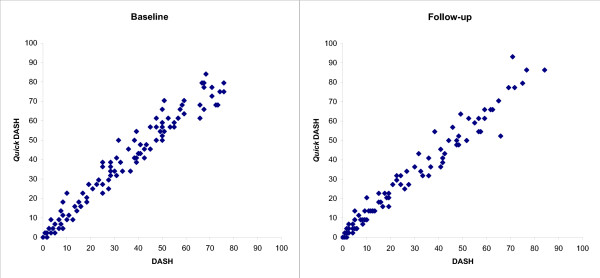
The mean DASH score was 34 (SD 22) and the mean QuickDASH score was 39 (SD 24) at baseline. For the different diagnostic groups the mean and median QuickDASH scores were higher than the corresponding DASH scores. For the whole population, the mean difference between the QuickDASH and DASH baseline scores was 4.2 (95% CI 3.2-5.3), follow-up scores was 2.6 (1.7-3.4), and change scores was 1.7 (0.6-2.8). The overall effect size and standardized response mean measured with the DASH and the QuickDASH were similar. In the ROC analysis of change scores among patients who rated their arm status as somewhat or much better and those who rated it as unchanged the difference in the area under the ROC curve for the DASH and QuickDASH was 0.01 (95% CI -0.05-0.07) indicating similar discriminant ability.Cross-sectional and test-retest reliability of the DASH and QuickDASH were similar.

CONCLUSION

The results indicate that the QuickDASH can be used instead of the DASH with similar precision in upper extremity disorders.

摘要

背景

30项上肢、肩部和手部功能障碍(DASH)问卷在涉及上肢肌肉骨骼疾病的临床研究中使用得越来越多。在原始DASH基础上开发了一个更简短的版本,即11项快速DASH(QuickDASH)。与DASH相比,关于QuickDASH评分变化的判别能力知之甚少。本研究的目的是评估QuickDASH的性能及其横断面和纵向效度与信度。

方法

本研究基于从105例患有各种上肢疾病的患者术前及术后6至21个月随访时填写的全长DASH问卷的回答中提取QuickDASH项目的回答。比较了整个人群以及不同诊断组的DASH和QuickDASH评分。对于纵向结构效度,计算了效应量和标准化反应均值。进行ROC曲线分析以比较DASH和QuickDASH区分根据自我评定改善程度分类的患者的能力。评估了横断面信度和重测信度。

结果

基线时DASH平均评分为34(标准差22),QuickDASH平均评分为39(标准差24)。对于不同诊断组,QuickDASH的平均和中位数评分高于相应的DASH评分。对于整个人群,QuickDASH与DASH基线评分的平均差异为4.2(95%CI 3.2 - 5.3),随访评分为2.6(1.7 - 3.4),变化评分为1.7(0.6 - 2.8)。用DASH和QuickDASH测量的总体效应量和标准化反应均值相似。在对将手臂状况评为有所改善或明显改善及评为无变化的患者的变化评分进行的ROC分析中,DASH和QuickDASH的ROC曲线下面积差异为0.01(95%CI -0.05 - 0.07),表明判别能力相似。DASH和QuickDASH的横断面信度和重测信度相似。

结论

结果表明,在评估上肢疾病时,QuickDASH可以替代DASH,且具有相似的精度。
https://cdn.ncbi.nlm.nih.gov/pmc/blobs/7232/1513569/e1b5cdf5e37c/1471-2474-7-44-1.jpg

相似文献

1
The shortened disabilities of the arm, shoulder and hand questionnaire (QuickDASH): validity and reliability based on responses within the full-length DASH.手臂、肩部和手部功能障碍简化问卷(QuickDASH):基于完整版DASH问卷回答的效度和信度
BMC Musculoskelet Disord. 2006 May 18;7:44. doi: 10.1186/1471-2474-7-44.
2
Validity of the QuickDASH in patients with shoulder-related disorders undergoing surgery.在接受肩部相关疾病手术的患者中,QuickDASH 的有效性。
J Orthop Sports Phys Ther. 2015 Jan;45(1):25-36. doi: 10.2519/jospt.2015.5033.
3
Validation of the Japanese Society for Surgery of the Hand Version of the Quick Disability of the Arm, Shoulder, and Hand (QuickDASH-JSSH) questionnaire.日本手部外科学会版上肢、肩部和手部快速残疾问卷(QuickDASH-JSSH)的效度验证。
J Orthop Sci. 2006 May;11(3):248-53. doi: 10.1007/s00776-006-1013-1.
4
The disabilities of the arm, shoulder and hand (DASH) outcome questionnaire: longitudinal construct validity and measuring self-rated health change after surgery.上肢、肩部和手部功能障碍(DASH)结果问卷:纵向结构效度及测量手术后自评健康状况的变化
BMC Musculoskelet Disord. 2003 Jun 16;4:11. doi: 10.1186/1471-2474-4-11.
5
Construct validity, reliability, response rate, and association with disease activity of the quick disabilities of the arm, shoulder and hand questionnaire in the assessment of rheumatoid arthritis.用于评估类风湿关节炎的手臂、肩部和手部快速残疾问卷的结构效度、信度、应答率及其与疾病活动的相关性。
Mod Rheumatol. 2015 Mar;25(2):241-5. doi: 10.3109/14397595.2014.939420. Epub 2014 Jul 28.
6
Reliability, validity and responsiveness of the French version of the questionnaire Quick Disability of the Arm, Shoulder and Hand in shoulder disorders.法语版《手臂、肩部和手部快速残疾问卷》在肩部疾病中的信度、效度及反应度
Man Ther. 2009 Apr;14(2):206-12. doi: 10.1016/j.math.2008.01.013. Epub 2008 Apr 23.
7
Minimal clinically important difference of the disabilities of the arm, shoulder and hand outcome measure (DASH) and its shortened version (QuickDASH).手臂、肩和手功能障碍(DASH)及其简化版(QuickDASH)的最小临床重要差异。
J Orthop Sports Phys Ther. 2014 Jan;44(1):30-9. doi: 10.2519/jospt.2014.4893. Epub 2013 Oct 30.
8
Measuring the whole or the parts? Validity, reliability, and responsiveness of the Disabilities of the Arm, Shoulder and Hand outcome measure in different regions of the upper extremity.测量整体还是部分?上肢不同区域的手臂、肩部和手部功能障碍结局测量指标的效度、信度和反应度
J Hand Ther. 2001 Apr-Jun;14(2):128-46.
9
Validation of the QuickDASH and DASH in Patients With Distal Radius Fractures Through Agreement Analysis.通过一致性分析验证QuickDASH和DASH在桡骨远端骨折患者中的应用
Arch Phys Med Rehabil. 2017 Jun;98(6):1217-1222.e1. doi: 10.1016/j.apmr.2016.11.023. Epub 2016 Dec 27.
10
DASH questionnaire for the analysis of musculoskeletal symptoms in industry workers: a validity and reliability study.用于分析产业工人肌肉骨骼症状的DASH问卷:一项效度和信度研究。
Appl Ergon. 2009 Mar;40(2):251-5. doi: 10.1016/j.apergo.2008.04.005. Epub 2008 Jun 16.

引用本文的文献

1
Effectiveness of Ultrasound-Guided Peritendinous Injection Treatment with Low Molecular Weight Hyaluronic Acid in Patients with Supraspinatus Tendinopathy.超声引导下低分子量透明质酸腱鞘周围注射治疗冈上肌腱病患者的疗效
J Clin Med. 2025 Sep 5;14(17):6291. doi: 10.3390/jcm14176291.
2
The Volar Central Approach for Distal Radius Fracture: A Prospective Nerve Conduction Study of 38 Patients.桡骨远端骨折的掌侧中央入路:38例患者的前瞻性神经传导研究
Hand (N Y). 2025 Sep 7:15589447251366459. doi: 10.1177/15589447251366459.
3
Long-term follow-up of sternoclavicular joint injuries with functional outcome analysis from a single-center study.

本文引用的文献

1
Development of the QuickDASH: comparison of three item-reduction approaches.快速DASH量表的开发:三种条目缩减方法的比较
J Bone Joint Surg Am. 2005 May;87(5):1038-46. doi: 10.2106/JBJS.D.02060.
2
Assessing reproducibility for interval data in health-related quality of life questionnaires: which coefficient should be used?评估健康相关生活质量问卷中区间数据的可重复性:应使用哪个系数?
Qual Life Res. 2004 Apr;13(3):571-86. doi: 10.1023/B:QURE.0000021318.92272.2a.
3
The disabilities of the arm, shoulder and hand (DASH) outcome questionnaire: longitudinal construct validity and measuring self-rated health change after surgery.
来自单中心研究的胸锁关节损伤长期随访及功能结果分析
Eur J Trauma Emerg Surg. 2025 Sep 3;51(1):288. doi: 10.1007/s00068-025-02964-x.
4
Functional and electrophysiological outcomes following surgical treatment of cubitus varus associated with tardy ulnar nerve palsy: A case series.与迟发性尺神经麻痹相关的肘内翻手术治疗后的功能和电生理结果:病例系列
Shoulder Elbow. 2025 Aug 21:17585732251369515. doi: 10.1177/17585732251369515.
5
Translation and Validation of the Swedish Patient-Rated Ulnar Nerve Evaluation in Ulnar Nerve Entrapment.瑞典患者自评尺神经评估量表在尺神经卡压症中的翻译与验证
Plast Reconstr Surg Glob Open. 2025 Aug 18;13(8):e7044. doi: 10.1097/GOX.0000000000007044. eCollection 2025 Aug.
6
Double trouble! Concomitant distal ulna fractures predict worse 1-year outcome in distal radius fractures: a registry-based cohort study of 5,536 patients.双重麻烦!尺骨远端骨折并发会预示桡骨远端骨折1年预后更差:一项基于登记的5536例患者队列研究。
Acta Orthop. 2025 Aug 15;96:606-611. doi: 10.2340/17453674.2025.44352.
7
Turkish Validity and Reliability of Short Form McGill Pain Questionnaire-2 in Patients with Chronic Cervical Radicular Pain Due to Disc Herniation.简化版麦吉尔疼痛问卷 -2 在椎间盘突出所致慢性颈神经根性疼痛患者中的土耳其语效度与信度
Arch Rheumatol. 2025 May 30;40(2):249-255. doi: 10.5152/ArchRheumatol.2025.11133.
8
Volar Plate Repair for Chronic Injury.掌板修复治疗慢性损伤
J Hand Surg Glob Online. 2025 Jul 23;7(5):100776. doi: 10.1016/j.jhsg.2025.100776. eCollection 2025 Sep.
9
Clinical and surgical outcome following chest wall reconstruction using a novel rigid prosthesis-a single-center experience.使用新型硬质假体进行胸壁重建后的临床及手术结果——单中心经验
J Thorac Dis. 2025 Jun 30;17(6):3981-3990. doi: 10.21037/jtd-2024-1983. Epub 2025 Jun 23.
10
Projected AR Serious Game "Painting Discovery" for Shoulder Rehabilitation: Assessment With Technicians, Physiotherapists, and Patients.用于肩部康复的预估增强现实严肃游戏“绘画探索”:由技术人员、物理治疗师和患者进行评估
IEEE J Transl Eng Health Med. 2025 Apr 2;13:149-157. doi: 10.1109/JTEHM.2025.3557250. eCollection 2025.
上肢、肩部和手部功能障碍(DASH)结果问卷:纵向结构效度及测量手术后自评健康状况的变化
BMC Musculoskelet Disord. 2003 Jun 16;4:11. doi: 10.1186/1471-2474-4-11.
4
On assessing responsiveness of health-related quality of life instruments: guidelines for instrument evaluation.关于评估健康相关生活质量工具的反应性:工具评估指南
Qual Life Res. 2003 Jun;12(4):349-62. doi: 10.1023/a:1023499322593.
5
Hi! How are you? Response shift, implicit theories and differing epistemologies.嗨!你好吗?反应转移、隐性理论与不同的认识论。
Qual Life Res. 2003 May;12(3):239-49. doi: 10.1023/a:1023211129926.
6
Performance of health-status scales when used selectively or within multi-scale questionnaire.健康状况量表在选择性使用或在多量表问卷中使用时的表现。
BMC Med Res Methodol. 2003 Feb 13;3:3. doi: 10.1186/1471-2288-3-3.
7
Measuring the whole or the parts? Validity, reliability, and responsiveness of the Disabilities of the Arm, Shoulder and Hand outcome measure in different regions of the upper extremity.测量整体还是部分?上肢不同区域的手臂、肩部和手部功能障碍结局测量指标的效度、信度和反应度
J Hand Ther. 2001 Apr-Jun;14(2):128-46.
8
The disabilities of the arm, shoulder and hand (DASH) outcome questionnaire: reliability and validity of the Swedish version evaluated in 176 patients.手臂、肩部和手部功能障碍(DASH)结果问卷:在176例患者中评估瑞典语版本的信度和效度。
Acta Orthop Scand. 2000 Dec;71(6):613-8. doi: 10.1080/000164700317362262.
9
Longitudinal construct validity: establishment of clinical meaning in patient evaluative instruments.纵向结构效度:在患者评估工具中确立临床意义。
Med Care. 2000 Sep;38(9 Suppl):II84-90.
10
Measuring disability of the upper extremity: a rationale supporting the use of a regional outcome measure.测量上肢功能障碍:支持使用区域结局指标的基本原理。
J Hand Ther. 1999 Oct-Dec;12(4):269-74. doi: 10.1016/s0894-1130(99)80063-5.