Knies Jennifer L, Izem Rima, Supler Katie L, Kingsolver Joel G, Burch Christina L
Department of Biology, University of North Carolina, Chapel Hill, North Carolina, USA.
PLoS Biol. 2006 Jul;4(7):e201. doi: 10.1371/journal.pbio.0040201.
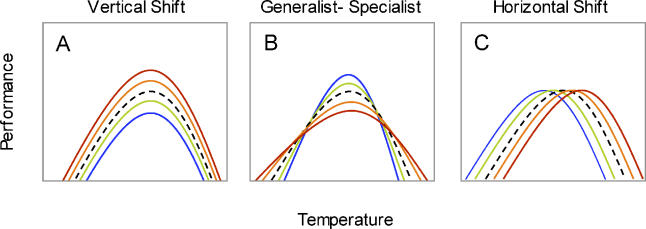
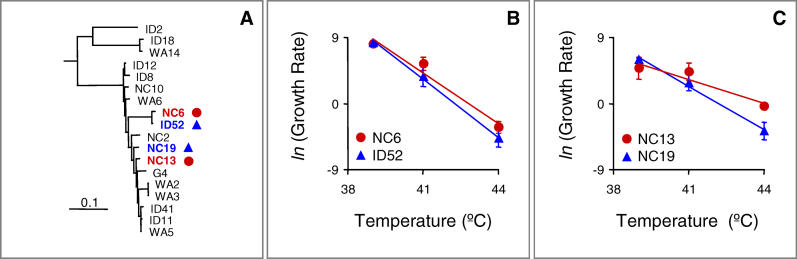
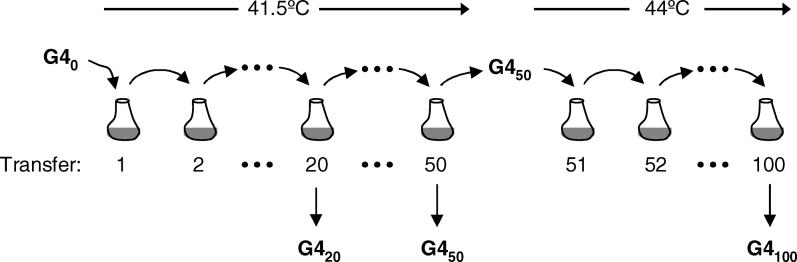
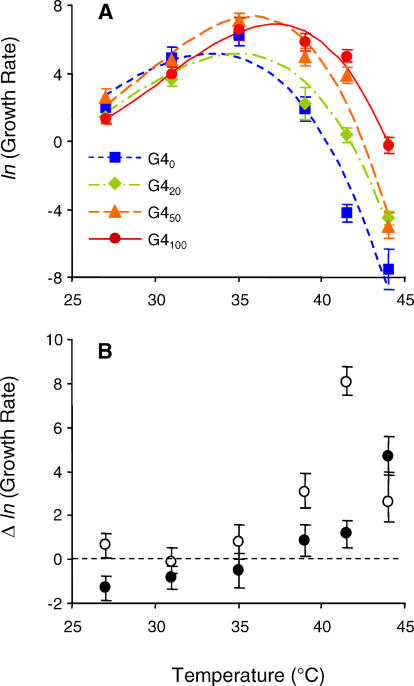
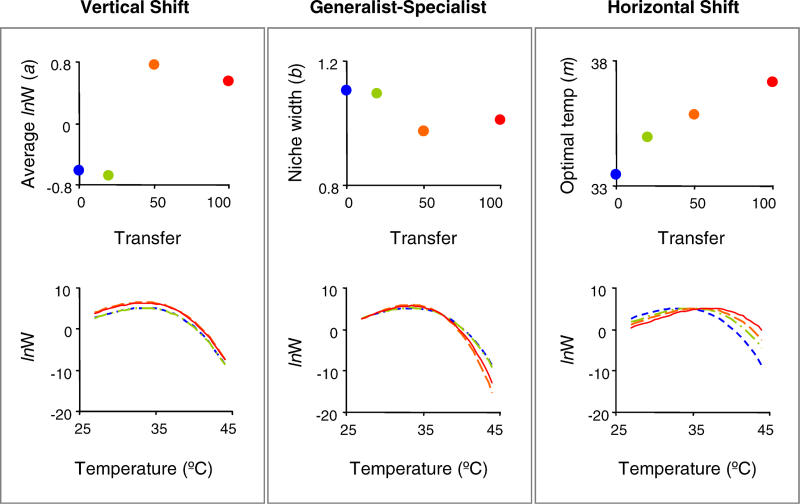
Two major goals of laboratory evolution experiments are to integrate from genotype to phenotype to fitness, and to understand the genetic basis of adaptation in natural populations. Here we demonstrate that both goals are possible by re-examining the outcome of a previous laboratory evolution experiment in which the bacteriophage G4 was adapted to high temperatures. We quantified the evolutionary changes in the thermal reaction norms--the curves that describe the effect of temperature on the growth rate of the phages--and decomposed the changes into modes of biological interest. Our analysis indicated that changes in optimal temperature accounted for almost half of the evolutionary changes in thermal reaction norm shape, and made the largest contribution toward adaptation at high temperatures. Genome sequencing allowed us to associate reaction norm shape changes with particular nucleotide mutations, and several of the identified mutations were found to be polymorphic in natural populations. Growth rate measures of natural phage that differed at a site that contributed substantially to adaptation in the lab indicated that this mutation also underlies thermal reaction norm shape variation in nature. In combination, our results suggest that laboratory evolution experiments may successfully predict the genetic bases of evolutionary responses to temperature in nature. The implications of this work for viral evolution arise from the fact that shifts in the thermal optimum are characterized by tradeoffs in performance between high and low temperatures. Optimum shifts, if characteristic of viral adaptation to novel temperatures, would ensure the success of vaccine development strategies that adapt viruses to low temperatures in an attempt to reduce virulence at higher (body) temperatures.
实验室进化实验的两个主要目标是从基因型到表型再到适应性进行整合,以及了解自然种群中适应的遗传基础。在这里,我们通过重新审视之前一个噬菌体G4适应高温的实验室进化实验结果,证明这两个目标都是可以实现的。我们对热反应规范中的进化变化进行了量化——热反应规范是描述温度对噬菌体生长速率影响的曲线——并将这些变化分解为具有生物学意义的模式。我们的分析表明,最适温度的变化几乎占热反应规范形状进化变化的一半,并且对高温下的适应性贡献最大。基因组测序使我们能够将反应规范形状的变化与特定的核苷酸突变联系起来,并且发现一些已识别的突变在自然种群中是多态的。对在实验室中对适应性有显著贡献的位点存在差异的天然噬菌体的生长速率测量表明,这种突变也是自然界中热反应规范形状变化的基础。综合来看,我们的结果表明实验室进化实验可能成功预测自然界中对温度的进化反应的遗传基础。这项工作对病毒进化的意义源于这样一个事实,即热最适值的变化以高低温性能之间的权衡为特征。如果最适值的变化是病毒适应新温度的特征,那么这将确保疫苗开发策略的成功,这些策略使病毒适应低温,以试图在较高(身体)温度下降低毒力。