Binns Derk, Januszewski Tom, Chen Yue, Hill Justin, Markin Vladislav S, Zhao Yingming, Gilpin Christopher, Chapman Kent D, Anderson Richard G W, Goodman Joel M
Department of Pharmacology, University of Texas Southwestern Medical School, Dallas, TX 75390, USA.
J Cell Biol. 2006 Jun 5;173(5):719-31. doi: 10.1083/jcb.200511125. Epub 2006 May 30.
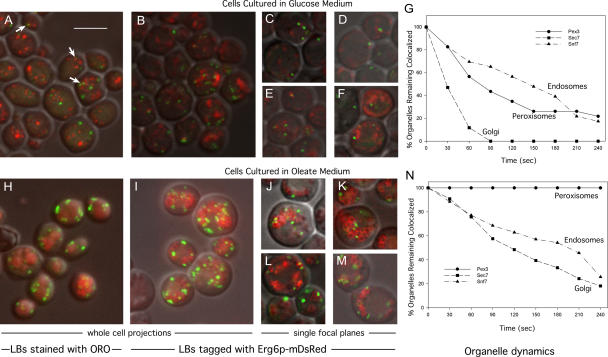
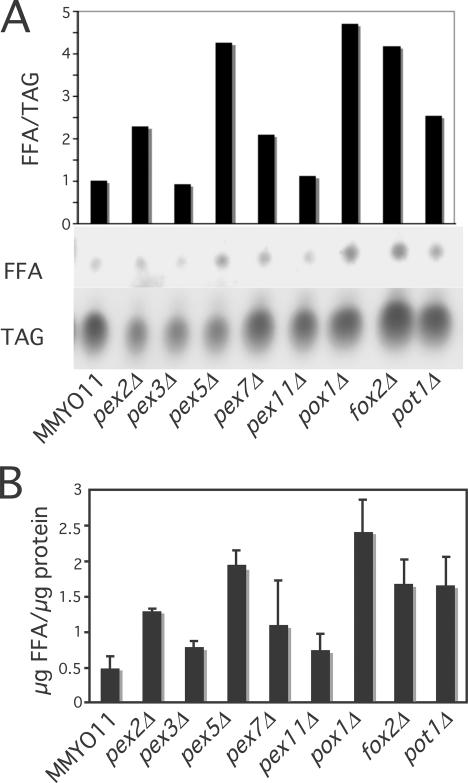
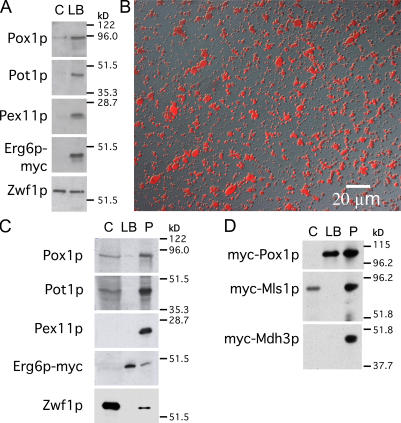
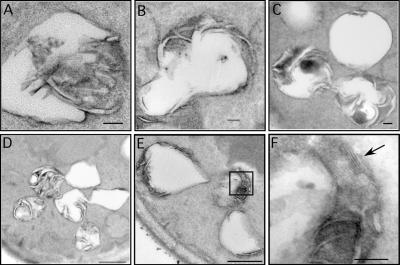
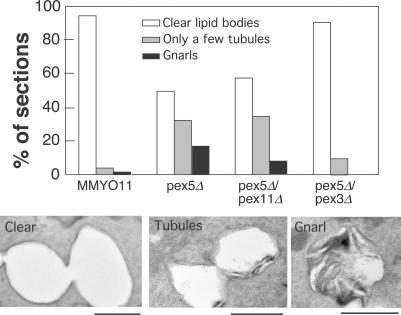
Although peroxisomes oxidize lipids, the metabolism of lipid bodies and peroxisomes is thought to be largely uncoupled from one another. In this study, using oleic acid-cultured Saccharomyces cerevisiae as a model system, we provide evidence that lipid bodies and peroxisomes have a close physiological relationship. Peroxisomes adhere stably to lipid bodies, and they can even extend processes into lipid body cores. Biochemical experiments and proteomic analysis of the purified lipid bodies suggest that these processes are limited to enzymes of fatty acid beta oxidation. Peroxisomes that are unable to oxidize fatty acids promote novel structures within lipid bodies ("gnarls"), which may be organized arrays of accumulated free fatty acids. However, gnarls are suppressed, and fatty acids are not accumulated in the absence of peroxisomal membranes. Our results suggest that the extensive physical contact between peroxisomes and lipid bodies promotes the coupling of lipolysis within lipid bodies with peroxisomal fatty acid oxidation.
尽管过氧化物酶体可氧化脂质,但脂质体和过氧化物酶体的代谢在很大程度上被认为是相互解偶联的。在本研究中,我们以油酸培养的酿酒酵母作为模型系统,提供证据表明脂质体和过氧化物酶体存在密切的生理关系。过氧化物酶体稳定地附着于脂质体,甚至可将突起延伸至脂质体核心。对纯化脂质体的生化实验和蛋白质组学分析表明,这些过程仅限于脂肪酸β氧化酶。无法氧化脂肪酸的过氧化物酶体促进脂质体内形成新结构(“节”),其可能是积累的游离脂肪酸的有序排列。然而,在没有过氧化物酶体膜的情况下,“节”受到抑制,脂肪酸也不会积累。我们的结果表明,过氧化物酶体与脂质体之间广泛的物理接触促进了脂质体内的脂解作用与过氧化物酶体脂肪酸氧化的偶联。