Baker Elizabeth A, Schootman Mario, Barnidge Ellen, Kelly Cheryl
Saint Louis University School of Public Health, Salus Center, 3545 Lafayette Ave, St Louis, MO 63104, USA.
Prev Chronic Dis. 2006 Jul;3(3):A76. Epub 2006 Jun 15.
The increase in obesity and disparities in obesity and related chronic diseases across racial and ethnic and income groups have led researchers to focus on the social and environmental factors that influence dietary intake. The question guiding the current study was whether all communities have equal access to foods that enable individuals to make healthy dietary choices.
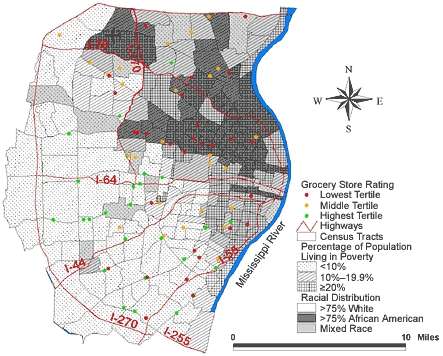
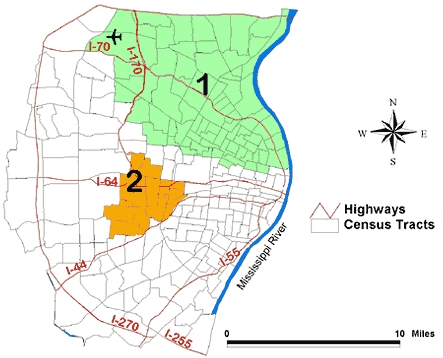
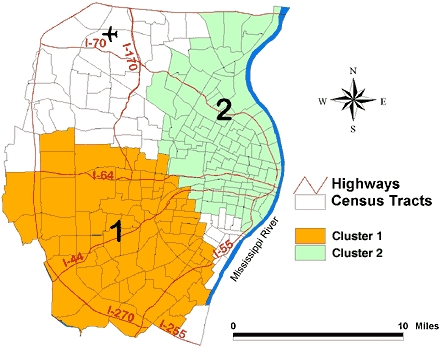
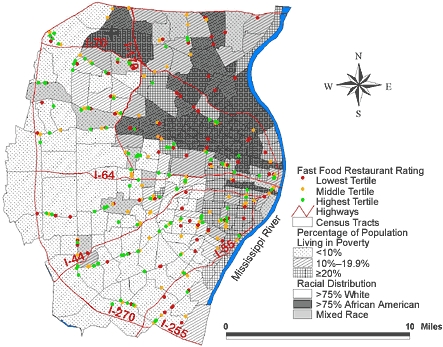
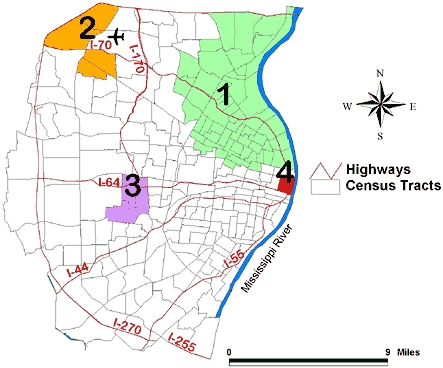
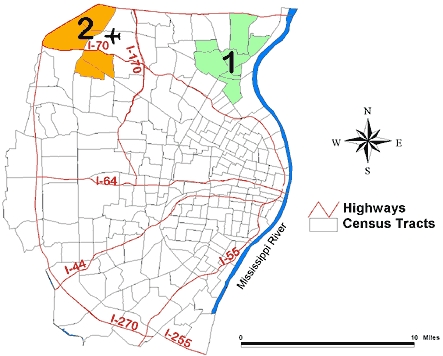
We conducted audits of community supermarkets and fast food restaurants to assess location and availability of food choices that enable individuals to meet the dietary guidelines established by the U.S. Department of Agriculture (e.g., fruit and vegetable consumption, low-fat options). We used 2000 census data to assess the racial distribution and the percentage of individuals living below the federal poverty level in a defined area of St Louis, Mo. Spatial clustering of supermarkets and fast food restaurants was determined using a spatial scan statistic.
The spatial distribution of fast food restaurants and supermarkets that provide options for meeting recommended dietary intake differed according to racial distribution and poverty rates. Mixed-race or white high-poverty areas and all African American areas (regardless of income) were less likely than predominantly white higher-income communities to have access to foods that enable individuals to make healthy choices.
Without access to healthy food choices, individuals cannot make positive changes to their diets. If certain eating behaviors are required to reduce chronic disease and promote health, then some communities will continue to have disparities in critical health outcomes unless we increase access to healthy food.
肥胖现象的增加以及不同种族、族裔和收入群体在肥胖及相关慢性病方面存在的差异,促使研究人员将重点放在影响饮食摄入的社会和环境因素上。本研究的指导问题是,是否所有社区都能平等地获取能让个人做出健康饮食选择的食物。
我们对社区超市和快餐店进行了调查,以评估能让个人满足美国农业部制定的饮食指南(如水果和蔬菜消费、低脂选择)的食物的位置和可获得性。我们使用2000年的人口普查数据来评估密苏里州圣路易斯市特定区域内的种族分布以及生活在联邦贫困线以下的个人比例。超市和快餐店的空间聚类是使用空间扫描统计量来确定的。
提供符合推荐饮食摄入量选择的快餐店和超市的空间分布因种族分布和贫困率而异。与以白人为主的高收入社区相比,混血或白人高贫困地区以及所有非裔美国人地区(无论收入如何)获得能让个人做出健康选择的食物的可能性较小。
如果无法获得健康的食物选择,个人就无法对其饮食做出积极改变。如果需要某些饮食行为来减少慢性病并促进健康,那么除非我们增加健康食物的可及性,否则一些社区在关键健康结果方面将继续存在差异。