Adriani Walter, Laviola Giovanni
Behavioural Neuroscience Section, Dept, Cell Biology & Neurosciences, Istituto Superiore di Sanità, Roma, Italy.
BMC Neurosci. 2006 Jun 23;7:52. doi: 10.1186/1471-2202-7-52.
Impulsivity is defined as intolerance/aversion to waiting for reward. In intolerance-to-delay (ID) protocols, animals must choose between small/soon (SS) versus large/late (LL) rewards. In the probabilistic discount (PD) protocols, animals are faced with choice between small/sure (SS) versus large/luck-linked (LLL) rewards. It has been suggested that PD protocols also measure impulsivity, however, a clear dissociation has been reported between delay and probability discounting.
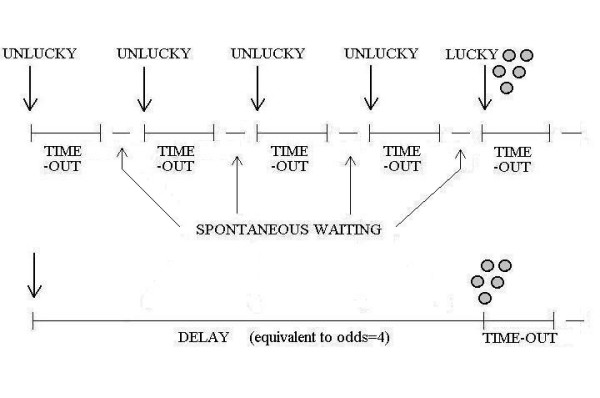
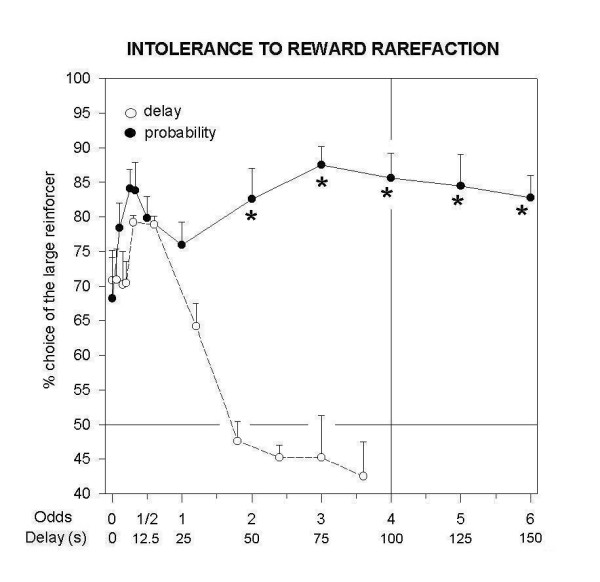
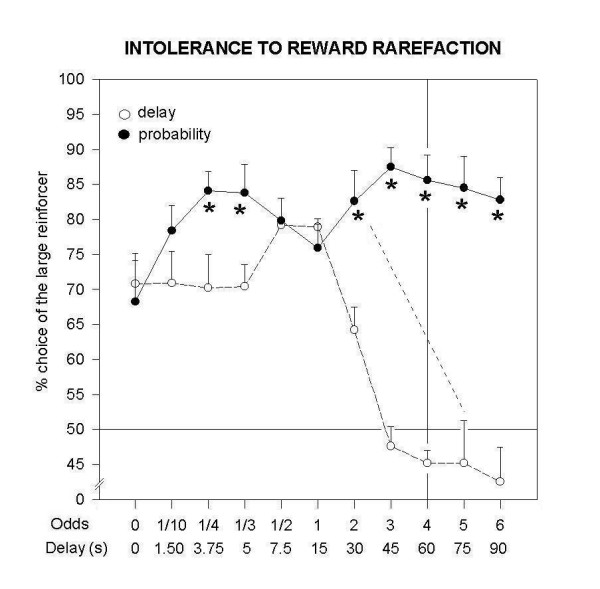
Wistar adolescent rats (30- to 46-day-old) were tested using either protocol in drug-free state. In the ID protocol, animals showed a marked shift from LL to SS reward when delay increased, and this despite adverse consequences on the total amount of food obtained. In the PD protocol, animals developed a stable preference for LLL reward, and maintained it even when SS and LLL options were predicted and demonstrated to become indifferent. We demonstrate a clear dissociation between these two protocols. In the ID task, the aversion to delay was anti-economical and reflected impulsivity. In the PD task, preference for large reward was maintained despite its uncertain delivery, suggesting a strong attraction for unitary rewards of great magnitude.
Uncertain delivery generated no aversion, when compared to delays producing an equivalent level of large-reward rarefaction. The PD task is suggested not to reflect impulsive behavior, and to generate patterns of choice that rather resemble the features of gambling. In summary, present data do indicate the need to interpret choice behavior in ID and PD protocols differently.
冲动被定义为对等待奖励的不耐受/厌恶。在不耐延迟(ID)实验中,动物必须在小/快(SS)与大/迟(LL)奖励之间做出选择。在概率折扣(PD)实验中,动物面临小/确定(SS)与大/运气关联(LLL)奖励之间的选择。有人认为PD实验也能测量冲动性,然而,已有报道称延迟折扣和概率折扣之间存在明显差异。
在无药物状态下,使用这两种实验对Wistar青春期大鼠(30至46日龄)进行测试。在ID实验中,当延迟增加时,动物表现出从LL奖励显著转向SS奖励,尽管这对获得的食物总量有不利影响。在PD实验中,动物对LLL奖励形成了稳定的偏好,即使预测并证明SS和LLL选项变得无差异时仍保持这种偏好。我们证明了这两种实验之间存在明显差异。在ID任务中,对延迟的厌恶是反经济的,反映了冲动性。在PD任务中,尽管大奖励的发放不确定,但对其偏好仍得以维持,这表明对大幅单一奖励有强烈的吸引力。
与产生同等程度大奖励稀缺的延迟相比,不确定的发放不会产生厌恶。建议PD任务不反映冲动行为,而是产生类似于赌博特征的选择模式。总之,目前的数据确实表明需要对ID和PD实验中的选择行为进行不同的解释。