
男性包皮环切术对撒哈拉以南非洲地区艾滋病毒的潜在影响。
The potential impact of male circumcision on HIV in Sub-Saharan Africa.
作者信息
Williams Brian G, Lloyd-Smith James O, Gouws Eleanor, Hankins Catherine, Getz Wayne M, Hargrove John, de Zoysa Isabelle, Dye Christopher, Auvert Bertran
机构信息
World Health Organization, Stop TB Department, Geneva, Switzerland.
出版信息
PLoS Med. 2006 Jul;3(7):e262. doi: 10.1371/journal.pmed.0030262.
BACKGROUND
A randomized controlled trial (RCT) has shown that male circumcision (MC) reduces sexual transmission of HIV from women to men by 60% (32%-76%; 95% CI) offering an intervention of proven efficacy for reducing the sexual spread of HIV. We explore the implications of this finding for the promotion of MC as a public health intervention to control HIV in sub-Saharan Africa.
METHODS AND FINDINGS
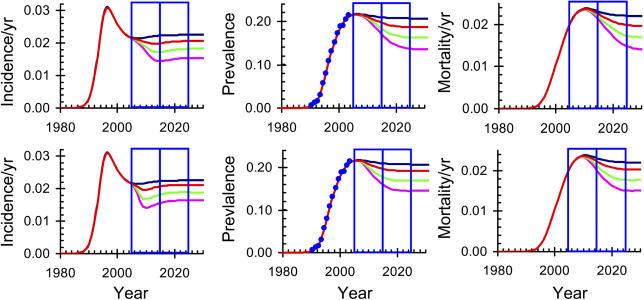
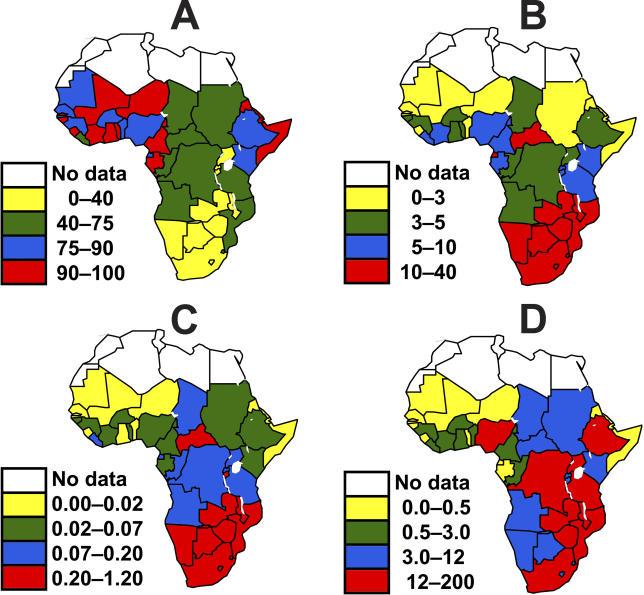
Using dynamical simulation models we consider the impact of MC on the relative prevalence of HIV in men and women and in circumcised and uncircumcised men. Using country level data on HIV prevalence and MC, we estimate the impact of increasing MC coverage on HIV incidence, HIV prevalence, and HIV-related deaths over the next ten, twenty, and thirty years in sub-Saharan Africa. Assuming that full coverage of MC is achieved over the next ten years, we consider three scenarios in which the reduction in transmission is given by the best estimate and the upper and lower 95% confidence limits of the reduction in transmission observed in the RCT. MC could avert 2.0 (1.1-3.8) million new HIV infections and 0.3 (0.1-0.5) million deaths over the next ten years in sub-Saharan Africa. In the ten years after that, it could avert a further 3.7 (1.9-7.5) million new HIV infections and 2.7 (1.5-5.3) million deaths, with about one quarter of all the incident cases prevented and the deaths averted occurring in South Africa. We show that a) MC will increase the proportion of infected people who are women from about 52% to 58%; b) where there is homogenous mixing but not all men are circumcised, the prevalence of infection in circumcised men is likely to be about 80% of that in uncircumcised men; c) MC is equivalent to an intervention, such as a vaccine or increased condom use, that reduces transmission in both directions by 37%.
CONCLUSIONS
This analysis is based on the result of just one RCT, but if the results of that trial are confirmed we suggest that MC could substantially reduce the burden of HIV in Africa, especially in southern Africa where the prevalence of MC is low and the prevalence of HIV is high. While the protective benefit to HIV-negative men will be immediate, the full impact of MC on HIV-related illness and death will only be apparent in ten to twenty years.
背景
一项随机对照试验(RCT)表明,男性包皮环切术(MC)可将HIV从女性向男性的性传播降低60%(32%-76%;95%置信区间),为减少HIV性传播提供了一种已证实有效的干预措施。我们探讨了这一发现对于在撒哈拉以南非洲推广MC作为控制HIV的公共卫生干预措施的意义。
方法与结果
我们使用动态模拟模型来考虑MC对男性和女性以及包皮环切和未包皮环切男性中HIV相对流行率的影响。利用各国关于HIV流行率和MC的数据,我们估计了未来十年、二十年和三十年内增加MC覆盖率对撒哈拉以南非洲地区HIV发病率、HIV流行率和与HIV相关死亡的影响。假设在未来十年内实现MC的全面覆盖,我们考虑三种情景,其中传播减少量分别由最佳估计值以及RCT中观察到的传播减少量的95%置信区间的上限和下限给出。在撒哈拉以南非洲地区,MC在未来十年内可避免200(110-380)万新发HIV感染和30(10-50)万例死亡。在之后的十年中,它还可进一步避免370(190-750)万新发HIV感染和270(150-530)万例死亡,所有预防的新发病例和死亡病例中约四分之一发生在南非。我们表明:a)MC将使感染人群中女性的比例从约52%增加到58%;b)在人群均匀混合但并非所有男性都接受包皮环切的情况下,包皮环切男性中的感染流行率可能约为未包皮环切男性的80%;c)MC等同于一种干预措施,如疫苗或增加安全套使用,可在两个方向上降低传播37%。
结论
本分析仅基于一项RCT的结果,但如果该试验结果得到证实,我们认为MC可大幅减轻非洲的HIV负担,特别是在撒哈拉以南非洲地区,那里MC的普及率低而HIV的流行率高。虽然对HIV阴性男性的保护益处将立即显现,但MC对HIV相关疾病和死亡的全面影响在10至20年内才会明显。

 Zotero 插件