Linsalata Michele, Giannini Romina, Notarnicola Maria, Cavallini Aldo
Laboratory of Biochemistry, National Institute for Digestive Diseases, I.R.C.C.S. Saverio de Bellis via Della Resistenza, 70013-Castellana Grotte (BA), Italy.
BMC Cancer. 2006 Jul 19;6:191. doi: 10.1186/1471-2407-6-191.
The peroxisome proliferator-activated receptor gamma (PPARgamma) is a transcription factor that regulates adipogenic differentiation and glucose homeostasis. Spermidine/spermine N1-acetyltransferase (SSAT) and ornithine decarboxylase (ODC) are key enzymes involved in the metabolism of polyamines, compounds that play an important role in cell proliferation. While the PPARgamma role in tumour growth has not been clearly defined, the involvement of the altered polyamine metabolism in colorectal carcinogenesis has been established. In this direction, we have evaluated the PPARgamma expression and its relationship with polyamine metabolism in tissue samples from 40 patients operated because of colorectal carcinoma. Since it is known that the functional role of K-ras mutation in colorectal tumorigenesis is associated with cell growth and differentiation, polyamine metabolism and the PPARgamma expression were also investigated in terms of K-ras mutation.
PPARgamma, ODC and SSAT mRNA levels were evaluated by reverse transcriptase and real-time PCR. Polyamines were quantified by high performance liquid chromatography (HPLC). ODC and SSAT activity were measured by a radiometric technique.
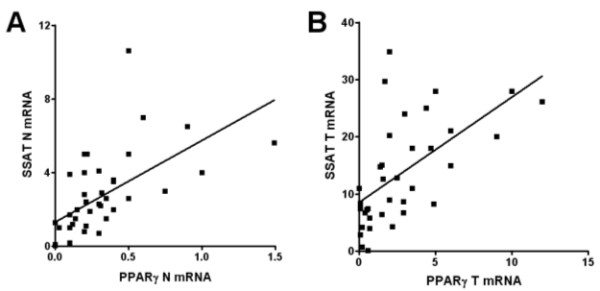
PPARgamma expression, as well as SSAT and ODC mRNA levels were significantly higher in cancer as compared to normal mucosa. Tumour samples also showed significantly higher polyamine levels and ODC and SSAT activities in comparison to normal samples. A significant and positive correlation between PPARgamma and the SSAT gene expression was observed in both normal and neoplastic tissue (r = 0.73, p < 0.0001; r = 0.65, p < 0.0001, respectively). Moreover, gene expression, polyamine levels and enzymatic activities were increased in colorectal carcinoma samples expressing K-ras mutation as compared to non mutated K-ras samples.
In conclusion, our data demonstrated a close relationship between PPARgamma and SSAT in human colorectal cancer and this could represent an attempt to decrease polyamine levels and to reduce cell growth and tumour development. Therefore, pharmacological activation of PPARgamma and/or induction of SSAT may represent a therapeutic or preventive strategy for treating colorectal cancer.
过氧化物酶体增殖物激活受体γ(PPARγ)是一种调节脂肪生成分化和葡萄糖稳态的转录因子。亚精胺/精胺N1 - 乙酰转移酶(SSAT)和鸟氨酸脱羧酶(ODC)是参与多胺代谢的关键酶,多胺在细胞增殖中起重要作用。虽然PPARγ在肿瘤生长中的作用尚未明确界定,但已证实多胺代谢改变与结直肠癌发生有关。在此方面,我们评估了40例因结直肠癌接受手术的患者组织样本中PPARγ的表达及其与多胺代谢的关系。由于已知K - ras突变在结直肠癌发生中的功能作用与细胞生长和分化相关,因此还从K - ras突变方面研究了多胺代谢和PPARγ表达。
通过逆转录和实时PCR评估PPARγ、ODC和SSAT mRNA水平。通过高效液相色谱(HPLC)对多胺进行定量。通过放射测量技术测量ODC和SSAT活性。
与正常黏膜相比,癌症组织中PPARγ表达以及SSAT和ODC mRNA水平显著更高。肿瘤样本与正常样本相比,多胺水平以及ODC和SSAT活性也显著更高。在正常组织和肿瘤组织中均观察到PPARγ与SSAT基因表达之间存在显著正相关(分别为r = 0.73,p < 0.0001;r = 0.65,p < 0.0001)。此外,与未发生K - ras突变的样本相比,表达K - ras突变的结直肠癌样本中的基因表达、多胺水平和酶活性增加。
总之,我们的数据表明在人类结直肠癌中PPARγ与SSAT之间存在密切关系,这可能是降低多胺水平以及减少细胞生长和肿瘤发展的一种尝试。因此,PPARγ的药理激活和/或SSAT的诱导可能代表一种治疗或预防结直肠癌的策略。