De Martino Benedetto, Kumaran Dharshan, Seymour Ben, Dolan Raymond J
Wellcome Department of Imaging Neuroscience, Institute of Neurology, University College London, 12 Queen Square, London WC1 3AR, UK.
Science. 2006 Aug 4;313(5787):684-7. doi: 10.1126/science.1128356.
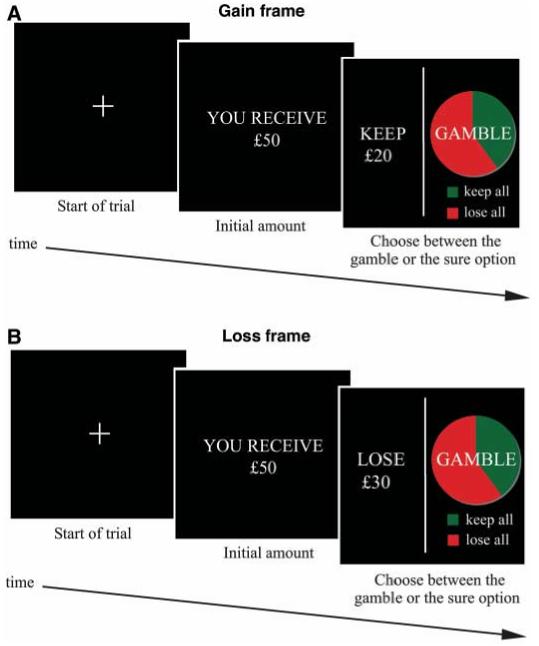
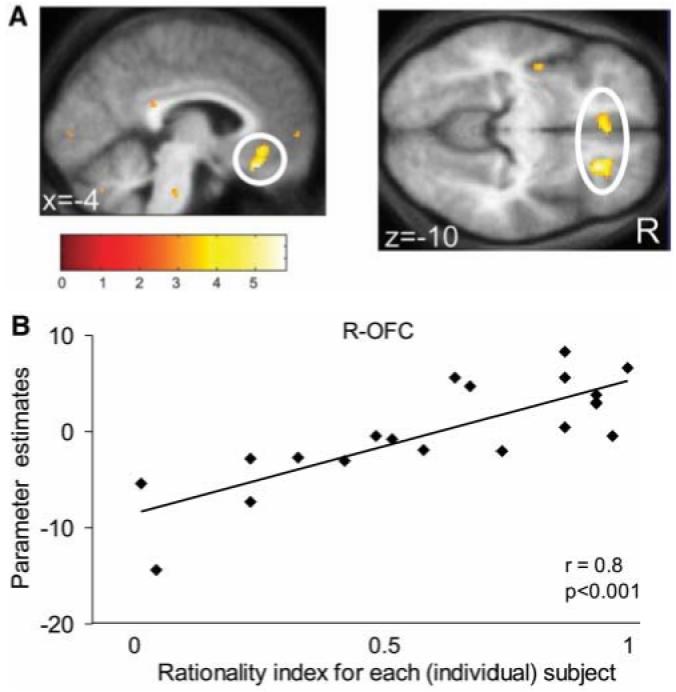
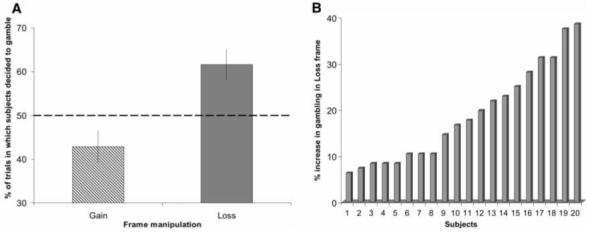
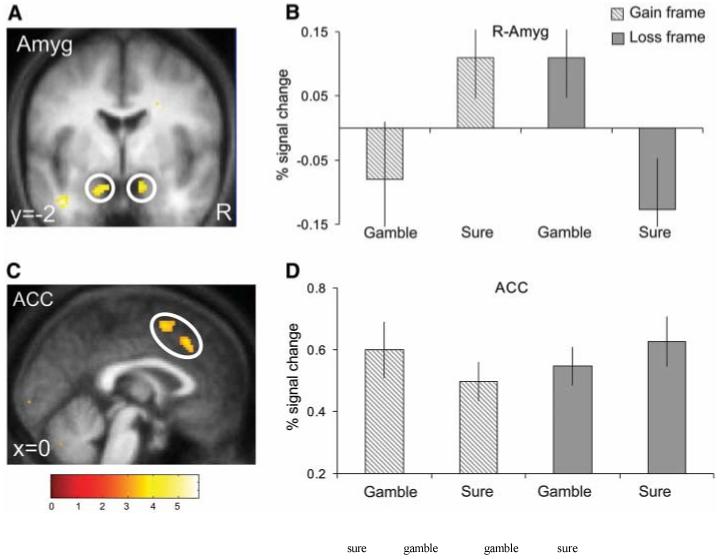
Human choices are remarkably susceptible to the manner in which options are presented. This so-called "framing effect" represents a striking violation of standard economic accounts of human rationality, although its underlying neurobiology is not understood. We found that the framing effect was specifically associated with amygdala activity, suggesting a key role for an emotional system in mediating decision biases. Moreover, across individuals, orbital and medial prefrontal cortex activity predicted a reduced susceptibility to the framing effect. This finding highlights the importance of incorporating emotional processes within models of human choice and suggests how the brain may modulate the effect of these biasing influences to approximate rationality.
人类的选择极易受到选项呈现方式的影响。这种所谓的“框架效应”明显违背了关于人类理性的标准经济理论,尽管其潜在的神经生物学机制尚不清楚。我们发现,框架效应与杏仁核活动存在特定关联,这表明情感系统在介导决策偏差方面发挥着关键作用。此外,在个体层面,眶额和内侧前额叶皮质的活动预示着对框架效应的易感性降低。这一发现凸显了在人类选择模型中纳入情感过程的重要性,并揭示了大脑可能如何调节这些偏差影响以趋近理性。