Rosvall Maria, Chaix Basile, Lynch John, Lindström Martin, Merlo Juan
Department of Health Sciences, Lund University, Malmö University Hospital, Malmö, Sweden.
BMC Public Health. 2006 Aug 4;6:203. doi: 10.1186/1471-2458-6-203.
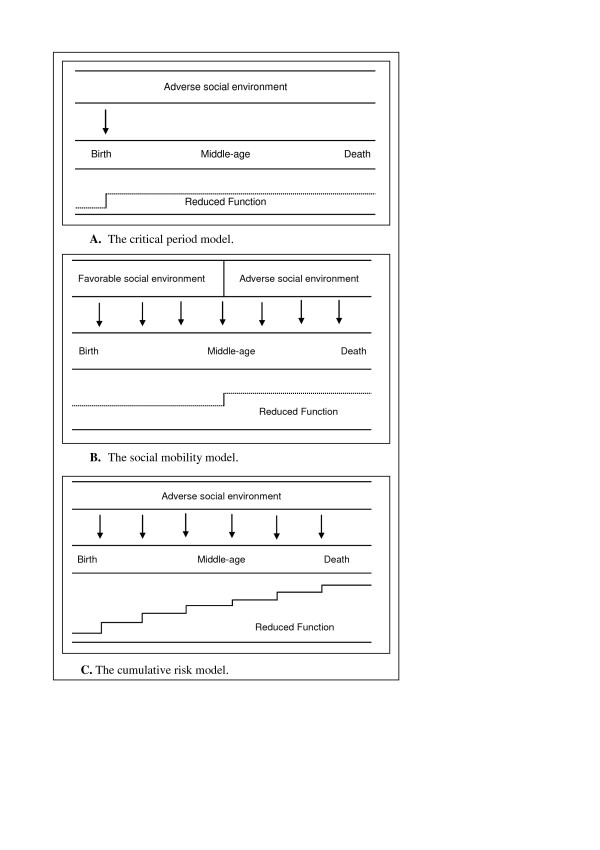
There are at least three broad conceptual models for the impact of the social environment on adult disease: the critical period, social mobility, and cumulative life course models. Several studies have shown an association between each of these models and mortality. However, few studies have investigated the importance of the different models within the same setting and none has been performed in samples of the whole population. The purpose of the present study was to study the relation between socioeconomic position (SEP) and mortality using different conceptual models in the whole population of Scania.
In the present investigation we use socioeconomic information on all men (N = 48,909) and women (N = 47,688) born between 1945 and 1950, alive on January, 1st,1990, and living in the Region of Scania, in Sweden. Focusing on three specific life periods (i.e., ages 10-15, 30-35 and 40-45), we examined the association between SEP and the 12-year risk of premature cardiovascular mortality and all-cause mortality.
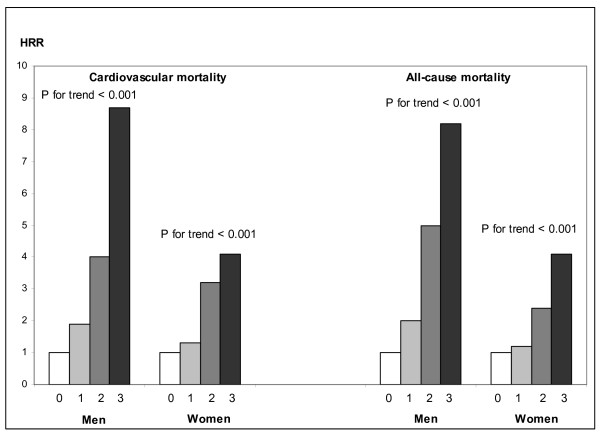
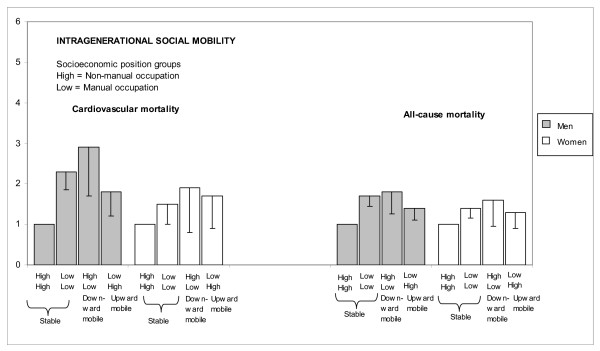
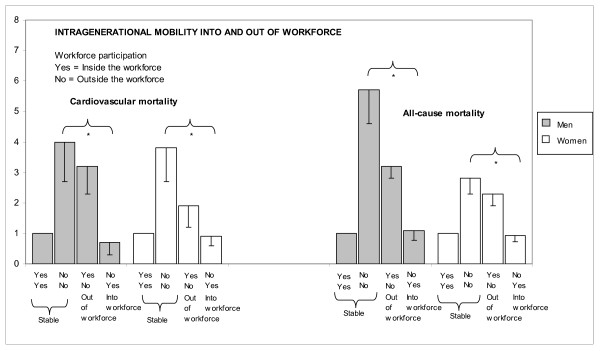
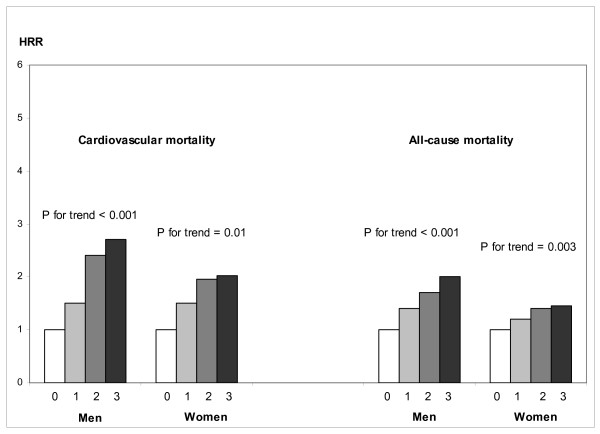
There was a strong relation between SEP and mortality among those inside the workforce, irrespective of the conceptual model used. There was a clear upward trend in the mortality hazard rate ratios (HRR) with accumulated exposure to manual SEP in both men (p for trend < 0.001 for both cardiovascular and all-cause mortality) and women (p for trend = 0.01 for cardiovascular mortality) and (p for trend = 0.003 for all-cause mortality). Inter- and intragenerational downward social mobility was associated with an increased mortality risk. When applying similar conceptual models based on workforce participation, it was shown that mortality was affected by the accumulated exposure to being outside the workforce.
There was a strong relation between SEP and cardiovascular and all-cause mortality, irrespective of the conceptual model used. The critical period, social mobility, and cumulative life course models, showed the same fit to the data. That is, one model could not be pointed out as "the best" model and even in this large unselected sample it was not possible to adjudicate which theories best describe the links between life course SEP and mortality risk.
社会环境对成人疾病影响的概念模型至少有三种:关键期模型、社会流动模型和累积生命历程模型。多项研究表明这些模型中的每一种与死亡率之间都存在关联。然而,很少有研究在同一环境中探讨不同模型的重要性,且尚无针对全体人群样本的相关研究。本研究的目的是在斯科讷的全体人群中,使用不同的概念模型研究社会经济地位(SEP)与死亡率之间的关系。
在本调查中,我们使用了1945年至1950年出生、1990年1月1日在世且居住在瑞典斯科讷地区的所有男性(N = 48,909)和女性(N = 47,688)的社会经济信息。聚焦于三个特定生命时期(即10 - 15岁、30 - 35岁和40 - 45岁),我们研究了SEP与12年心血管过早死亡率和全因死亡率风险之间的关联。
在职人员中,SEP与死亡率之间存在很强的关联,无论使用哪种概念模型。男性(心血管死亡率和全因死亡率的趋势p值均< 0.001)和女性(心血管死亡率的趋势p值 = 0.01,全因死亡率的趋势p值 = 0.003)中,随着体力劳动SEP累积暴露增加,死亡率风险比(HRR)呈明显上升趋势。代际间和代内的社会向下流动与死亡率风险增加相关。当基于劳动力参与情况应用类似的概念模型时,结果表明死亡率受劳动力外部累积暴露的影响。
SEP与心血管死亡率和全因死亡率之间存在很强的关联,无论使用哪种概念模型。关键期模型、社会流动模型和累积生命历程模型对数据的拟合程度相同。也就是说,无法指出某一个模型是“最佳”模型,即使在这个未经过筛选的大样本中,也无法判定哪种理论最能描述生命历程SEP与死亡风险之间的联系。