Matsuda S, Yamamoto M
School of Medicine, University of Occupational and Environmental Health Iseigaoka 1-1, Yhatanishi, Kitakyushu 807-8555, Japan.
Int J Integr Care. 2001;1:e28. doi: 10.5334/ijic.39.
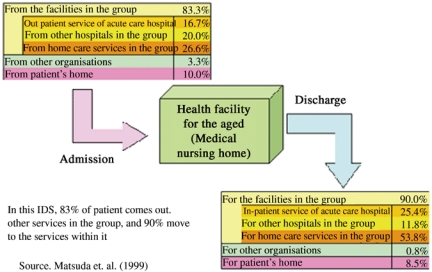
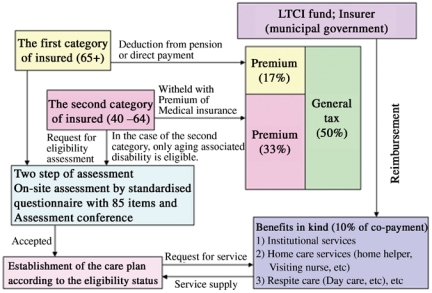
By the introduction of a public, mandatory program of Long-Term Care Insurance (LTCI) on April 1, 2000, Japan has moved towards a system of social care for the frail and elderly. The program covers care that is both home-based and institutional. Fifty percent of the insurance is financed from the general tax and the other fifty percent from the premiums of the insured. The eligibility process begins with the individual or his/her family applying to the insurer (usually municipal government). A two-step assessment process to determine the limit of benefit follows this. The first step is an on-site assessment using a standardised questionnaire comprising 85 items. These items are analysed by an official computer program in order to determine either the applicant's eligibility or not. If the applicant is eligible it determines which of 6 levels of dependency is applicable. The Japanese LTCI scheme has thus formalised the care management process. A care manager is entrusted with the entire responsibility of planning all care and services for individual clients. The introduction of LTCI is introducing two fundamental structural changes in the Japanese health system; the development of an Integrated Delivery System (IDS) and greater informatisation of the health system.
2000年4月1日,日本通过引入一项公共的强制性长期护理保险(LTCI)计划,朝着为体弱老人提供社会护理的体系迈进。该计划涵盖居家护理和机构护理。保险资金的50%来自一般税收,另外50%来自被保险人的保费。资格认定程序始于个人或其家庭向保险公司(通常是市政府)提出申请。在此之后是一个两步评估过程,以确定福利额度。第一步是使用一份包含85项内容的标准化问卷进行现场评估。这些项目由官方计算机程序进行分析,以确定申请人是否符合资格。如果申请人符合资格,程序会确定适用6个依赖级别中的哪一级。因此,日本的LTCI计划使护理管理流程正规化。一名护理经理被赋予为个别客户规划所有护理和服务的全部责任。LTCI的引入正在给日本医疗体系带来两个根本性的结构变化:综合服务体系(IDS)的发展以及医疗体系的更大程度信息化。