Kida I A, Astrøm A N, Strand G V, Masalu J R, Tsakos G
Centre for international health, UoB, Bergen, Norway.
Health Qual Life Outcomes. 2006 Aug 27;4:56. doi: 10.1186/1477-7525-4-56.
The objective was to study whether a Kiswahili version of the OIDP (Oral Impacts on Daily Performance) inventory was valid and reliable for use in a population of older adults in urban and rural areas of Tanzania; and to assess the area specific prevalence, intensity and perceived causes of OIDP.
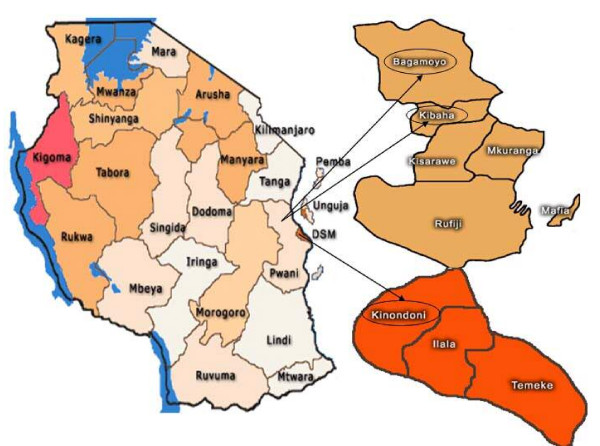
A cross-sectional survey was conducted in Pwani region and in Dar es Salaam in 2004/2005. A two-stage stratified cluster sample design was utilized. Information became available for 511 urban and 520 rural subjects (mean age 62.9 years) who were interviewed and participated in a full mouth clinical examination in their own homes.
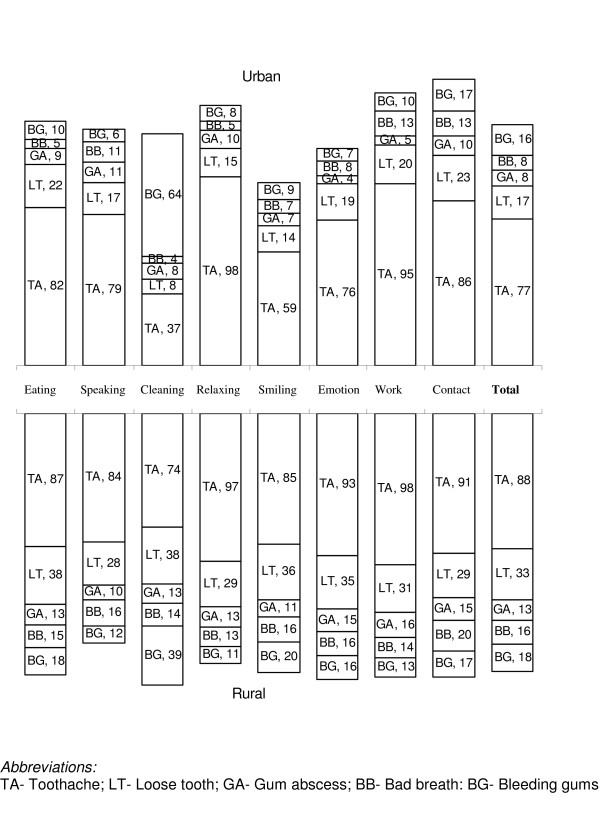
The Kiswahili version of the weighted OIDP inventory preserved the overall concept of the original English version. Cronbach's alpha was 0.83 and 0.90 in urban and rural areas, respectively, and the OIDP inventory varied systematically in the expected direction with self-reported oral health measures. The respective prevalence of oral impacts was 51.2% and 62.1% in urban and rural areas. Problems with eating was the performance reported most frequently (42.5% in urban, 55.1% in rural) followed by cleaning teeth (18.2% in urban, 30.6% in rural). More than half of the urban and rural residents with impacts had very little, little and moderate impact intensity. The most frequently reported causes of impacts were toothache and loose teeth.
The Kiswahili OIDP inventory had acceptable psychometric properties among non-institutionalized adults 50 years and above in Tanzania. The impacts affecting their performances were relatively common but not very severe.
目的是研究斯瓦希里语版的口腔功能影响日常表现(OIDP)量表在坦桑尼亚城乡老年人群中使用时是否有效且可靠;并评估特定地区OIDP的患病率、严重程度及感知到的病因。
2004/2005年在滨海省和达累斯萨拉姆进行了一项横断面调查。采用两阶段分层整群抽样设计。共有511名城市受试者和520名农村受试者(平均年龄62.9岁)纳入研究,他们接受了访谈,并在自己家中接受了全口临床检查。
加权OIDP量表的斯瓦希里语版保留了原始英文版的整体概念。城市和农村地区的Cronbach's α系数分别为0.83和0.90,且OIDP量表随自我报告的口腔健康指标在预期方向上有系统性变化。城市和农村地区口腔功能影响的患病率分别为51.2%和62.1%。进食问题是最常报告的表现(城市为42.5%,农村为55.1%),其次是刷牙问题(城市为18.2%,农村为30.6%)。超过一半的受影响的城市和农村居民的影响强度为很小或小或中等。最常报告的影响病因是牙痛和牙齿松动。
斯瓦希里语OIDP量表在坦桑尼亚50岁及以上的非机构化成年人中具有可接受的心理测量学特性。影响他们日常表现的情况相对常见,但不太严重。