Department of Clinical Dentistry, Faculty of Medicine and Dentistry-University of Bergen, Bergen, Norway.
Health Qual Life Outcomes. 2010 Dec 23;8:152. doi: 10.1186/1477-7525-8-152.
Information on oral health-related quality of life, in addition to clinical measures, is essential for healthcare policy makers to promote oral health resources and address oral health needs.
This paper aimed at evaluating the psychometric properties of the Arabic version of Child-OIDP, estimating the prevalence, severity and causes of oral impacts on daily performances in 12-year-old public and private school attendees in Khartoum State and to identify socio-demographic and clinical correlates of oral impacts as assessed by the Child-OIDP inventory.
The Child-OIDP questionnaire was translated into Arabic was administered to a representative sample of 1109 schoolchildren in Khartoum state. Clinical measures employed in this study included DMFT index, Gingival index, Plaque index and Dean's index. A food frequency questionnaire was used to study the sugar-sweetened snack consumption.
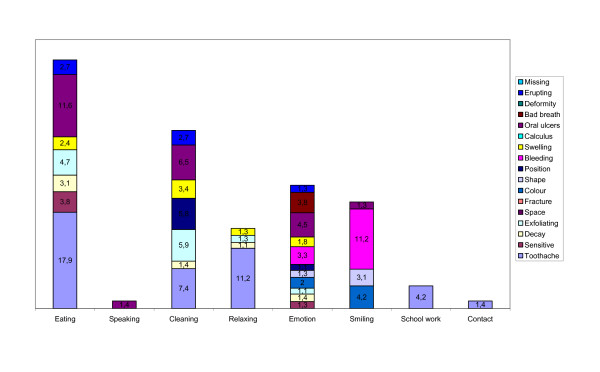
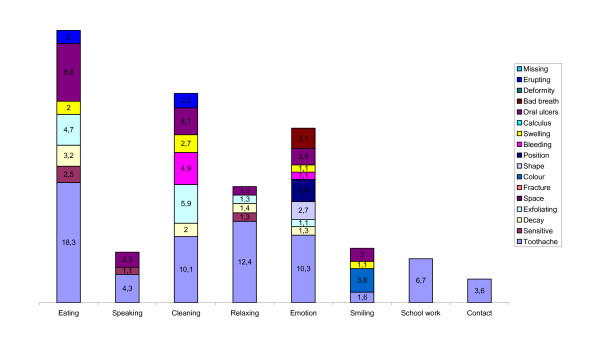
The instrument showed acceptable psychometric properties and is considered as a valid, reliable (Cronbach's alpha 0.73) and practical inventory for use in this population. An impact was reported by 54.6% of the schoolchildren. The highest impact was reported on eating (35.5%) followed by cleaning (28.3%) and the lowest impacts were on speaking (8.6%) and social contact (8.7%). Problems which contributed to all eight impacts were toothache, sensitive teeth, exfoliating teeth, swollen gums and bad breath. Toothache was the most frequently associated cause of almost all impacts in both private and public school attendees. After adjusting for confounders in the 3 multiple variable regression models (whole sample, public and private school attendees), active caries maintained a significant association with the whole sample (OR 2.0 95% CI 1.4-2.6) and public school attendees (OR 3.5 95% CI 2.1-5.6), and higher SES was associated with only public school attendees' Child-OIDP (OR 1.9 95% 1.1-3.1).
This study showed that the Arabic version of the Child-OIDP was applicable for use among schoolchildren in Khartoum. Despite the low prevalence of the dental caries pathology (24%), a significant relationship, with an average moderate intensity was found with OHRQoL. Focus in this population should be on oral health education, improving knowledge of the prospective treatment opportunities and provision of such services.
除了临床指标外,口腔健康相关生活质量信息对于医疗保健政策制定者来说至关重要,这有助于他们合理分配口腔健康资源,满足人们的口腔健康需求。
本文旨在评估阿拉伯版儿童口腔影响生活质量调查问卷(Child-OIDP)的心理测量特性,评估喀土穆州公立和私立学校 12 岁儿童的口腔健康对日常生活影响的流行程度、严重程度和原因,并确定通过儿童口腔影响生活质量调查问卷评估的口腔影响的社会人口学和临床相关性。
将儿童口腔影响生活质量调查问卷翻译成阿拉伯语,对喀土穆州的 1109 名代表性学龄儿童进行了问卷调查。本研究采用的临床指标包括 DMFT 指数、牙龈指数、菌斑指数和 Dean 指数。使用食物频率问卷研究了含糖零食的消费情况。
该工具具有可接受的心理测量特性,被认为是一种有效的、可靠的(Cronbach's alpha 0.73)和实用的工具,可在该人群中使用。54.6%的儿童报告存在口腔健康问题。报告的影响中,受影响最大的是饮食(35.5%),其次是口腔清洁(28.3%),影响最小的是言语(8.6%)和社会交往(8.7%)。导致所有八项影响的问题包括牙痛、牙齿敏感、牙齿剥落、牙龈肿胀和口臭。在私立和公立学校的学生中,牙痛是几乎所有影响的最常见相关原因。在 3 个多变量回归模型(全样本、公立和私立学校学生)中调整混杂因素后,活跃性龋与全样本(OR 2.0,95%CI 1.4-2.6)和公立学校学生(OR 3.5,95%CI 2.1-5.6)均保持显著关联,较高的社会经济地位仅与公立学校学生的儿童口腔影响生活质量(OR 1.9,95%CI 1.1-3.1)相关。
本研究表明,阿拉伯版儿童口腔影响生活质量调查问卷适用于喀土穆的学龄儿童。尽管龋齿病理的低流行率(24%),但仍发现与口腔健康相关生活质量存在显著关系,平均关联强度为中度。在该人群中,应关注口腔健康教育,提高对潜在治疗机会的认识,并提供此类服务。