Roth Thomas, Jaeger Savina, Jin Robert, Kalsekar Anupama, Stang Paul E, Kessler Ronald C
Sleep Disorders Center, Department of Psychiatry and Behavioral Neurosciences, Henry Ford Hospital, Detroit, Michigan, USA.
Biol Psychiatry. 2006 Dec 15;60(12):1364-71. doi: 10.1016/j.biopsych.2006.05.039. Epub 2006 Sep 6.
Little is known about the population prevalence of sleep problems or whether the associations of sleep problems with role impairment are due to comorbid mental disorders.
The associations of four 12-month sleep problems (difficulty initiating or maintaining sleep, early morning awakening, nonrestorative sleep) with role impairment were analyzed in the National Comorbidity Survey Replication controlling 12-month DSM-IV anxiety, mood, impulse-control, and substance disorders. The WHO Composite International Diagnostic Interview was used to assess sleep problems and DSM-IV disorders. The WHO Disability Schedule-II (WHO-DAS) was used to assess role impairment.
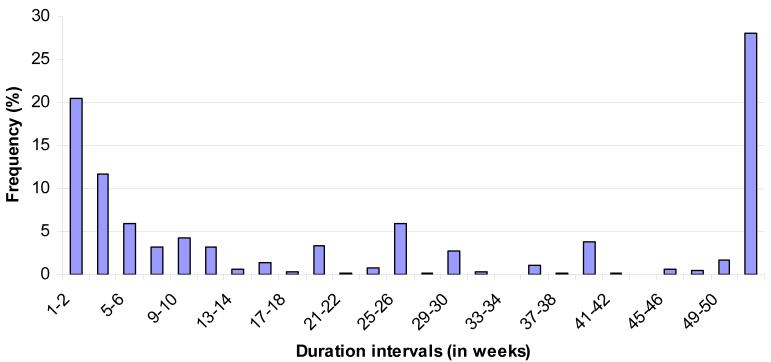
Prevalence estimates of the separate sleep problems were in the range 16.4-25.0%, with 36.3% reporting at least one of the four. Mean 12-month duration was 24.4 weeks. All four problems were significantly comorbid with all the 12-month DMS-IV disorders assessed in the survey (median OR: 3.4; 25(th)-75(th) percentile: 2.8-3.9) and significantly related to role impairment. Relationships with role impairment generally remained significant after controlling comorbid mental disorders. Nonrestorative sleep was more strongly and consistently related to role impairment than were the other sleep problems.
The four sleep problems considered here are of public health significance because of their high prevalence and significant associations with role impairment.
关于睡眠问题在人群中的患病率,以及睡眠问题与角色功能损害之间的关联是否归因于共病的精神障碍,我们所知甚少。
在全国共病调查复制研究中,控制12个月的DSM-IV焦虑症、情绪障碍、冲动控制障碍和物质使用障碍,分析四种12个月的睡眠问题(入睡困难或维持睡眠困难、早醒、睡眠无恢复感)与角色功能损害之间的关联。采用世界卫生组织综合国际诊断访谈来评估睡眠问题和DSM-IV障碍。使用世界卫生组织残疾评定量表第二版(WHO-DAS)来评估角色功能损害。
各睡眠问题的患病率估计在16.4%-25.0%之间,36.3%的人报告至少有这四种问题中的一种。12个月的平均持续时间为24.4周。所有这四种问题都与调查中评估的所有12个月的DMS-IV障碍显著共病(中位数比值比:3.4;第25-75百分位数:2.8-3.9),并且与角色功能损害显著相关。在控制共病的精神障碍后,与角色功能损害的关系通常仍然显著。与其他睡眠问题相比,睡眠无恢复感与角色功能损害的关系更强且更一致。
本文所考虑的这四种睡眠问题具有公共卫生意义,因为它们患病率高且与角色功能损害显著相关。