Butler Karin M, Zacks Rose T
Department of Psychology, University of New Mexico, Albuquerque, 87131-0001, USA.
Psychol Aging. 2006 Sep;21(3):638-43. doi: 10.1037/0882-7974.21.3.638.
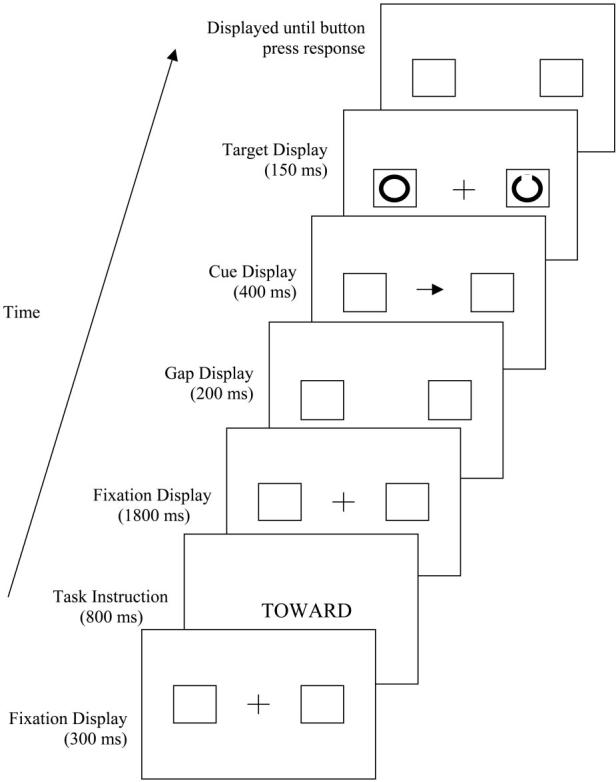
Older adults have more difficulty than younger adults appropriately directing their behavior when the required response is in competition with a prepotent response. The authors varied the difficulty of inhibiting a prepotent eye movement response by varying the response cue (peripheral onset or central arrow). The response cue manipulation did not affect prosaccade accuracy and latency for either age group and did not affect younger adults' antisaccades. Older adults' antisaccades were slower in the peripheral cue condition than in the central arrow condition. These findings are taken as support for the inhibitory deficit hypothesis of aging (L. Hasher, R. T. Zacks, & C. P. May, 1999).
当所需反应与优势反应相互竞争时,老年人比年轻人更难适当地引导自己的行为。作者通过改变反应提示(外周起始或中央箭头)来改变抑制优势眼动反应的难度。反应提示操作对两个年龄组的前扫视准确性和潜伏期均无影响,也未影响年轻人的反扫视。在外周提示条件下,老年人的反扫视比中央箭头条件下更慢。这些发现被视为对衰老抑制缺陷假说的支持(L.哈舍、R.T.扎克斯和C.P.梅,1999年)。