Catelinois Olivier, Rogel Agnès, Laurier Dominique, Billon Solenne, Hemon Denis, Verger Pierre, Tirmarche Margot
Institute for Radiation Protection and Nuclear Safety, Fontenay-aux-Roses, France.
Environ Health Perspect. 2006 Sep;114(9):1361-6. doi: 10.1289/ehp.9070.
The inhalation of radon, a well-established human carcinogen, is the principal-and omnipresent-source of radioactivity exposure for the general population of most countries. Scientists have thus sought to assess the lung cancer risk associated with indoor radon. Our aim here is to assess this risk in France, using all available epidemiologic results and performing an uncertainty analysis.
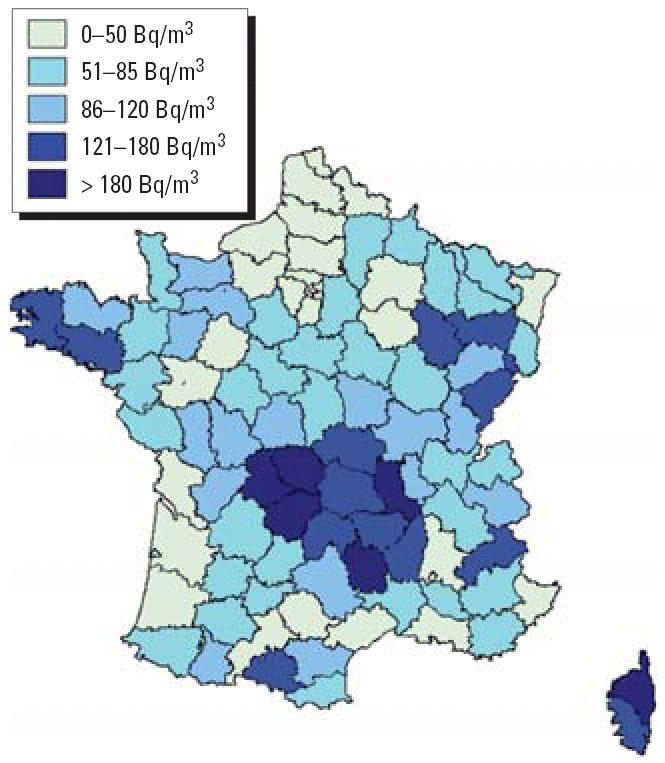
We examined the exposure-response relations derived from cohorts of miners and from joint analyses of residential case-control studies and considered the interaction between radon and tobacco. The exposure data come from measurement campaigns conducted since the beginning of the 1980s by the Institute for Radiation Protection and Nuclear Safety and the Directorate-General of Health in France. We quantified the uncertainties associated with risk coefficients and exposures and calculated their impact on risk estimates.
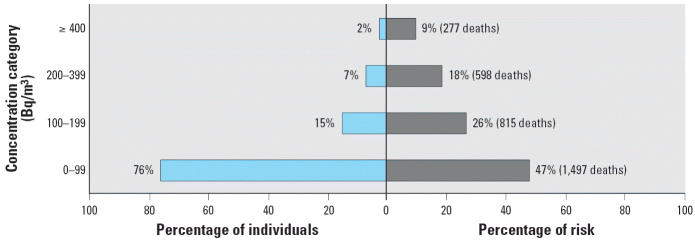
The estimated number of lung cancer deaths attributable to indoor radon exposure ranges from 543 [90% uncertainty interval (UI) , 75-1,097] to 3,108 (90% UI, 2,996-3,221) , depending on the model considered. This calculation suggests that from 2.2% (90% UI, 0.3-4.4) to 12.4% (90% UI, 11.9-12.8) of these deaths in France may be attributable to indoor radon.
In this original work we used different exposure-response relations from several epidemiologic studies and found that regardless of the relation chosen, the number of lung cancer deaths attributable to indoor radon appears relatively stable. Smokers can reduce their risk not only by reducing their indoor radon concentration but also by giving up smoking.
氡气吸入是一种公认的人类致癌物,是大多数国家普通人群放射性暴露的主要且普遍存在的来源。因此,科学家们一直试图评估与室内氡气相关的肺癌风险。我们在此的目的是利用所有可用的流行病学结果并进行不确定性分析,来评估法国的这种风险。
我们研究了矿工队列以及住宅病例对照研究联合分析得出的暴露 - 反应关系,并考虑了氡气与烟草之间的相互作用。暴露数据来自自20世纪80年代初以来法国辐射防护与核安全研究所和法国卫生部开展的测量活动。我们对与风险系数和暴露相关的不确定性进行了量化,并计算了它们对风险估计的影响。
根据所考虑的模型,归因于室内氡气暴露的肺癌死亡估计数在543例[90%不确定区间(UI),75 - 1,097]至3,108例(90% UI,2,996 - 3,221)之间。这一计算表明,法国这些死亡病例中2.2%(90% UI,0.3 - 4.4)至12.4%(90% UI,11.9 - 12.8)可能归因于室内氡气。
在这项原创性工作中,我们使用了来自多项流行病学研究的不同暴露 - 反应关系,发现无论选择哪种关系,归因于室内氡气的肺癌死亡人数似乎相对稳定。吸烟者不仅可以通过降低室内氡气浓度,还可以通过戒烟来降低风险。