Cui Qinghua, Yu Zhenbao, Purisima Enrico O, Wang Edwin
Computational Chemistry and Biology Group, Biotechnology Research Institute, National Research Council Canada, Montreal, Quebec, Canada.
Mol Syst Biol. 2006;2:46. doi: 10.1038/msb4100089. Epub 2006 Sep 12.
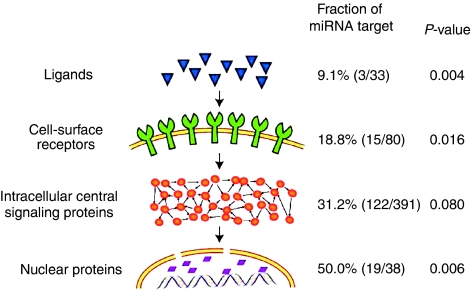
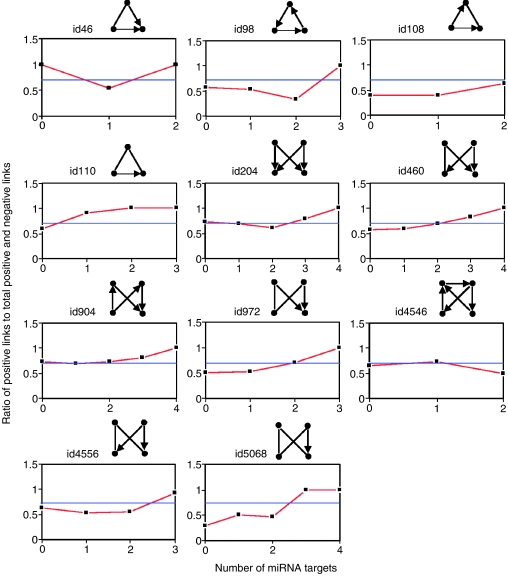
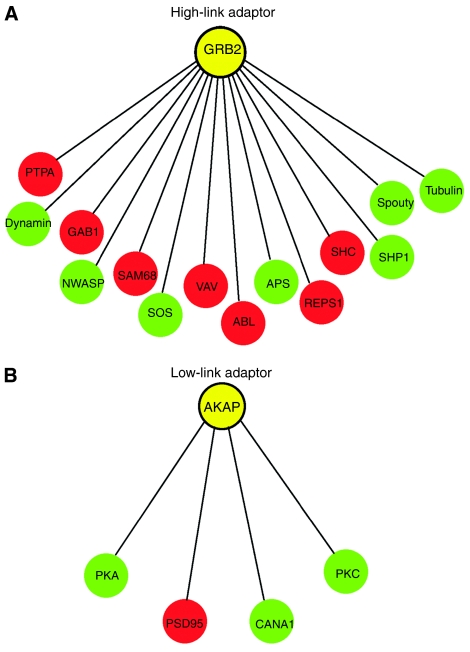
MicroRNAs (miRNAs) are endogenous approximately 22-nucleotide RNAs, which suppress gene expression by selectively binding to the 3'-noncoding region of specific messenger RNAs through base-pairing. Given the diversity and abundance of miRNA targets, miRNAs appear to functionally interact with various components of many cellular networks. By analyzing the interactions between miRNAs and a human cellular signaling network, we found that miRNAs predominantly target positive regulatory motifs, highly connected scaffolds and most downstream network components such as signaling transcription factors, but less frequently target negative regulatory motifs, common components of basic cellular machines and most upstream network components such as ligands. In addition, when an adaptor has potential to recruit more downstream components, these components are more frequently targeted by miRNAs. This work uncovers the principles of miRNA regulation of signal transduction networks and implies a potential function of miRNAs for facilitating robust transitions of cellular response to extracellular signals and maintaining cellular homeostasis.
微小RNA(miRNA)是内源性的约22个核苷酸的RNA,其通过碱基配对选择性地结合特定信使RNA的3'非编码区来抑制基因表达。鉴于miRNA靶标的多样性和丰富性,miRNA似乎在功能上与许多细胞网络的各种组分相互作用。通过分析miRNA与人类细胞信号网络之间的相互作用,我们发现miRNA主要靶向正调控基序、高度连接的支架以及大多数下游网络组分,如信号转录因子,但较少靶向负调控基序、基本细胞机器的常见组分以及大多数上游网络组分,如配体。此外,当衔接蛋白有可能招募更多下游组分时,这些组分更频繁地被miRNA靶向。这项工作揭示了miRNA调控信号转导网络的原理,并暗示了miRNA在促进细胞对细胞外信号的反应进行稳健转变以及维持细胞稳态方面的潜在功能。