Department of Respiratory Medicine, Japanese Red Cross Ishinomaki Hospital, Ishinomaki, Miyagi, Japan.
BMJ Open. 2013 Jan 3;3(1):e000865. doi: 10.1136/bmjopen-2012-000865.
To investigate the impact in an aging society of the 2011 Great East Japan earthquake on hospitalisation for respiratory disease at the disaster base hospital.
Descriptive and cross-sectional study.
Emergency care in Japanese Red Cross Ishinomaki Hospital, a regional disaster base hospital in Miyagi, Japan.
322 emergency patients who were hospitalised for respiratory disease from 11 March to 9 May 2011, and 99 and 105 emergency patients who were hospitalised in the corresponding periods in 2009 and 2010, respectively.
Description and comparison of patient characteristics and disease distribution in terms of age, time after the disaster and activities of daily living (ADL).
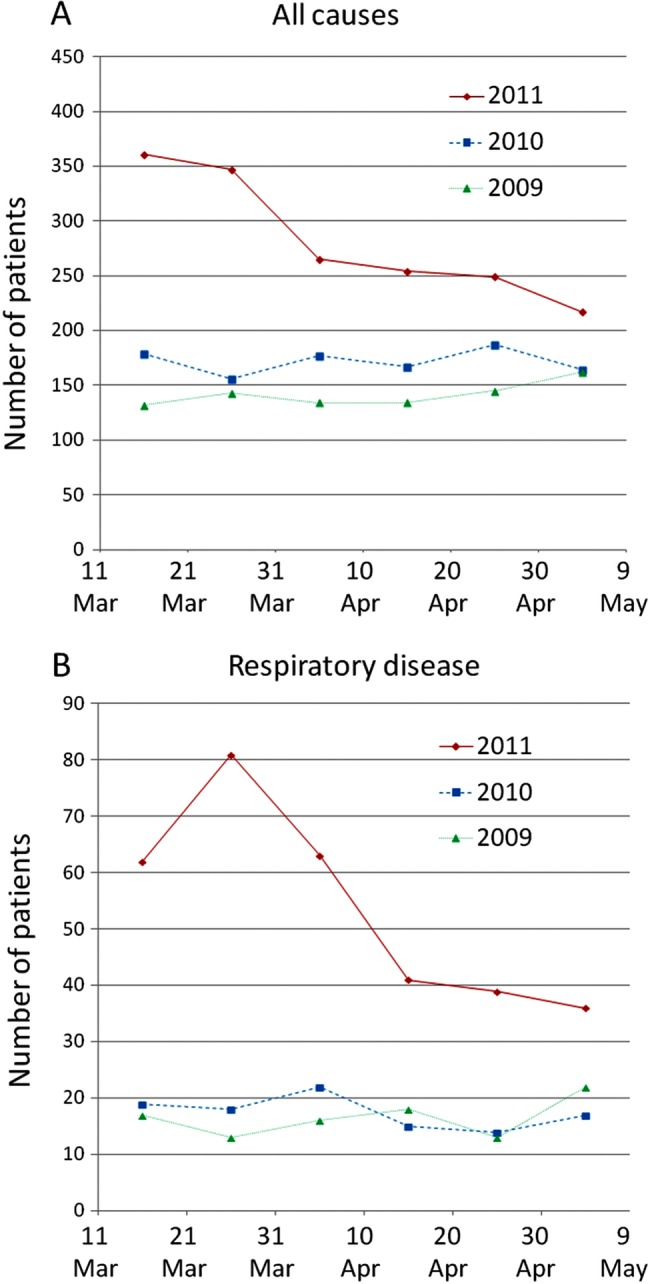
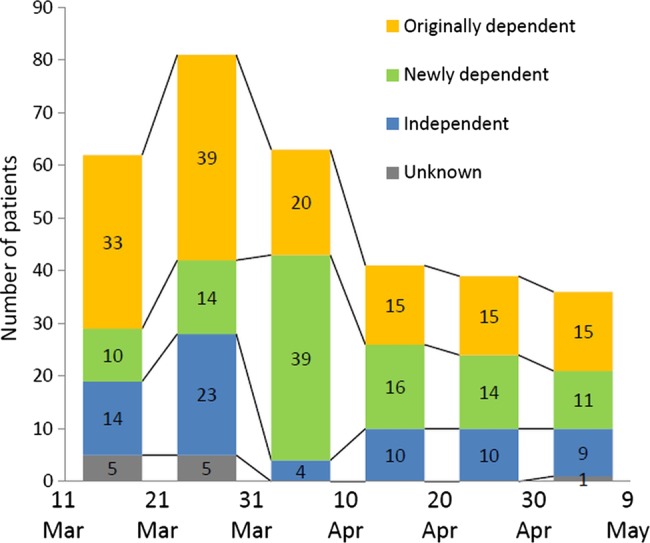
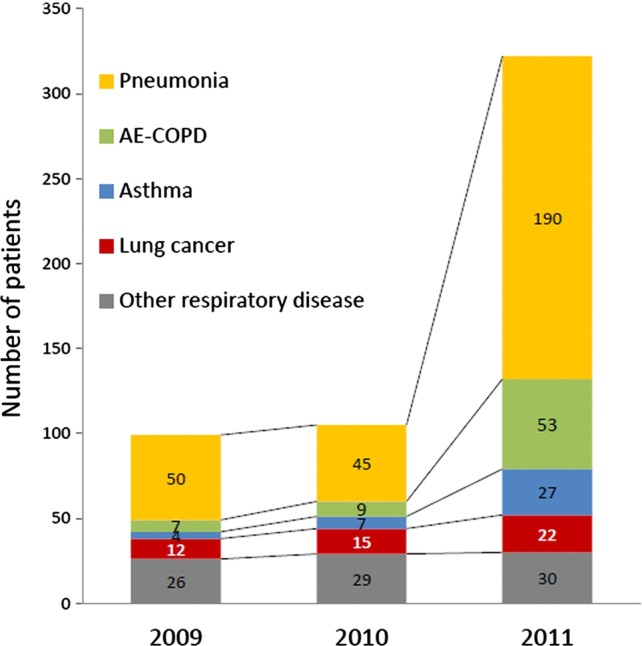
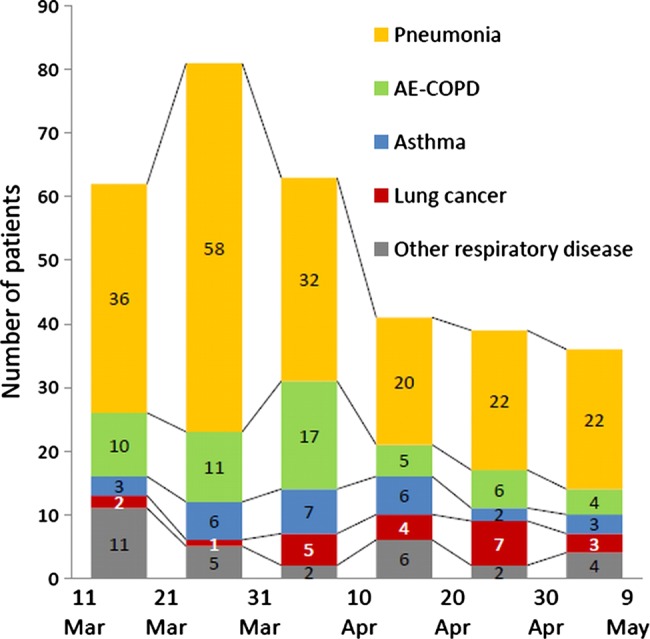
1769 patients were admitted to our hospital during the study period (compared to 850 in 2009 and 1030 in 2010), among whom 322 were hospitalised for respiratory disease (compared to 99 in 2009 and 105 in 2010). Pneumonia (n=190, 59.0%) was the most frequent cause of admission for pulmonary disease, followed by acute exacerbation of chronic obstructive pulmonary disease (AE-COPD) (n=53, 16.5%), asthma attacks (n=27, 8.4%) and progression of lung cancer (n=22, 6.8%). Compared with the corresponding periods in 2009 and 2010, the increase in the absolute numbers of admissions was highest for pneumonia, followed by AE-COPD and asthma attacks. At hospitalisation, 195 patients were 'dependent' and 54 patients were 'partially dependent'. Respiratory admissions accompanied by deterioration of ADL after the disaster were more frequent in elderly and female patients.
After the Great East Japan Earthquake, admissions for pneumonia and exacerbation of chronic respiratory disease in the elderly increased at the disaster base hospital.
调查 2011 年东日本大地震对受灾基地医院呼吸系统疾病住院的影响。
描述性和横断面研究。
日本宫城县日本红十字石卷医院,一个地区性的受灾基地医院。
2011 年 3 月 11 日至 5 月 9 日期间,因呼吸系统疾病住院的 322 名急诊患者,以及 2009 年和 2010 年同期分别住院的 99 名和 105 名急诊患者。
根据年龄、灾难后时间和日常生活活动(ADL),描述和比较患者特征和疾病分布。
在研究期间,有 1769 名患者入住我院(与 2009 年的 850 名和 2010 年的 1030 名相比),其中 322 名因呼吸系统疾病住院(与 2009 年的 99 名和 2010 年的 105 名相比)。肺炎(n=190,59.0%)是肺部疾病入院的最常见原因,其次是慢性阻塞性肺疾病急性加重(AE-COPD)(n=53,16.5%)、哮喘发作(n=27,8.4%)和肺癌进展(n=22,6.8%)。与 2009 年和 2010 年同期相比,肺炎、AE-COPD 和哮喘发作的入院绝对人数增加最多。入院时,195 名患者为“依赖”,54 名患者为“部分依赖”。在灾难后 ADL 恶化的情况下,呼吸系统疾病的住院治疗在老年和女性患者中更为常见。
在东日本大地震后,受灾基地医院老年患者的肺炎和慢性呼吸系统疾病住院人数增加。