Nødtvedt Ane, Bergvall Kerstin, Emanuelson Ulf, Egenvall Agneta
Department of Small Animal Clinical Sciences, Faculty of Veterinary Medicine and Animal Science, Swedish University of Agricultural Sciences, Uppsala, Sweden.
Acta Vet Scand. 2006 Jun 15;48(1):8. doi: 10.1186/1751-0147-48-8.
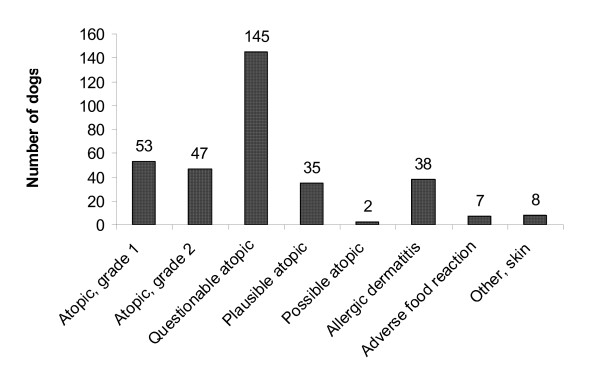
A cross-sectional study of insured Swedish dogs with a recorded diagnosis of canine atopic dermatitis (CAD) was performed. In order to validate the correctness of this specific diagnosis in the insurance database, medical records were requested by mail from the attending veterinarians. All dogs with a reimbursed claim for the disease during 2002 were included in the original study sample (n = 373). Medical records were available for 335 individuals (response rate: 89.8%). By scrutinizing the submitted records it was determined that all dogs had been treated for dermatologic disease, and that 327 (97.6%) could be considered to have some allergic skin disease. However, as information regarding dietary trial testing was missing in many dogs the number that were truly atopic could not be determined. The clinical presentation and nature of test diet for dogs with or without response to dietary trial testing was compared for a subset of 109 individuals that had undergone such testing. The only significant difference between these two groups was that the proportion of dogs with reported gastrointestinal signs was higher in the group that subsequently responded to a diet trial. In conclusion, the agreement between the recorded diagnosis in the insurance database and the clinical manifestations recorded in the submitted medical records was considered acceptable. The concern was raised that many attending veterinarians did not exclude cutaneous adverse food reactions before making the diagnosis of CAD.
对有犬特应性皮炎(CAD)确诊记录的瑞典参保犬进行了一项横断面研究。为了验证保险数据库中该特定诊断的正确性,通过邮件向主治兽医索要病历。2002年期间所有因该病获得理赔的犬都纳入了原始研究样本(n = 373)。335只犬有病历可用(回复率:89.8%)。通过仔细审查提交的病历确定,所有犬都曾接受过皮肤病治疗,且327只(97.6%)可被认为患有某种过敏性皮肤病。然而,由于许多犬缺少饮食试验检测的信息,无法确定真正患特应性皮炎的犬只数量。对109只接受过此类检测的犬的一个子集,比较了饮食试验检测有反应或无反应的犬的临床表现和试验饮食的性质。这两组之间唯一显著的差异是,随后对饮食试验有反应的组中报告有胃肠道症状的犬的比例更高。总之,保险数据库中的记录诊断与提交病历中记录的临床表现之间的一致性被认为是可以接受的。有人担心许多主治兽医在诊断CAD之前没有排除皮肤食物不良反应。