Norman Cameron D, Huerta Tim
Department of Public Health Sciences, Faculty of Medicine, University of Toronto, Toronto, ON, Canada.
Implement Sci. 2006 Sep 25;1:20. doi: 10.1186/1748-5908-1-20.
Health services and population health innovations advance when knowledge transfer and exchange (KTE) occurs among researchers, practitioners, policy-makers and consumers using high-quality evidence. However, few KTE models have been evaluated in practice. Communities of practice (CoP) - voluntary, self-organizing, and focused groups of individuals and organizations - may provide one option. This paper outlines an approach to lay the foundation for a CoP within the area of Web-assisted tobacco interventions (WATI). The objectives of the study were to provide a data-driven foundation to inform decisions about organizing a CoP within the geographically diverse, multi-disciplinary WATI group using evaluation and social network methodologies.
A single-group design was employed using a survey of expectations, knowledge, and interpersonal WATI-related relationships administered prior to a meeting of the WATI group followed by a 3-week post-meeting Web survey to assess short-term impact on learning and networking outcomes.
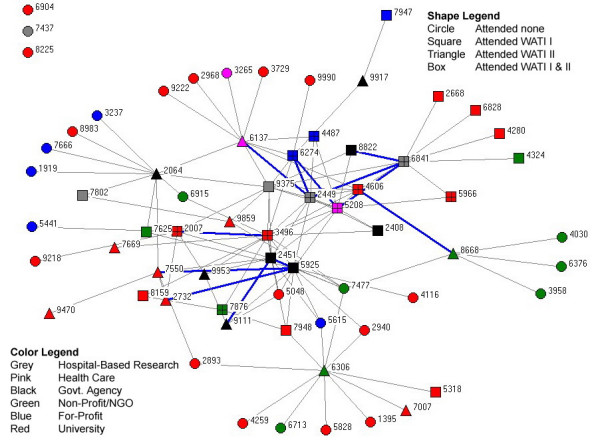
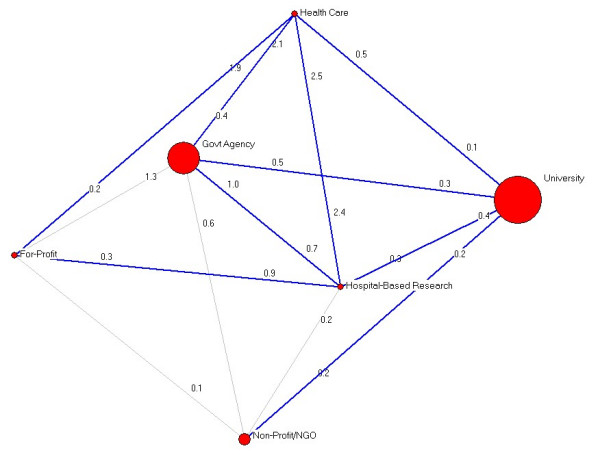
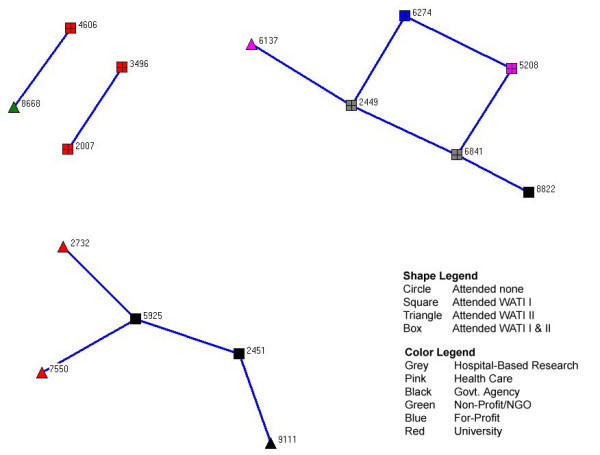
Twenty-three of 27 WATI attendees (85%) from diverse disciplinary and practice backgrounds completed the baseline survey, with 21 (91%) of those participants completing the three-week follow-up. Participants had modest expectations of the meeting at baseline. A social network map produced from the data illustrated a centralized, yet sparse network comprising of interdisciplinary teams with little trans-sectoral collaboration. Three-week follow-up survey results showed that participants had made new network connections and had actively engaged in KTE activities with WATI members outside their original network.
Data illustrating both the shape and size of the WATI network as well as member's interests and commitment to KTE, when shared and used to frame action steps, can positively influence the motivation to collaborate and create communities of practice. Guiding KTE planning through blending data and theory can create more informed transdisciplinary and trans-sectoral collaboration environments.
当研究人员、从业者、政策制定者和消费者利用高质量证据进行知识转移和交流(KTE)时,卫生服务和人群健康创新就会取得进展。然而,很少有KTE模型在实践中得到评估。实践社区(CoP)——由个人和组织组成的自愿、自组织且专注的群体——可能提供一种选择。本文概述了一种在网络辅助烟草干预(WATI)领域为实践社区奠定基础的方法。该研究的目的是提供一个数据驱动的基础,以便在地理上分散、多学科的WATI群体中,利用评估和社会网络方法为组织实践社区的决策提供信息。
采用单组设计,在WATI群体会议之前进行一项关于期望、知识和与WATI相关的人际关系的调查,随后进行为期3周的会后网络调查,以评估对学习和建立联系成果的短期影响。
来自不同学科和实践背景的27名WATI参会者中有23名(85%)完成了基线调查,其中21名(91%)参与者完成了为期3周的随访。参与者在基线时对会议期望不高。根据数据生成的社会网络图显示,这是一个集中但稀疏的网络,由跨学科团队组成,跨部门合作很少。为期3周的随访调查结果显示,参与者建立了新的网络联系,并与原网络之外的WATI成员积极参与了KTE活动。
当共享并用于制定行动步骤时,说明WATI网络的形状和规模以及成员对KTE的兴趣和承诺的数据,可以对合作动机和创建实践社区产生积极影响。通过将数据与理论相结合来指导KTE规划,可以创造更明智的跨学科和跨部门合作环境。