Cole J Alexander, Rothman Kenneth J, Cabral Howard J, Zhang Yuqing, Farraye Francis A
Department of Epidemiology, Boston University School of Public Health, Boston MA, USA.
BMC Gastroenterol. 2006 Sep 28;6:26. doi: 10.1186/1471-230X-6-26.
Case descriptions suggest IBS patients are more likely to have other disorders, including migraine, fibromyalgia, and depression. We sought to examine the prevalence of these conditions in cohorts of people with and without IBS.
The source of data was a large U.S. health plan from January 1, 1996 though June 30, 2002. We identified all people with a medical claim associated with an ICD-9 code for IBS. A non-IBS cohort was a random sample of people with an ICD-9 code for routine medical care. In the cohorts, we identified all claims for migraine, depression, and fibromyalgia. We estimated the prevalence odds ratios (PORs) of each of the three conditions using the Mantel-Haenszel method. We conducted quantitative sensitivity analyses to quantify the impact of residual confounding and in differential outcome identification.
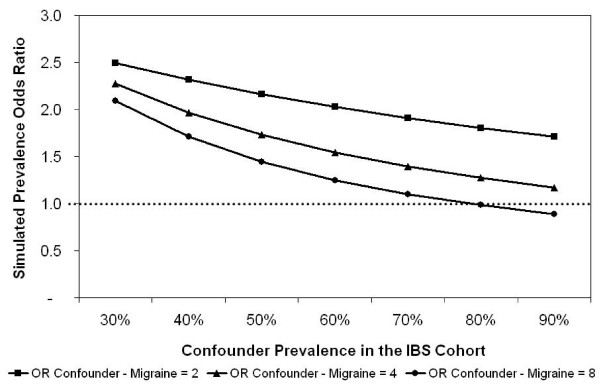
We identified 97,593 people in the IBS cohort, and a random sample of 27,402 people to compose the non-IBS comparison cohort. With adjustment, there was a 60% higher odds in the IBS cohort of having any one of the three disorders relative to the comparison cohort (POR 1.6, 95% CI 1.5 - 1.7). There was a 40% higher odds of depression in the IBS cohort (POR 1.4, 95% CI 1.3 - 1.4). The PORs for fibromyalgia and migraine were similar (POR for fibromyalgia 1.8, 95% CI 1.7 - 1.9; POR for migraine 1.6, 95% CI 1.4 - 1.7). Differential prevalence of an unmeasured confounder, or imperfect sensitivity or specificity of outcome detection would have impacted the observed results.
People in the IBS cohort had a 40% to 80% higher prevalence odds of migraine, fibromyalgia, and depression.
病例描述表明,肠易激综合征(IBS)患者更有可能患有其他疾病,包括偏头痛、纤维肌痛和抑郁症。我们试图研究这些疾病在有和没有IBS的人群队列中的患病率。
数据来源是1996年1月1日至2002年6月30日期间美国的一个大型健康计划。我们识别出所有有与IBS的ICD-9编码相关的医疗索赔的人。非IBS队列是有常规医疗护理的ICD-9编码的人群的随机样本。在这些队列中,我们识别出所有偏头痛、抑郁症和纤维肌痛的索赔。我们使用Mantel-Haenszel方法估计这三种疾病各自的患病率比值比(PORs)。我们进行了定量敏感性分析,以量化残余混杂因素和不同结局识别的影响。
我们在IBS队列中识别出97,593人,并随机抽取27,402人组成非IBS对照队列。经过调整后,IBS队列中患有这三种疾病中任何一种的几率比对照队列高60%(POR 1.6,95%置信区间1.5 - 1.7)。IBS队列中患抑郁症的几率高40%(POR 1.4,95%置信区间1.3 - 1.4)。纤维肌痛和偏头痛的PORs相似(纤维肌痛的POR 1.8,95%置信区间1.7 - 1.9;偏头痛的POR 1.6,95%置信区间1.4 - 1.7)。未测量的混杂因素的不同患病率,或结局检测的敏感性或特异性不完善,都会影响观察到的结果。
IBS队列中的人群患偏头痛、纤维肌痛和抑郁症的患病率几率高40%至80%。