Marquet Richard L, Bartelds Aad I M, van Noort Sander P, Koppeschaar Carl E, Paget John, Schellevis François G, van der Zee Jouke
NIVEL (Netherlands Institute for Health Services Research), The Netherlands, Utrecht, The Netherlands.
BMC Public Health. 2006 Oct 4;6:242. doi: 10.1186/1471-2458-6-242.
An internet-based survey of influenza-like illness (ILI)--the Great Influenza Survey or GIS--was launched in the Netherlands in the 2003-2004 influenza season. The aim of the present study was to validate the representativeness of the GIS population and to compare the GIS data with the official ILI data obtained by Dutch GPs participating in the Dutch Sentinel Practice Network.
Direct mailings to schools and universities, and repeated interviews on television and radio, and in newspapers were used to kindle the enthusiasm of a broad section of the public for GIS. Strict symptomatic criteria for ILI were formulated with the assistance of expert institutes and only participants who responded at least five times to weekly e-mails asking them about possible ILI symptoms were included in the survey. Validation of GIS was done at different levels: 1) some key demographic (age distribution) and public health statistics (prevalence of asthma and diabetes, and influenza vaccination rates) for the Dutch population were compared with corresponding figures calculated from GIS; 2) the ILI rates in GIS were compared with the ILI consultation rates reported by GPs participating in the Dutch Sentinel Practice Network.
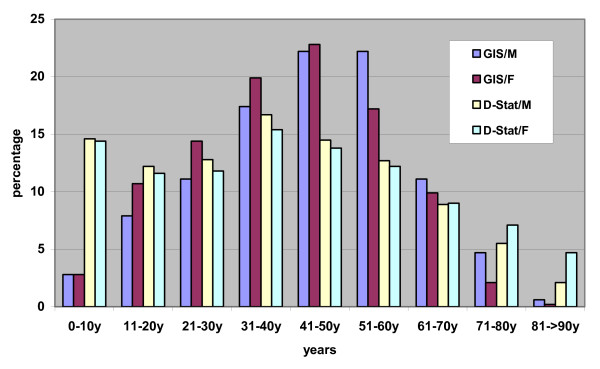
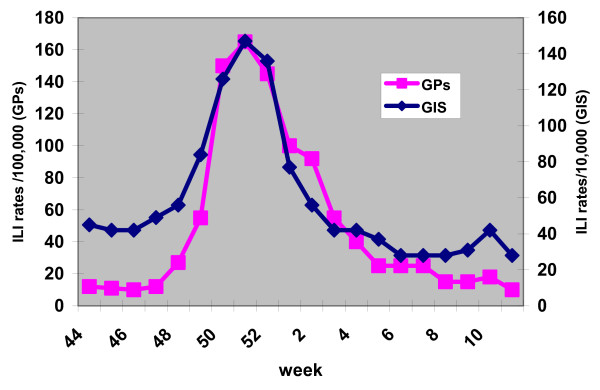
13,300 persons (53% of total responders), replied at least five times to weekly e-mails and were included in the survey. As expected, there was a marked under-representation of the age groups 0-10 years and 81->90 years in the GIS population, although the similarities were remarkable for most other age groups, albeit that the age groups between 21 and 70 years were slightly overrepresented. There were striking similarities between GIS and the Dutch population with regard to the prevalence of asthma (6.4% vs. 6.9%) and the influenza vaccination rates, and to a lesser degree for diabetes (2.4% vs. 3.5%). The vaccination rates in patients with asthma or diabetes, and persons older than 65 years were 68%, 85%, and 85% respectively in GIS, while the corresponding percentages in the Dutch population were 73%, 85% and 87%. There was also a marked similarity between the seasonal course of ILI measured by GIS and the GPs. Although the ILI rate in GIS was about 10 times higher, the curves followed an almost similar pattern, with peak incidences occurring in the same week.
The current study demonstrates that recruitment of a high number of persons willing to participate in on-line health surveillance is feasible. The information gathered proved to be reliable, as it paralleled the information obtained via an undisputed route. We believe that the interactive nature of GIS and the appealing subject were keys to its success.
2003 - 2004年流感季节,荷兰开展了一项基于互联网的流感样疾病调查——大流感调查(GIS)。本研究的目的是验证GIS人群的代表性,并将GIS数据与参与荷兰哨点实践网络的荷兰全科医生获得的官方流感样疾病数据进行比较。
通过直接邮寄给学校和大学,并在电视、广播及报纸上反复宣传,以激发广大公众对GIS的热情。在专家机构的协助下制定了严格的流感样疾病症状标准,只有那些每周至少回复五次询问其可能的流感样疾病症状的电子邮件的参与者才被纳入调查。对GIS的验证在不同层面进行:1)将荷兰人群的一些关键人口统计学(年龄分布)和公共卫生统计数据(哮喘和糖尿病患病率以及流感疫苗接种率)与从GIS计算得出的相应数据进行比较;2)将GIS中的流感样疾病发病率与参与荷兰哨点实践网络的全科医生报告的流感样疾病诊疗率进行比较。
13300人(占总回复者的53%)每周至少回复五次电子邮件并被纳入调查。正如预期的那样,GIS人群中0 - 10岁和81 - 90岁年龄组的代表性明显不足,尽管大多数其他年龄组的相似性显著,不过21至70岁年龄组的代表性略高。在哮喘患病率(6.4%对6.9%)和流感疫苗接种率方面,GIS与荷兰人群有显著相似之处,糖尿病患病率方面的相似程度稍低(2.4%对3.5%)。GIS中哮喘或糖尿病患者以及65岁以上人群的疫苗接种率分别为68%、85%和85%,而荷兰人群中的相应百分比分别为73%、85%和87%。GIS测量的流感样疾病的季节性过程与全科医生的数据也有显著相似性。尽管GIS中的流感样疾病发病率约高10倍,但曲线几乎遵循相似模式,高峰发病率出现在同一周。
当前研究表明,招募大量愿意参与在线健康监测的人员是可行的。收集到的信息被证明是可靠的,因为它与通过无可争议的途径获得的信息相似。我们认为,GIS的互动性质和有吸引力的主题是其成功的关键。