Meyer Anneke, Sagvolden Terje
School of Health Sciences, University of Limpopo, Private Bag X1106, 0727 Sovenga, South Africa.
Behav Brain Funct. 2006 Oct 9;2:33. doi: 10.1186/1744-9081-2-33.
Motor problems, often characterised as clumsiness or poor motor coordination, have been associated with ADHD in addition to the main symptom groups of inattention, impulsiveness, and overactivity. The problems addressed in this study were: (1) Are motor problems associated with ADHD symptoms, also in African cultures? (2) Are there differences in motor skills among the subtypes with ADHD symptoms? (3) Are there gender differences? (4) Is there an effect of age? (5) Are there differences in performance between the dominant and non-dominant hand?
A total of 528 children (264 classified as having symptoms of ADHD and 264 matched comparisons) of both genders and from seven different South African ethnic groups participated in the study. They were assessed with three simple, easy to administer instruments which measure various functions of motor speed and eye-hand coordination: The Grooved Pegboard, the Maze Coordination Task, and the Finger Tapping Test. The results were analysed as a function of subtype, gender, age, and hand dominance.
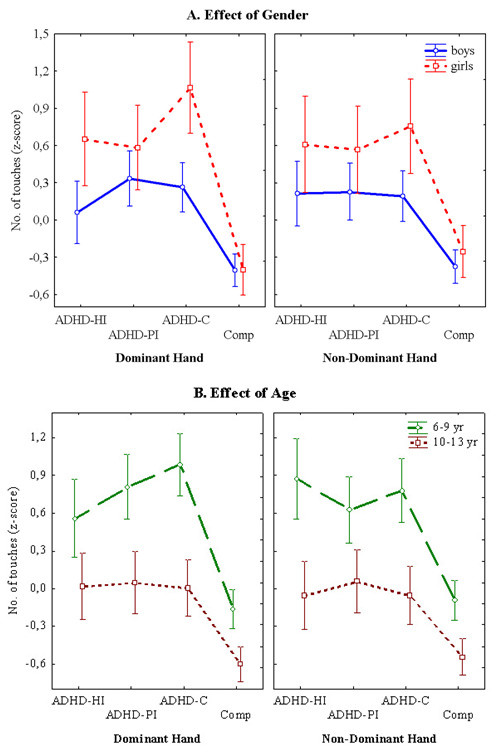
The findings indicate that children with symptoms of ADHD performed significantly poorer on the Grooved Pegboard and Motor Coordination Task, but not on the Finger Tapping Test than their comparisons without ADHD symptoms. The impairment was most severe for the subtype with symptoms of ADHD-C (combined) and less severe for the subtypes with symptoms of ADHD-PI (predominantly inattentive) and ADHD-HI (predominantly hyperactive/impulsive). With few exceptions, both genders were equally affected while there were only slight differences in performance between the dominant and non-dominant hand. The deficiencies in motor control were mainly confined to the younger age group (6-9 yr).
An association between the symptoms of ADHD and motor problems was demonstrated in terms of accuracy and speed in fairly complex tasks, but not in simple motor tests of speed. This deficiency is found mainly in the children with ADHD-C symptoms, but also to a lesser degree in the children with symptoms of ADHD-PI and ADHD-HI.
运动问题通常表现为笨拙或运动协调性差,除了注意力不集中、冲动和多动等主要症状外,还与注意力缺陷多动障碍(ADHD)有关。本研究探讨的问题包括:(1)在非洲文化中,运动问题是否也与ADHD症状相关?(2)有ADHD症状的各亚型之间运动技能是否存在差异?(3)是否存在性别差异?(4)年龄是否有影响?(5)优势手和非优势手的表现是否存在差异?
共有528名来自南非七个不同种族群体的儿童(264名被归类为有ADHD症状,264名作为匹配对照)参与了该研究。他们使用三种简单易操作的工具进行评估,这些工具用于测量运动速度和眼手协调的各种功能:有槽钉板测试、迷宫协调任务和手指敲击测试。结果根据亚型、性别、年龄和手的优势进行分析。
研究结果表明,有ADHD症状的儿童在有槽钉板测试和运动协调任务中的表现明显比没有ADHD症状的对照儿童差,但在手指敲击测试中并非如此。ADHD-C(混合型)症状亚型的损伤最为严重,ADHD-PI(主要为注意力不集中型)和ADHD-HI(主要为多动/冲动型)症状亚型的损伤较轻。除了少数例外,两性受影响程度相同,优势手和非优势手的表现仅有细微差异。运动控制缺陷主要局限于较年轻的年龄组(6 - 9岁)。
在相当复杂的任务中,ADHD症状与运动问题在准确性和速度方面存在关联,但在简单的速度运动测试中未发现。这种缺陷主要存在于有ADHD-C症状的儿童中,但在有ADHD-PI和ADHD-HI症状的儿童中程度较轻。