University of Konstanz, Konstanz, Germany.
School of Health Professions, Institute of Health Science, Zurich University of Applied Sciences ZHAW, Winterthur, Switzerland.
BMC Pediatr. 2021 Nov 4;21(1):490. doi: 10.1186/s12887-021-02916-5.
Motor deficiencies are observed in a large number of children with ADHD. Especially fine motor impairments can lead to academic underachievement, low self-esteem and frustration in affected children. Despite these far-reaching consequences, fine motor deficiencies have remained widely undertreated in the ADHD population. The aim of this review was to systematically map the evidence on existing training programs for remediating fine motor impairments in children with ADHD and to assess their effectiveness.
The scoping review followed the PRISMA-ScR guidelines. In March 2020, PsycINFO, MEDLINE (PubMed), Web of Science, Google Scholar and The Cochrane Database of Systematic Reviews were searched for evidence. The eligibility criteria and the data charting process followed the PICO framework, complemented by study design. The investigated population included children with a formal ADHD diagnosis (either subtype) or elevated ADHD symptoms aged between 4 and 12 years, both on and off medication. All training interventions aiming at improving fine motor skills, having a fine motor component or fine motor improvements as a secondary outcome were assessed for eligibility; no comparators were specified.
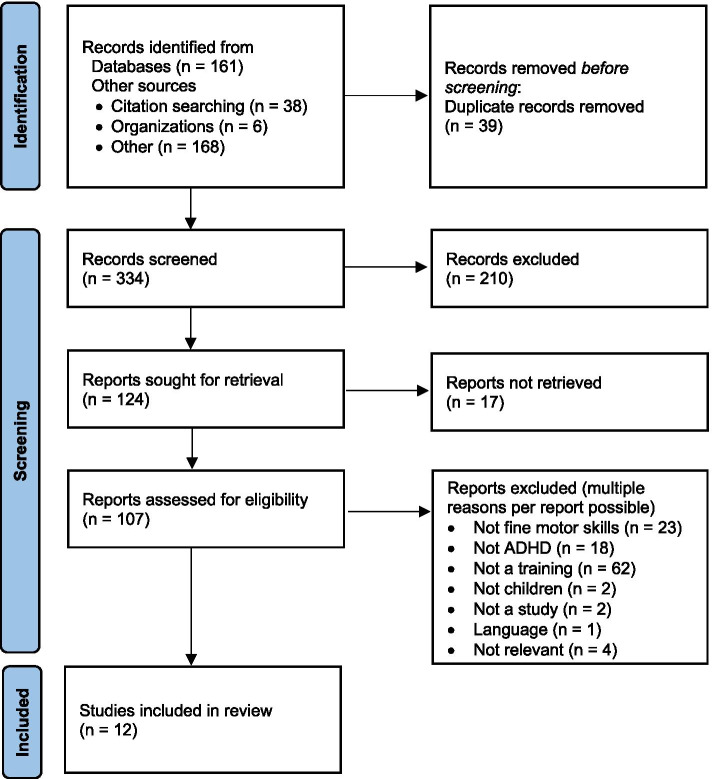
Twelve articles were included in the final report, comprising observational and experimental studies as well as a review. Both offline and online or virtual training interventions were reported, often accompanied by physical activity and supplemented by training sessions at home. The training programs varied in length and intensity, but generally comprised several weeks and single or multiple training sessions per week. All interventions including more than one session were effective in the treatment of fine motor deficiencies in children with ADHD and had a wide range of additional positive outcomes. The effects could be maintained at follow-up.
Fine motor training in children with ADHD can be very effective and multiple approaches including specific fine motor and cognitive training components, some kind of physical activity, feedback mechanisms, or multimodal treatments can be successful. Training programs need to be tailored to the specific characteristics of the ADHD population. A mHealth approach using serious games could be promising in this context due to its strong motivational components.
患有 ADHD 的儿童中存在大量运动机能障碍。特别是精细运动障碍会导致受影响儿童学业成绩不佳、自尊心低和受挫感。尽管这些影响深远,但 ADHD 人群中的精细运动障碍仍未得到广泛治疗。本综述的目的是系统地描述现有的针对 ADHD 儿童的精细运动障碍矫正训练计划的证据,并评估其效果。
该范围综述遵循 PRISMA-ScR 指南。2020 年 3 月,在 PsycINFO、MEDLINE(PubMed)、Web of Science、Google Scholar 和 The Cochrane Database of Systematic Reviews 上搜索证据。纳入标准和数据图表制作过程遵循 PICO 框架,辅以研究设计。所调查的人群包括年龄在 4 至 12 岁之间、有正式 ADHD 诊断(无论亚型)或 ADHD 症状升高的儿童,无论是否服用药物。所有旨在提高精细运动技能、具有精细运动成分或精细运动改善作为次要结果的训练干预都被评估为合格;没有指定对照。
最终报告纳入了 12 篇文章,包括观察性和实验性研究以及综述。报告了离线和在线或虚拟训练干预措施,通常伴有体育活动,并辅以家庭训练课程。培训计划在长度和强度上有所不同,但通常包括数周和每周一次或多次培训课程。所有包括多个疗程的干预措施都能有效治疗 ADHD 儿童的精细运动缺陷,并具有广泛的其他积极结果。这些效果在随访时仍能维持。
ADHD 儿童的精细运动训练非常有效,多种方法包括特定的精细运动和认知训练成分、某种形式的体育活动、反馈机制或多模式治疗都可能成功。培训计划需要根据 ADHD 人群的特定特征进行调整。由于其强大的激励成分,使用严肃游戏的移动健康方法在这种情况下可能很有前途。