Cobb Nathan K, Graham Amanda L
Massachusetts General Hospital, Pulmonary & CC Unit-Bul 148, 55 Fruit St, Boston MA 02114, USA.
J Med Internet Res. 2006 Sep 19;8(3):e17. doi: 10.2196/jmir.8.3.e17.
The Internet is a viable channel to deliver evidence-based smoking cessation treatment that has the potential to make a large population impact on reducing smoking prevalence. There is high demand for smoking cessation information and support on the Internet. Approximately 7% (10.2 million) of adult American Internet users have searched for information on quitting smoking. Little is known about these individuals, their smoking status, what type of cessation services they are seeking on the Internet, or how frequently these searches for cessation information are conducted.
The primary goal of this study was to characterize individuals who search for smoking cessation information on the Internet to determine appropriate triage and treatment strategies. The secondary goal was to estimate the incidence of searches for cessation information using publicly available search engine data.
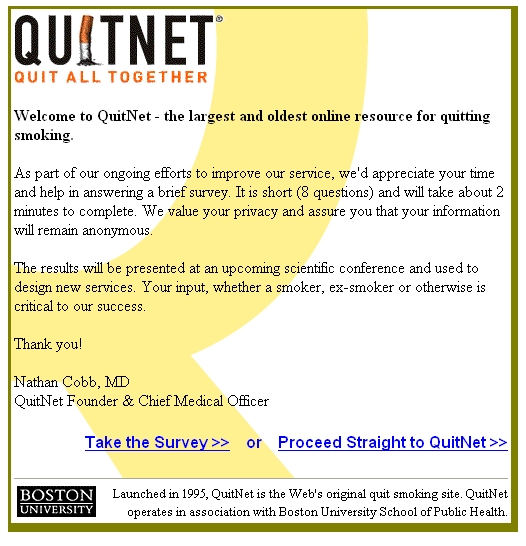
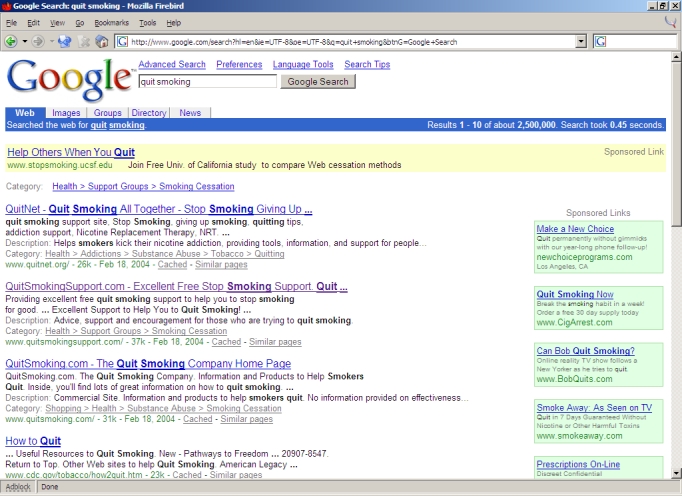
We recruited individuals who clicked on a link to a leading smoking cessation website (QuitNet) from within the results of a search engine query. Individuals were "intercepted" before seeing the QuitNet home page and were invited to participate in the study. Those accepting the invitation were routed to an online survey about demographics, smoking characteristics, preferences for specific cessation services, and Internet search patterns. To determine the generalizability of our sample, national datasets on search engine usage patterns, market share, and keyword rankings were examined. These datasets were then used to estimate the number of queries for smoking cessation information each year.
During the 10-day study period, 2265 individuals were recruited and 29% (N = 655) responded. Of these, 59% were female and overall tended to be younger than the previously characterized general Internet population. Most (76%) respondents were current smokers; 17% had quit within the last 7 days, and 7% had quit more than 7 days ago. Slightly more than half of active smokers (53%) indicated that they were planning to quit in the next 30 days. Smokers were more likely to seek information on how to quit and on medications; former smokers were more interested in how to cope with withdrawal. All participants rated withdrawal information and individually tailored information as being more useful, while displaying little interest in telephone counseling, expert support, or peer support. Publicly available data from large search engines suggest that 4 million Americans search for resources on smoking cessation each year.
This study adds to the limited data available on individuals who search for smoking cessation information on the Internet, supports the prior estimates of the size of the population, and indicates that these individuals are in appropriate stages for both active cessation interventions and aggressive relapse prevention efforts. Continued development and evaluation of online interventions is warranted, and organizations seeking to promote cessation should carefully evaluate the Internet as a possible modality for treatment and as a gateway to other traditional programs.

互联网是提供循证戒烟治疗的可行渠道,有潜力对降低吸烟率产生广泛的人群影响。互联网上对戒烟信息和支持的需求很高。约7%(1020万)成年美国互联网用户搜索过戒烟信息。对于这些人、他们的吸烟状况、在互联网上寻求何种戒烟服务,以及这些戒烟信息搜索的频率,我们知之甚少。
本研究的主要目标是描述在互联网上搜索戒烟信息的人群特征,以确定合适的分诊和治疗策略。次要目标是利用公开的搜索引擎数据估计戒烟信息搜索的发生率。
我们招募了在搜索引擎查询结果中点击领先戒烟网站(QuitNet)链接的人。这些人在看到QuitNet主页之前被“拦截”,并被邀请参与研究。接受邀请的人会被引导至一项关于人口统计学、吸烟特征、对特定戒烟服务的偏好以及互联网搜索模式的在线调查。为确定我们样本的可推广性,我们检查了关于搜索引擎使用模式、市场份额和关键词排名的全国数据集。然后利用这些数据集估计每年戒烟信息查询的数量。
在为期10天的研究期间,招募了2265人,29%(N = 655)做出回应。其中,59%为女性,总体上比之前描述的一般互联网人群更年轻。大多数(76%)受访者为当前吸烟者;17%在过去7天内已戒烟,7%在7天前就已戒烟。略超过一半的现吸烟者(53%)表示他们计划在未来30天内戒烟。吸烟者更倾向于寻求如何戒烟和药物方面的信息;已戒烟者对如何应对戒断反应更感兴趣。所有参与者都认为戒断信息和个性化信息更有用,而对电话咨询、专家支持或同伴支持兴趣不大。大型搜索引擎的公开数据表明,每年有400万美国人搜索戒烟资源。
本研究补充了关于在互联网上搜索戒烟信息人群的有限数据,支持了之前对该人群规模的估计,并表明这些人处于积极戒烟干预和积极预防复吸的合适阶段。有必要持续开展和评估在线干预措施,寻求促进戒烟的组织应仔细评估互联网作为一种可能的治疗方式以及通往其他传统项目的途径。