van Passel Mark W J, Kuramae Eiko E, Luyf Angela C M, Bart Aldert, Boekhout Teun
Centraalbureau voor Schimmelcultures (CBS), Uppsalalaan 8, Utrecht, The Netherlands.
BMC Evol Biol. 2006 Oct 13;6:84. doi: 10.1186/1471-2148-6-84.
With the increased availability of sequenced genomes there have been several initiatives to infer evolutionary relationships by whole genome characteristics. One of these studies suggested good congruence between genome synteny, shared gene content, 16S ribosomal DNA identity, codon usage and the genome signature in prokaryotes. Here we rigorously test the phylogenetic signal of the genome signature, which consists of the genome-specific relative frequencies of dinucleotides, on 334 sequenced prokaryotic genome sequences.
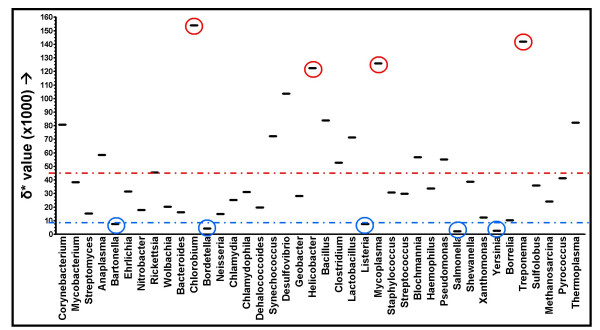
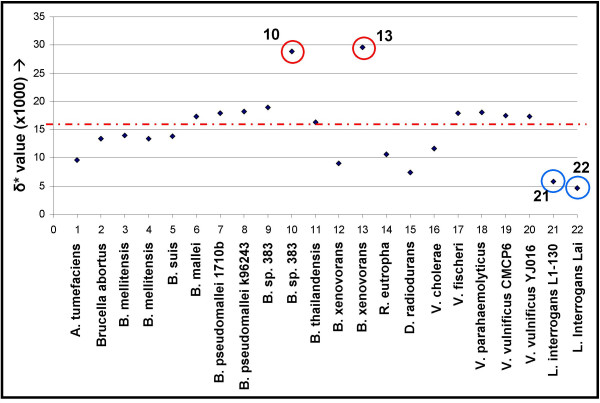
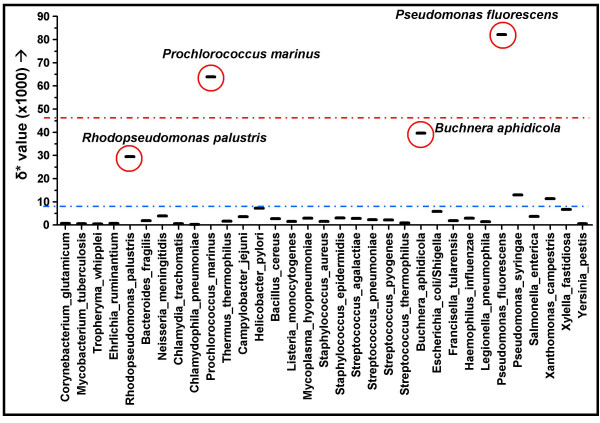
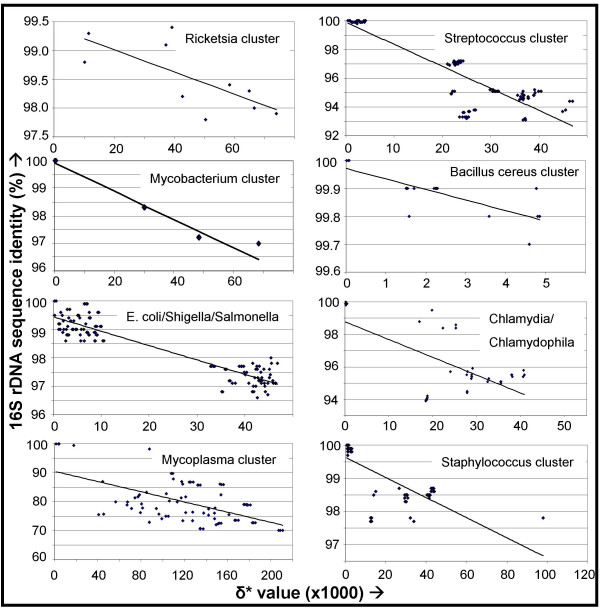
Intrageneric comparisons show that in general the genomic dissimilarity scores are higher than in intraspecific comparisons, in accordance with the suggested phylogenetic signal of the genome signature. Exceptions to this trend, (Bartonella spp., Bordetella spp., Salmonella spp. and Yersinia spp.), which have low average intrageneric genomic dissimilarity scores, suggest that members of these genera might be considered the same species. On the other hand, high genomic dissimilarity values for intraspecific analyses suggest that in some cases (e.g. Prochlorococcus marinus, Pseudomonas fluorescens, Buchnera aphidicola and Rhodopseudomonas palustris) different strains from the same species may actually represent different species. Comparing 16S rDNA identity with genomic dissimilarity values corroborates the previously suggested trend in phylogenetic signal, albeit that the dissimilarity values only provide low resolution.
The genome signature has a distinct phylogenetic signal, independent of individual genetic marker genes. A reliable phylogenetic clustering cannot be based on dissimilarity values alone, as bootstrapping is not possible for this parameter. It can however be used to support or refute a given phylogeny and resulting taxonomy.
随着测序基因组的可得性增加,已经有多项通过全基因组特征推断进化关系的举措。其中一项研究表明,原核生物的基因组共线性、共享基因内容、16S核糖体DNA同一性、密码子使用和基因组特征之间具有良好的一致性。在此,我们对334个已测序的原核生物基因组序列,严格测试了由二核苷酸的基因组特异性相对频率组成的基因组特征的系统发育信号。
属内比较表明,总体而言,基因组差异得分高于种内比较,这与基因组特征所暗示的系统发育信号一致。这一趋势的例外情况(巴尔通体属、博德特氏菌属、沙门氏菌属和耶尔森氏菌属),其属内平均基因组差异得分较低,表明这些属的成员可能被视为同一物种。另一方面,种内分析的高基因组差异值表明,在某些情况下(例如,聚球藻属、荧光假单胞菌、蚜虫内共生菌和沼泽红假单胞菌),同一物种的不同菌株实际上可能代表不同的物种。将16S rDNA同一性与基因组差异值进行比较,证实了先前提出的系统发育信号趋势,尽管差异值仅提供低分辨率。
基因组特征具有独特的系统发育信号,独立于单个遗传标记基因。可靠的系统发育聚类不能仅基于差异值,因为该参数无法进行自展检验。然而,它可用于支持或反驳给定的系统发育和由此产生的分类法。