Boix Raquel, del Barrio José Luis, Saz Pedro, Reñé Ramón, Manubens José María, Lobo Antonio, Gascón Jordi, de Arce Ana, Díaz-Guzmán Jaime, Bergareche Alberto, Bermejo-Pareja Félix, de Pedro-Cuesta Jesús
National Centre for Epidemiology, Carlos III Institute of Public Health, Madrid, Spain.
BMC Neurol. 2006 Oct 16;6:36. doi: 10.1186/1471-2377-6-36.
This study sought to describe stroke prevalence in Spanish elderly populations and compare it against that of other European countries.
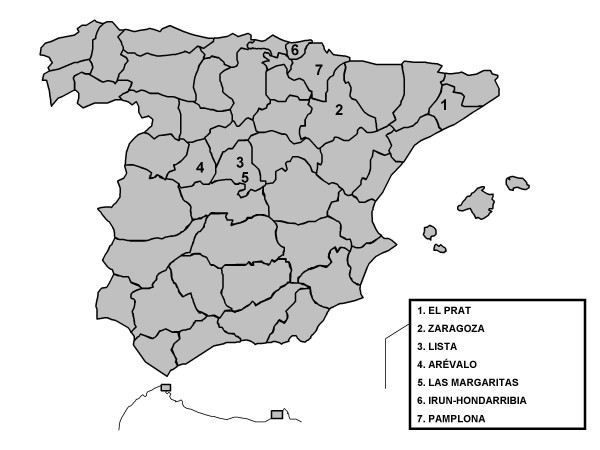
We identified screening surveys--both published and unpublished--in Spanish populations, which fulfilled specific quality requirements and targeted prevalence of stroke in populations aged 70 years and over. Surveys covering seven geographically different populations with prevalence years in the period 1991-2002 were selected, and the respective authors were then asked to provide descriptions of the methodology and raw age-specific data by completing a questionnaire. In addition, five reported screening surveys in European populations furnished useful data for comparison purposes. Prevalence data were combined, using direct adjustment and logistic regression.
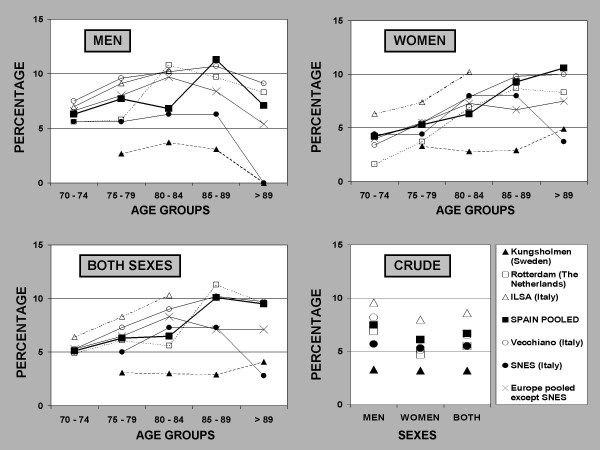
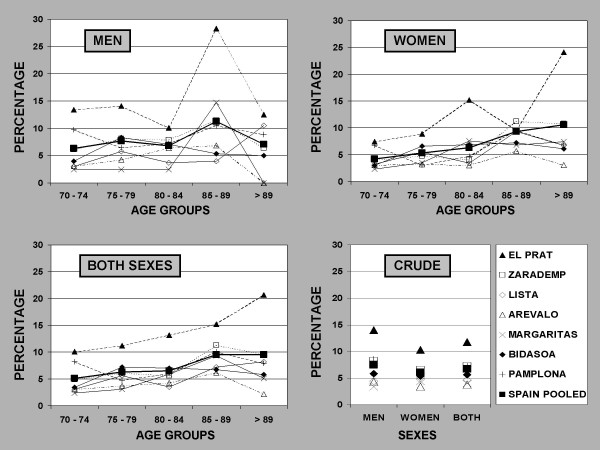
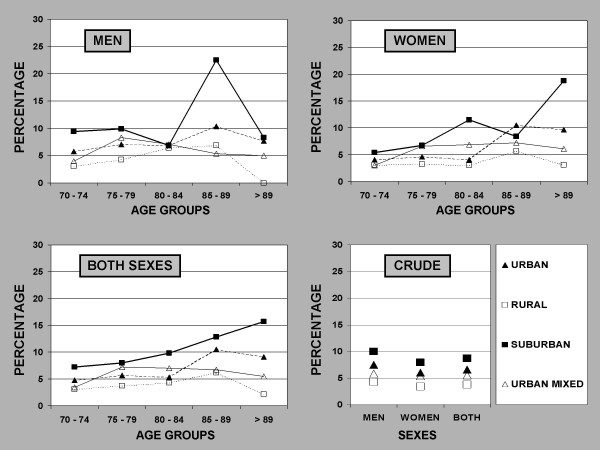
The overall study population, resident in central and north-eastern Spain, totalled 10,647 persons and yielded 715 cases. Age-adjusted prevalences, using the European standard population, were 7.3% for men, 5.6% for women, and 6.4% for both sexes. Prevalence was significantly lower in women, OR 0.79 95% CI 0.68-0.93, increased with age, particularly among women, and displayed a threefold spatial variation with statistically significant differences. Prevalences were highest, 8.7%, in suburban, and lowest, 3.8%, in rural populations. Compared to pooled Spanish populations, statistically significant differences were seen in eight Italian populations, OR 1.39 95% CI (1.18-1.64), and in Kungsholmen, Sweden, OR 0.40 95% CI (0.27-0.58).
Prevalence in central and north-eastern Spain is higher in males and in suburban areas, and displays a threefold geographic variation, with women constituting the majority of elderly stroke sufferers. Compared to reported European data, stroke prevalence in Spain can be said to be medium and presents similar age- and sex-specific traits.
本研究旨在描述西班牙老年人群中的中风患病率,并与其他欧洲国家进行比较。
我们在西班牙人群中识别出已发表和未发表的筛查调查,这些调查满足特定质量要求,目标是70岁及以上人群中的中风患病率。选择了涵盖1991年至2002年期间七个地理区域不同、有患病率数据的人群的调查,然后要求各自的作者通过填写问卷提供方法描述和按年龄划分的原始数据。此外,欧洲人群中五项报告的筛查调查提供了用于比较的有用数据。使用直接调整和逻辑回归对患病率数据进行合并。
居住在西班牙中部和东北部的总体研究人群共有10647人,有715例病例。使用欧洲标准人群进行年龄调整后的患病率,男性为7.3%,女性为5.6%,两性合计为6.4%。女性患病率显著较低,比值比为0.79,95%置信区间为0.68 - 0.93,随年龄增加,尤其是女性,并且呈现出三倍的空间差异,具有统计学显著差异。患病率在郊区最高,为8.7%,在农村人口中最低,为3.8%。与合并的西班牙人群相比,在八个意大利人群中观察到统计学显著差异,比值比为1.39,95%置信区间为(1.18 - 1.64),在瑞典的 Kungsholmen 地区,比值比为0.40,95%置信区间为(0.27 - 0.58)。
西班牙中部和东北部的患病率在男性和郊区较高,呈现出三倍的地理差异,老年中风患者中女性占多数。与报告的欧洲数据相比,西班牙的中风患病率可说是中等水平,并且呈现出类似的年龄和性别特征。