Primary Healthcare Centre Riu Nord-Riu Sud, Institut Català de Salut, Santa Coloma de Gramenet, Spain.
BMC Public Health. 2010 Jan 27;10:38. doi: 10.1186/1471-2458-10-38.
The early diagnosis of atherosclerotic disease is essential for developing preventive strategies in populations at high risk and acting when the disease is still asymptomatic. A low ankle-arm index is a good marker of vascular events and may be diminished without presenting symptomatology (silent peripheral arterial disease). The aim of the study is to know the prevalence and associated risk factors of peripheral arterial disease in the general population.
We performed a cross-sectional, multicentre, population-based study in 3786 individuals >49 years, randomly selected in 28 primary care centres in Barcelona (Spain). Peripheral arterial disease was evaluated using the ankle-arm index. Values < 0.9 were considered as peripheral arterial disease.
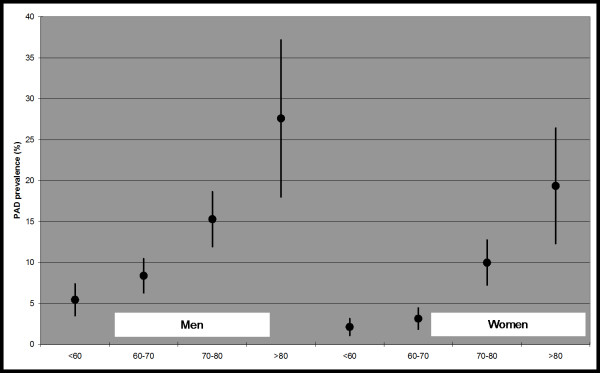
The prevalence (95% confidence interval) of peripheral arterial disease was 7.6% (6.7-8.4), (males 10.2% (9.2-11.2), females 5.3% (4.6-6.0); p < 0.001).Multivariate analysis showed the following risk factors: male sex [odds ratio (OR) 1.62; 95% confidence interval 1.01-2.59]; age OR 2.00 per 10 years (1.64-2.44); inability to perform physical activity [OR 1.77 (1.17-2.68) for mild limitation to OR 7.08 (2.61-19.16) for breathless performing any activity]; smoking [OR 2.19 (1.34-3.58) for former smokers and OR 3.83 (2.23-6.58) for current smokers]; hypertension OR 1.85 (1.29-2.65); diabetes OR 2.01 (1.42-2.83); previous cardiovascular disease OR 2.19 (1.52-3.15); hypercholesterolemia OR 1.55 (1.11-2.18); hypertriglyceridemia OR 1.55 (1.10-2.19). Body mass index > or =25 Kg/m2 OR 0.57 (0.38-0.87) and walking >7 hours/week OR 0.67 (0.49-0.94) were found as protector factors.
The prevalence of peripheral arterial disease is low, higher in males and increases with age in both sexes. In addition to previously described risk factors we found a protector effect in physical exercise and overweight.
动脉粥样硬化疾病的早期诊断对于高危人群制定预防策略和在疾病仍无症状时进行治疗至关重要。踝臂指数降低是血管事件的良好标志物,可能在没有出现症状(无症状外周动脉疾病)的情况下发生。本研究旨在了解普通人群中外周动脉疾病的患病率和相关危险因素。
我们在巴塞罗那的 28 个初级保健中心中,对 3786 名年龄大于 49 岁的个体进行了一项横断面、多中心、基于人群的研究。使用踝臂指数评估外周动脉疾病。<0.9 的值被认为是外周动脉疾病。
外周动脉疾病的患病率(95%置信区间)为 7.6%(6.7-8.4),(男性为 10.2%(9.2-11.2),女性为 5.3%(4.6-6.0);<0.001)。多变量分析显示以下危险因素:男性[比值比(OR)1.62;95%置信区间 1.01-2.59];年龄每增加 10 岁 OR 2.00(1.64-2.44);无法进行体力活动[轻度受限的 OR 1.77(1.17-2.68),任何活动均呼吸困难的 OR 7.08(2.61-19.16)];吸烟[前吸烟者的 OR 2.19(1.34-3.58)和当前吸烟者的 OR 3.83(2.23-6.58)];高血压[OR 1.85(1.29-2.65)];糖尿病[OR 2.01(1.42-2.83)];既往心血管疾病[OR 2.19(1.52-3.15)];高胆固醇血症[OR 1.55(1.11-2.18)];高甘油三酯血症[OR 1.55(1.10-2.19)]。身体质量指数(BMI)≥25 Kg/m2[OR 0.57(0.38-0.87)]和每周步行>7 小时[OR 0.67(0.49-0.94)]为保护因素。
外周动脉疾病的患病率较低,男性较高,且在两性中均随年龄增长而增加。除了先前描述的危险因素外,我们还发现体育锻炼和超重具有保护作用。