Fehm Tanja, Becker Sven, Becker-Pergola Graziella, Sotlar Karl, Gebauer Gerhard, Dürr-Störzer Silke, Neubauer Hans, Wallwiener Diethelm, Solomayer Erich-Franz
Department of Obstetrics and Gynecology, University of Tuebingen, Calwerstrasse 7, D-72076 Tuebingen, Germany.
Breast Cancer Res. 2006;8(5):R60. doi: 10.1186/bcr1611.
Neoadjuvant systemic therapy (NST) is an established strategy to reduce tumor size in breast cancer patients prior to breast-conserving therapy. The effect of NST on tumor cell dissemination in these patients is not known. The aim of this study was to investigate the incidence of disseminated tumor cells (DTC), including apoptotic DTC, in breast cancer patients after NST, and to investigate the correlation of DTC status with therapy response.
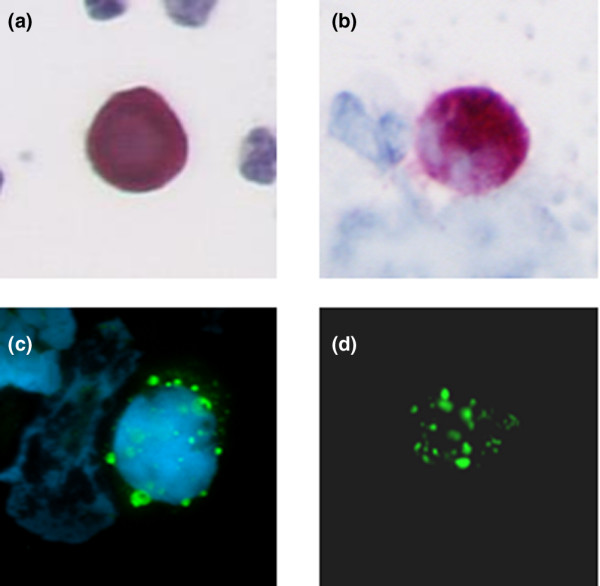
Bone marrow aspiration was performed in 157 patients after NST. DTC were detected by immunocytochemistry using the A45-B/B3 anticytokeratin antibody. To detect apoptotic DTC the antibody M30 (Roche Diagnostics, Germany) was used, which detects a neo-epitope expressed only after caspase cleavage of cytokeratin 18 during early apoptosis.
The incidence of DTC in breast cancer patients was 53% after completion of NST. Tumor dissemination was observed more frequently in patients with no change/progressive disease (69%) than in patients with partial remission or complete remission of the primary tumor (46%) (P < 0.05). Ten out of 24 patients with complete remission, however, were still bone marrow positive. Apoptotic DTC were present in 36 of 157 (23%) breast cancer patients. Apoptotic cells only were detected in 14% of the patients with partial remission or complete remission, but were detected in just 5% of the patients with stable disease. Apoptotic DTC were detectable in none of the patients with tumor progression.
The pathological therapy response in breast cancer patients is reflected by the presence of apoptotic DTC. Patients with complete remission, however, may still have nonapoptotic DTC. These patients may also benefit from secondary adjuvant therapy.
新辅助全身治疗(NST)是一种在保乳治疗前缩小乳腺癌患者肿瘤大小的既定策略。NST对这些患者肿瘤细胞播散的影响尚不清楚。本研究的目的是调查NST后乳腺癌患者中播散肿瘤细胞(DTC)的发生率,包括凋亡性DTC,并研究DTC状态与治疗反应的相关性。
对157例接受NST后的患者进行骨髓穿刺。使用A45-B/B3抗细胞角蛋白抗体通过免疫细胞化学检测DTC。为检测凋亡性DTC,使用了抗体M30(德国罗氏诊断公司),该抗体可检测在早期凋亡期间细胞角蛋白18经半胱天冬酶切割后才表达的新表位。
NST完成后,乳腺癌患者中DTC的发生率为53%。与原发肿瘤部分缓解或完全缓解的患者(46%)相比,疾病无变化/进展的患者中肿瘤播散更为常见(69%)(P<0.05)。然而,24例完全缓解的患者中有10例骨髓仍为阳性。157例(23%)乳腺癌患者中存在凋亡性DTC。仅在14%的部分缓解或完全缓解患者中检测到凋亡细胞,但在疾病稳定的患者中仅5%检测到凋亡细胞。肿瘤进展的患者中均未检测到凋亡性DTC。
凋亡性DTC的存在反映了乳腺癌患者的病理治疗反应。然而,完全缓解的患者可能仍有非凋亡性DTC。这些患者也可能从辅助性二次治疗中获益。