Lee Yong-Jae, Lee Hye-Ree, Nam Chung-Mo, Hwang Ue-Kyoung, Jee Sun-Ha
Graduate School of Public Health, Yonsei University, 134 Shinchon-dong, Seodaemun- gu, Seoul 120-152, Korea.
Yonsei Med J. 2006 Oct 31;47(5):646-56. doi: 10.3349/ymj.2006.47.5.646.
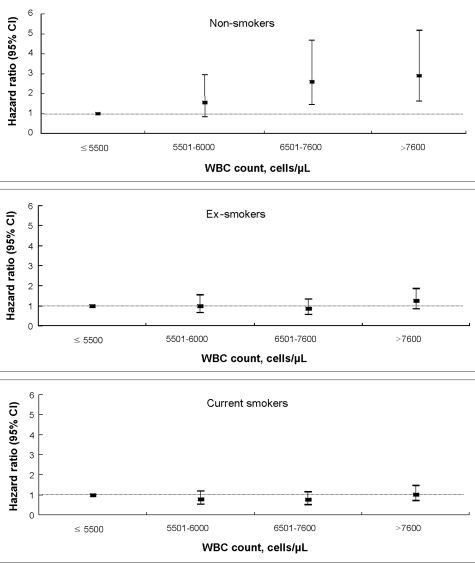
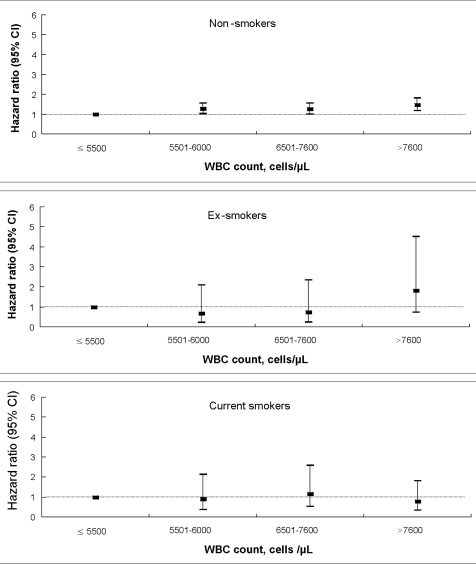
Inflammation may be linked to the pathogenesis of colorectal cancer. However, two conflicting observational results were recently reported on the relationship between the inflammatory marker C-reactive protein (CRP) and the risk of colorectal cancer. Few epidemiologic studies have examined the association between inflammatory markers and the risk of colorectal cancer. We prospectively examined the mortality and incidence risk for colon and rectal cancers among 424,419 Koreans (108,907 men and 315,512 women). The subjects were 40 to 95 years of age and from the Korean Cancer Prevention Study (KCPS) cohort. All subjects received medical examination from the National Health Insurance Corporation in 1993 and 1995. The maximum follow-up period was 10 years, and the follow-up periods began in January 1, 1994 and ended in December 31, 2003. An elevated white blood cell count (WBC) was associated with a higher mortality risk of colon cancer (highest versus lowest quartile: men, 1.55, 95% CI 1.10-2.18, p for trend = 0.0014; women, 1.51, 95% CI 1.12- 2.03, p for trend = 0.0049). Similarly, an elevated WBC was associated with a higher incidence risk of colon cancer (highest versus lowest quartile: men, 1.38, 1.09-1.76, p for trend = 0.0017; women, 1.46, 95% CI 1.20-1.78, p for trend= 0.0003). A positive linear trend was also observed in non- smokers. There was no significant association between WBC and the risk of rectal cancer. Our findings demonstrate that an elevated WBC is associated with an increase in both the mortality and incidence rates of colon cancer. These results support our hypothesis that inflammation increases the risk of colon cancer.
炎症可能与结直肠癌的发病机制有关。然而,最近有两项关于炎症标志物C反应蛋白(CRP)与结直肠癌风险之间关系的相互矛盾的观察结果被报道。很少有流行病学研究考察炎症标志物与结直肠癌风险之间的关联。我们前瞻性地研究了424,419名韩国人(108,907名男性和315,512名女性)中结肠癌和直肠癌的死亡率及发病风险。研究对象年龄在40至95岁之间,来自韩国癌症预防研究(KCPS)队列。所有研究对象在1993年和1995年接受了国民健康保险公团的体检。最长随访期为10年,随访期从1994年1月1日开始,至2003年12月31日结束。白细胞计数(WBC)升高与结肠癌较高的死亡风险相关(最高四分位数与最低四分位数相比:男性,1.55,95%可信区间1.10 - 2.18,趋势p值 = 0.0014;女性,1.51,95%可信区间1.12 - 2.03,趋势p值 = 0.0049)。同样,WBC升高与结肠癌较高的发病风险相关(最高四分位数与最低四分位数相比:男性,1.38,95%可信区间1.09 - 1.76,趋势p值 = 0.0017;女性,1.46,95%可信区间1.20 - 1.78,趋势p值 = 0.0003)。在不吸烟者中也观察到了正线性趋势。WBC与直肠癌风险之间无显著关联。我们的研究结果表明,WBC升高与结肠癌死亡率和发病率的增加均相关。这些结果支持了我们关于炎症增加结肠癌风险的假设。