Park Yon Jung, Wen Jing, Bang Seungmin, Park Seung Woo, Song Si Young
Department of Internal Medicine, Yonsei University College of Medicine, 134 Shinchon-dong, Seodaemoon-gu, Seoul 120-752, Korea.
Yonsei Med J. 2006 Oct 31;47(5):688-97. doi: 10.3349/ymj.2006.47.5.688.
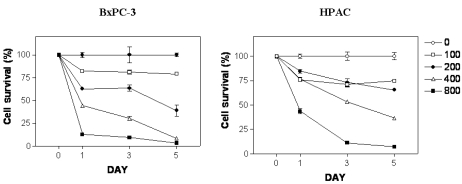
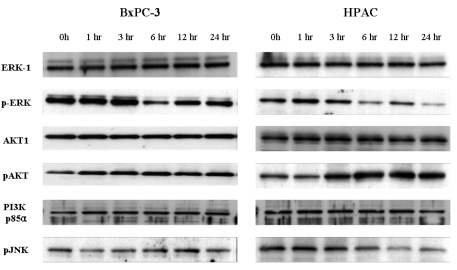
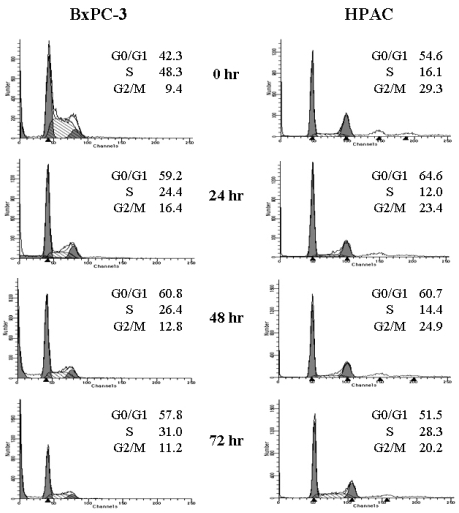
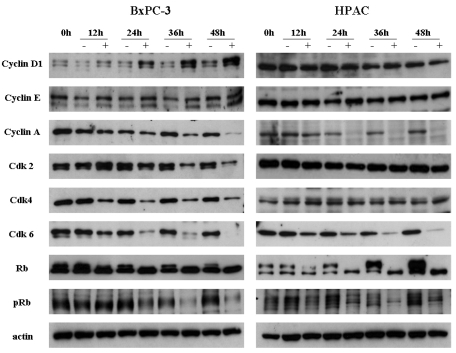
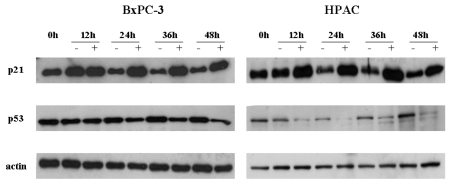
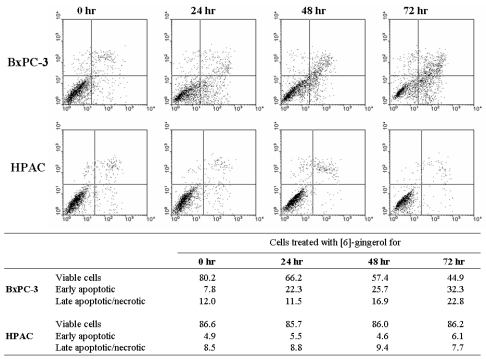
[6]-Gingerol, a major phenolic compound derived from ginger, has anti-bacterial, anti-inflammatory and anti-tumor activities. While several molecular mechanisms have been described to underlie its effects on cells in vitro and in vivo, the underlying mechanisms by which [6]-gingerol exerts anti-tumorigenic effects are largely unknown. The purpose of this study was to investigate the action of [6]-gingerol on two human pancreatic cancer cell lines, HPAC expressing wild- type (wt) p53 and BxPC-3 expressing mutated p53. We found that [6]-gingerol inhibited the cell growth through cell cycle arrest at G1 phase in both cell lines. Western blot analyses indicated that [6]-gingerol decreased both Cyclin A and Cyclin-dependent kinase (Cdk) expression. These events led to reduction in Rb phosphorylation followed by blocking of S phase entry. p53 expression was decreased by [6]-gingerol treatment in both cell lines suggesting that the induction of Cyclin-dependent kinase inhibitor, p21cip1, was p53-independent. [6]-Gingerol induced mostly apoptotic death in the mutant p53-expressing cells, while no signs of early apoptosis were detected in wild type p53-expressing cells and this was related to the increased phosphorylation of AKT. These results suggest that [6]-gingerol can circumvent the resistance of mutant p53- expressing cells towards chemotherapy by inducing apoptotic cell death while it exerts cytostatic effect on wild type p53- expressing cells by inducing temporal growth arrest.
[6]-姜辣素是从生姜中提取的一种主要酚类化合物,具有抗菌、抗炎和抗肿瘤活性。虽然已经描述了几种分子机制来解释其在体外和体内对细胞的作用,但[6]-姜辣素发挥抗肿瘤作用的潜在机制在很大程度上仍不清楚。本研究的目的是研究[6]-姜辣素对两种人胰腺癌细胞系的作用,即表达野生型(wt)p53的HPAC细胞系和表达突变型p53的BxPC-3细胞系。我们发现,[6]-姜辣素通过使两种细胞系的细胞周期停滞在G1期来抑制细胞生长。蛋白质免疫印迹分析表明,[6]-姜辣素降低了细胞周期蛋白A和细胞周期蛋白依赖性激酶(Cdk)的表达。这些事件导致Rb磷酸化减少,随后阻止细胞进入S期。在两种细胞系中,[6]-姜辣素处理均降低了p53的表达,这表明细胞周期蛋白依赖性激酶抑制剂p21cip1的诱导与p53无关。[6]-姜辣素在表达突变型p53的细胞中主要诱导凋亡性死亡,而在表达野生型p53的细胞中未检测到早期凋亡迹象,这与AKT磷酸化增加有关。这些结果表明,[6]-姜辣素可以通过诱导凋亡性细胞死亡来规避表达突变型p53的细胞对化疗的耐药性,同时通过诱导暂时的生长停滞对表达野生型p53的细胞发挥细胞抑制作用。