Wahab Habibah A, Ahmad Khairudin Nurul Bahiyah, Samian Mohd Razip, Najimudin Nazalan
Laboratory of Biocrystallography and Structural Bioinformatics, Universiti Sains Malaysia, Penang, Malaysia.
BMC Struct Biol. 2006 Nov 1;6:23. doi: 10.1186/1472-6807-6-23.
Polyhydroxyalkanoates (PHA), are biodegradable polyesters derived from many microorganisms such as the pseudomonads. These polyesters are in great demand especially in the packaging industries, the medical line as well as the paint industries. The enzyme responsible in catalyzing the formation of PHA is PHA synthase. Due to the limited structural information, its functional properties including catalysis are lacking. Therefore, this study seeks to investigate the structural properties as well as its catalytic mechanism by predicting the three-dimensional (3D) model of the Type II Pseudomonas sp. USM 4-55 PHA synthase 1 (PhaC1P.sp USM 4-55).
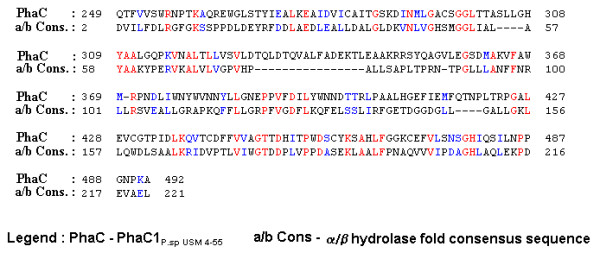
Sequence analysis demonstrated that PhaC1P.sp USM 4-55 lacked similarity with all known structures in databases. PSI-BLAST and HMM Superfamily analyses demonstrated that this enzyme belongs to the alpha/beta hydrolase fold family. Threading approach revealed that the most suitable template to use was the human gastric lipase (PDB ID: 1HLG). The superimposition of the predicted PhaC1P.sp USM 4-55 model with 1HLG covering 86.2% of the backbone atoms showed an RMSD of 1.15 A. The catalytic residues comprising of Cys296, Asp451 and His479 were found to be conserved and located adjacent to each other. In addition to this, an extension to the catalytic mechanism was also proposed whereby two tetrahedral intermediates were believed to form during the PHA biosynthesis. These transition state intermediates were further postulated to be stabilized by the formation of oxyanion holes. Based on the sequence analysis and the deduced model, Ser297 was postulated to contribute to the formation of the oxyanion hole.
The 3D model of the core region of PhaC1P.sp USM 4-55 from residue 267 to residue 484 was developed using computational techniques and the locations of the catalytic residues were identified. Results from this study for the first time highlighted Ser297 potentially playing an important role in the enzyme's catalytic mechanism.