Vogt Florian, Hall Sue, Marteau Theresa M
Health Psychology Section, Department of Psychology (at Guy's), Institute of Psychiatry, King's College London, London, UK.
BMC Public Health. 2006 Nov 8;6:277. doi: 10.1186/1471-2458-6-277.
General practitioners' (GPs) negative beliefs about nicotine dependence medications may act as barriers to prescribing them.
Study1: Twenty-five GPs from 16 practices across London were interviewed in this qualitative study. Framework analysis was used to identify key themes. Study 2: A convenience sample of 367 GPs completed an internet-based survey. Path-analysis was used to examine the relations between beliefs and intentions to prescribe smoking cessation medications.
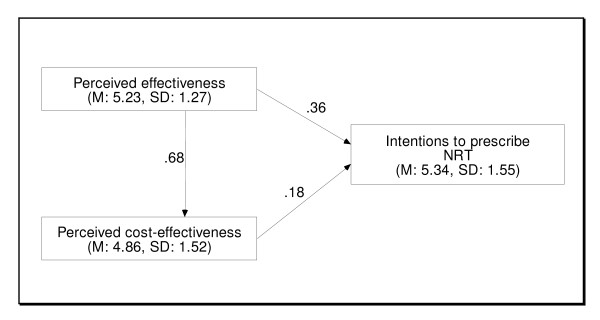
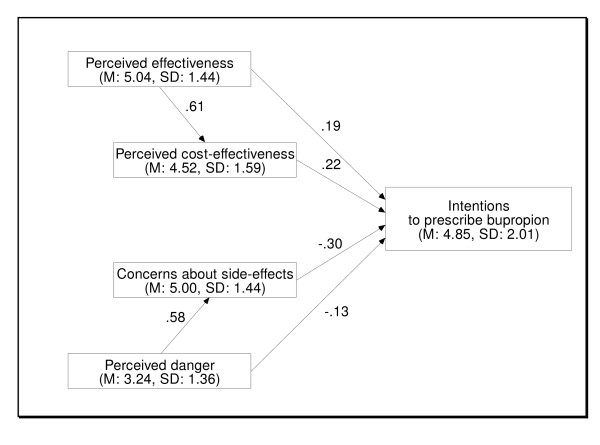
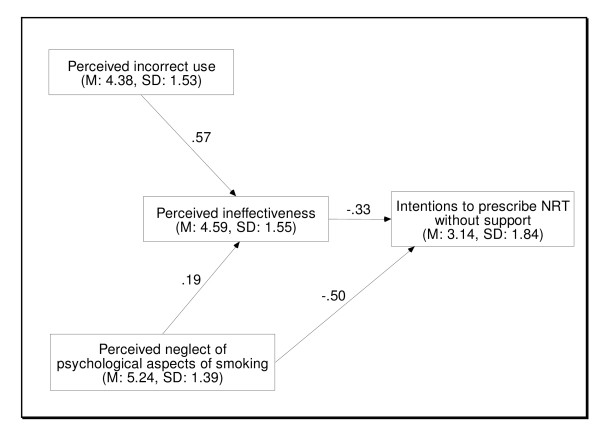
Study 1: Whilst nicotine replacement therapy (NRT) and bupropion were generally perceived as effective and cost-effective, the effectiveness of NRT was seen as critically dependent on behavioural support for smoking cessation. This dependence appeared to be influenced by perceptions that without support smokers would neglect psychological aspects of smoking and use NRT incorrectly. GPs perceived bupropion as dangerous and were concerned about its side-effects. Study 2: GPs' beliefs had medium (NRT, f2 = .23) to large (bupropion, f2=.45; NRT without support, f2=.59) effects on their intentions to prescribe medications. Beliefs about effectiveness of NRT and bupropion and the perceived danger of bupropion were the key predictors of intentions to prescribe NRT and bupropion, respectively. Beliefs about neglecting psychological aspects of smoking and incorrect use had indirect effects on intentions to prescribe NRT without support, operating via beliefs about effectiveness.
GPs vary in their beliefs about the effectiveness and safety of smoking cessation medications. Their intentions to prescribe these medications vary in line with these beliefs. Interventions aimed at increasing the likelihood with which GPs prescribe these medications may be more effective if they addressed these beliefs.
全科医生(GP)对尼古丁依赖药物的负面看法可能成为开具此类药物的障碍。
研究1:在这项定性研究中,对来自伦敦16家诊所的25名全科医生进行了访谈。采用框架分析法确定关键主题。研究2:对367名全科医生的便利样本进行了基于网络的调查。采用路径分析法研究信念与开具戒烟药物意图之间的关系。
研究1:虽然尼古丁替代疗法(NRT)和安非他酮通常被认为有效且具有成本效益,但NRT的有效性被视为严重依赖于戒烟的行为支持。这种依赖性似乎受到以下观念的影响,即如果没有支持,吸烟者会忽视吸烟的心理方面并错误使用NRT。全科医生认为安非他酮有危险,并担心其副作用。研究2:全科医生的信念对其开具药物的意图有中等(NRT,f2 = 0.23)到较大(安非他酮,f2 = 0.45;无支持的NRT,f2 = 0.59)的影响。对NRT和安非他酮有效性的信念以及对安非他酮的感知危险分别是开具NRT和安非他酮意图的关键预测因素。对忽视吸烟心理方面和错误使用的信念通过对有效性的信念对无支持开具NRT的意图产生间接影响。
全科医生对戒烟药物的有效性和安全性的信念各不相同。他们开具这些药物的意图因这些信念而异。如果针对这些信念进行干预,旨在增加全科医生开具这些药物可能性的干预措施可能会更有效。